Get Full Government Meeting Transcripts, Videos, & Alerts Forever!
Get email alerts on the Technology Innovation topic
No spam. Unsubscribe anytime.
South Bend outlines 2025 technology priorities: SmartRec, expanded cameras, AI tools and a $12 million digital equity bid
Summary
The City of South Bend Department of Innovation and Technology presented 2024 accomplishments and a 2025 workplan that includes SmartRec recreation software, additional real‑time crime center integrations, generative AI pilots and a proposed $12 million regional digital equity grant.
Denise Lynn Riedel, chief innovation officer for the City of South Bend, told the Common Council on March 24 that the Department of Innovation and Technology will focus in 2025 on customer service modernization, cybersecurity, expanded sensor networks and managed rollouts of generative AI tools.
Riedel said the department will implement a new recreation registration system (SmartRec), continue expansion of the city’s real‑time crime center cameras and pursue digital equity and broadband projects including a recommended $12,000,000 federal grant for the South Bend–Elkhart region. “Our mantra is ‘listen first, build with,’” Riedel said, summarizing the department’s approach to technology and resident engagement.
The presentation reviewed 2024 outcomes — digitized paper forms, a resident success team tied to 311, expanded public‑safety camera partnerships and initial uses of generative AI for internal translation and staff tools — and laid out planned 2025 work. Key items named in the update: SmartRec for parks and recreation (to unify program registration across Howard Park, O’Brien and MLK community centers), deployment of additional city‑owned cameras and private partner integrations downtown, rollouts of an internal assistant (“Ida”) and Copilot pilots for staff, a centralized payments platform (DoDAT) and continued digitization of public forms (including APRA requests).
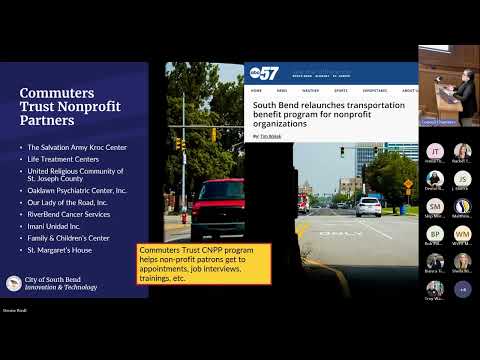
Riedel described specific pilots and partners: automated vehicle locator (AVL) devices to track city fleet emissions and plow coverage; SunSouth Bend air‑quality monitors with sustainability staff; SYNC South Bend grants to help small businesses and nonprofits integrate with the real‑time crime center; and Commuters Trust, a mobility‑assistance program for hourly workers. She said the department was recognized as a top digital city for its population bracket and received a Mission 41 award from TechPoint Indiana for hiring and culture.
Council members asked about transparency and access. Councilwoman McBride asked whether data on vacant properties and the code‑enforcement process could be made more visible to residents; Riedel said there is a basic vacant/abandoned dataset on the open data portal and suggested expanding neighborhood “report cards” and other outreach formats. Councilwoman White and other members asked whether SmartRec and other upgrades would reach neighborhood recreation centers; Riedel said city‑run centers will be onboarded but acknowledged some programs use externally required systems and full standardization may not be possible immediately.
Riedel described efforts to avoid overpromising on AI. She said city staff have tested chat and voice prototypes against the public knowledge base and that products must return reliable answers about basic city services (for example, yard‑waste costs or trash schedules) before being put in front of residents. “What’s worse than a long hold time is a bad AI in front of a long hold time,” she said, explaining the department’s caution toward deploying consumer‑facing bots.
Council members raised equity and access concerns for seniors and residents without internet access. Riedel said the planned “one‑stop shop” resident service at the new city hall will include in‑person options and suggested the council help the department identify senior groups or centers for hands‑on demonstrations and training. She also said the resident success team (an outreach arm of 311) is piloting proactive outreach to households at risk of utility shutoff and has expanded eligibility to include renters.
Riedel named pending funding prospects and next steps: a recommended $12,000,000 federal digital equity award for the South Bend–Elkhart region (a competitive award the city was recommended to receive), additional rounds of SYNC South Bend grant awards to small businesses/nonprofits, and continued internal modernization work through 2025–2026. She invited council members to follow up with the Department of Innovation and Technology on neighborhood‑level reporting, training for seniors and council‑specific website improvements.
The council asked follow‑up questions after the presentation; Riedel stayed for roughly an hour of Q&A. The council later moved the item into routine committee procedure as part of the meeting’s agenda flow.