Get Full Government Meeting Transcripts, Videos, & Alerts Forever!
Get email alerts on the State Budget HB1 topic
No spam. Unsubscribe anytime.
House approves FY2026 budget with $199.5 million teacher stipend; health officials brief lawmakers on Medicaid forecast
Summary
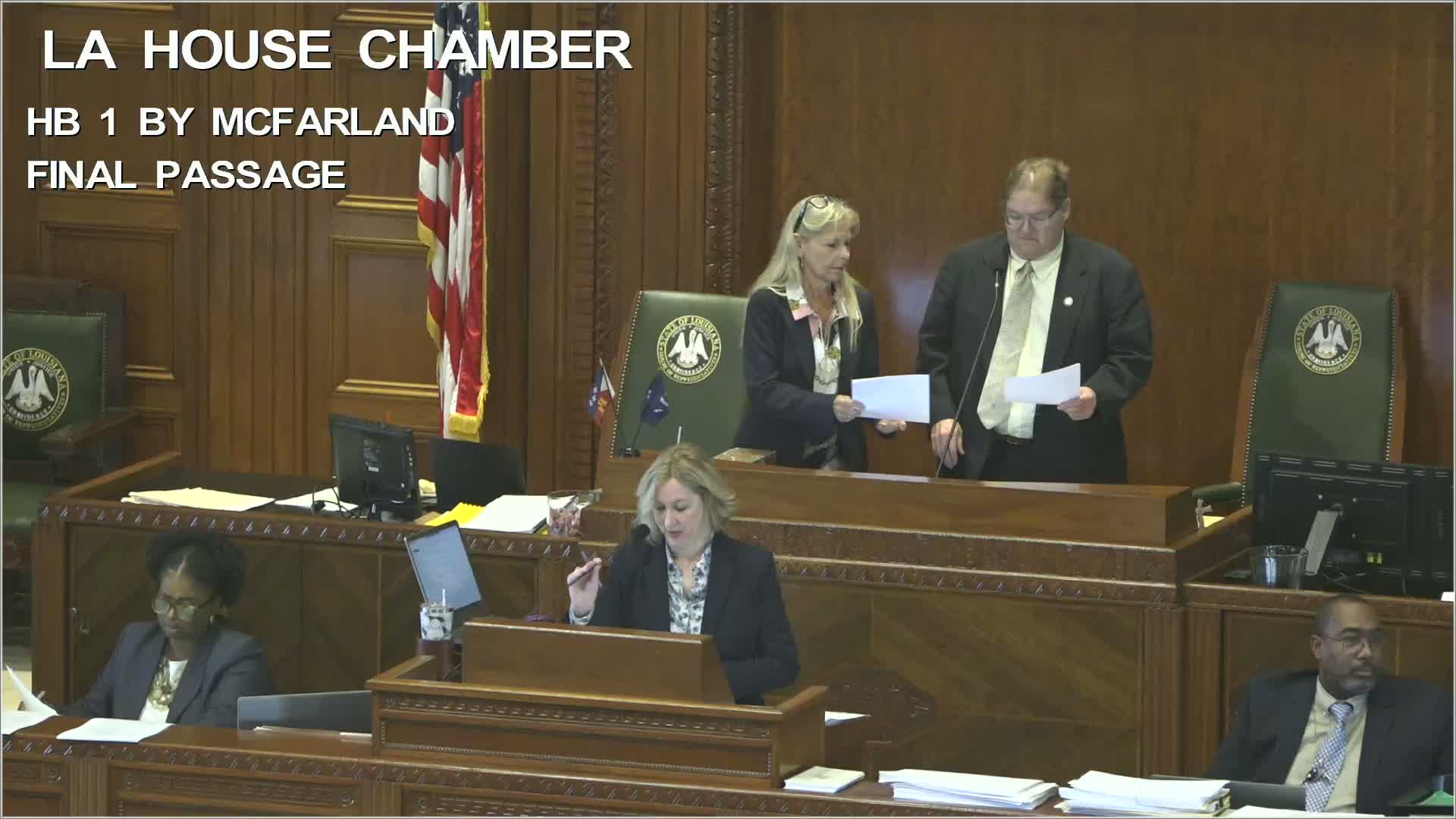
The Louisiana House of Representatives on May 14 approved House Bill 1, the fiscal 2025–26 general appropriations bill, after the Appropriations Committee added $199,500,000 for a statewide teacher stipend and other funding adjustments; the House recorded 94 yeas and 0 nays on final passage.
The Louisiana House of Representatives on May 14 approved House Bill 1, the fiscal 2025–26 general appropriations bill, after the Appropriations Committee added $199,500,000 for a statewide teacher stipend and other funding adjustments, Chairman Representative Mark McFarland said. The House adopted the bill following a committee‑of‑the‑whole review and a recorded vote; the clerk announced 94 yeas, 0 nays on final passage.
The addition of $199.5 million for a teacher stipend was the headline change made by the Appropriations Committee. "We did add a $199,500,000 for the teacher stipend," Representative Mark McFarland said when summarizing committee changes. Committee amendments covered offsets and program changes across state agencies to keep the budget balanced while creating room for the stipends.
The amendments McFarland described included removing $91,300,000 in acquisitions and new equipment purchases, a $26,300,000 reduction to the Department of Health budget (LDH) tied to forecast updates, and a $30,000,000 reduction in funding for high‑dosage tutoring. The committee also directed $148,800,000 toward a state police retirement payment, generating an estimated $25,500,000 in FY2026 savings used elsewhere in the bill. Other added items included $7,000,000 for domestic violence shelters, $5,800,000 for local jail per diem increases, and $2,900,000 to expand Community Choice waivers, McFarland said.
LDH officials answered detailed questions on Medicaid funding during the schedule‑by‑schedule review. "We do not need to increase from what's submitted," Bruce Greenstein, Secretary of the Louisiana Department of Health, told lawmakers when asked whether the department would need additional appropriation for the Medicaid forecast mentioned in an LDH cover letter. Greenstein and Pam Diaz, LDH’s chief operating officer for Medicaid, said the FY2026 budget as proposed incorporates current forecast adjustments.
Diaz told the House that LDH’s enrollment figures for April showed about 1,622,000 people enrolled in Medicaid, with an expansion population of roughly 526,356 and a non‑expansion population of about 1,095,000. She said the FY2026 budget "incorporates the projections that we have for '26, which accounts for the changes that we're seeing in '25. So, it would be adequate for it."
Lawmakers pressed LDH on a shortfall cited in a departmental forecast covering the current fiscal year. The forecast cover letter noted a projected FY2025 overrun of about $135,000,000 driven by higher managed care rates, increased hospital directed payments and nursing home costs. Greenstein and Diaz said the FY2026 appropriation already accounts for current trends and that some FY2025 pressures are being managed through one‑time adjustments and means‑of‑finance swaps.
LDH also described program‑integrity work that produced immediate savings estimates. The department matched Medicaid enrollment against Office of Motor Vehicles residency records and identified a cohort of enrollees who appeared to live out of state and had no claims in two years. That review identified more than 9,000 individuals and a total expenditure associated with them of $73,500,000; LDH reported an estimated state general fund savings of $10,900,000 from addressing those cases. "We're making those payments" while people remain enrolled, Diaz explained; removing ineligible enrollments reduces capitation payments to managed‑care plans and saves state dollars.
Lawmakers also asked about potential federal changes to Medicaid that have been discussed in Washington. Greenstein described activity in the U.S. House Energy and Commerce Committee and said some proposals under consideration would return tools and flexibilities to states — for example, to tighten eligibility checks, impose targeted work requirements beginning in 2029, and clarify retroactivity — and that provider taxes in place appear to have been grandfathered. "Those provider taxes that are in today are grandfathered in in perpetuity," Greenstein said. He cautioned that federal proposals still must clear committee and floor processes before any final outcome is known.
Representative Amity pressed LDH on implications for future baselines if FY2025 shortfalls become recurring costs. Diaz said that FY2026 is built to reflect current projections and that continuing pressures could roll into baseline needs for FY2027. She and Greenstein repeatedly emphasized that program‑integrity measures and state policy tools are part of the department’s plan to control costs without further immediate state general fund increases.
House Bill 1 passed after the Appropriations Committee walked the House through the bill schedule by schedule; the committee adopted multiple technical and policy amendments on the floor. Representative McFarland moved the House into the committee of the whole for detailed consideration; that motion carried without objection. The House then adopted each schedule and reported the bill back for final passage.
The bill’s passage sends the amended FY2026 appropriation package forward from the House. Several lawmakers thanked appropriations and fiscal staff for the work producing the bill and its amendments during an extended session day.