Get Full Government Meeting Transcripts, Videos, & Alerts Forever!
Get email alerts on the Education Sports Governance topic
No spam. Unsubscribe anytime.
Louisiana House forms special committee to study LHSAA governance and impact on public schools
Summary
The Louisiana House on May 7 adopted a concurrent resolution creating a special legislative committee to examine the policy, governance and public-funding ties of the Louisiana High School Athletic Association after lawmakers raised concerns about transparency, penalties and fairness for student athletes and schools.
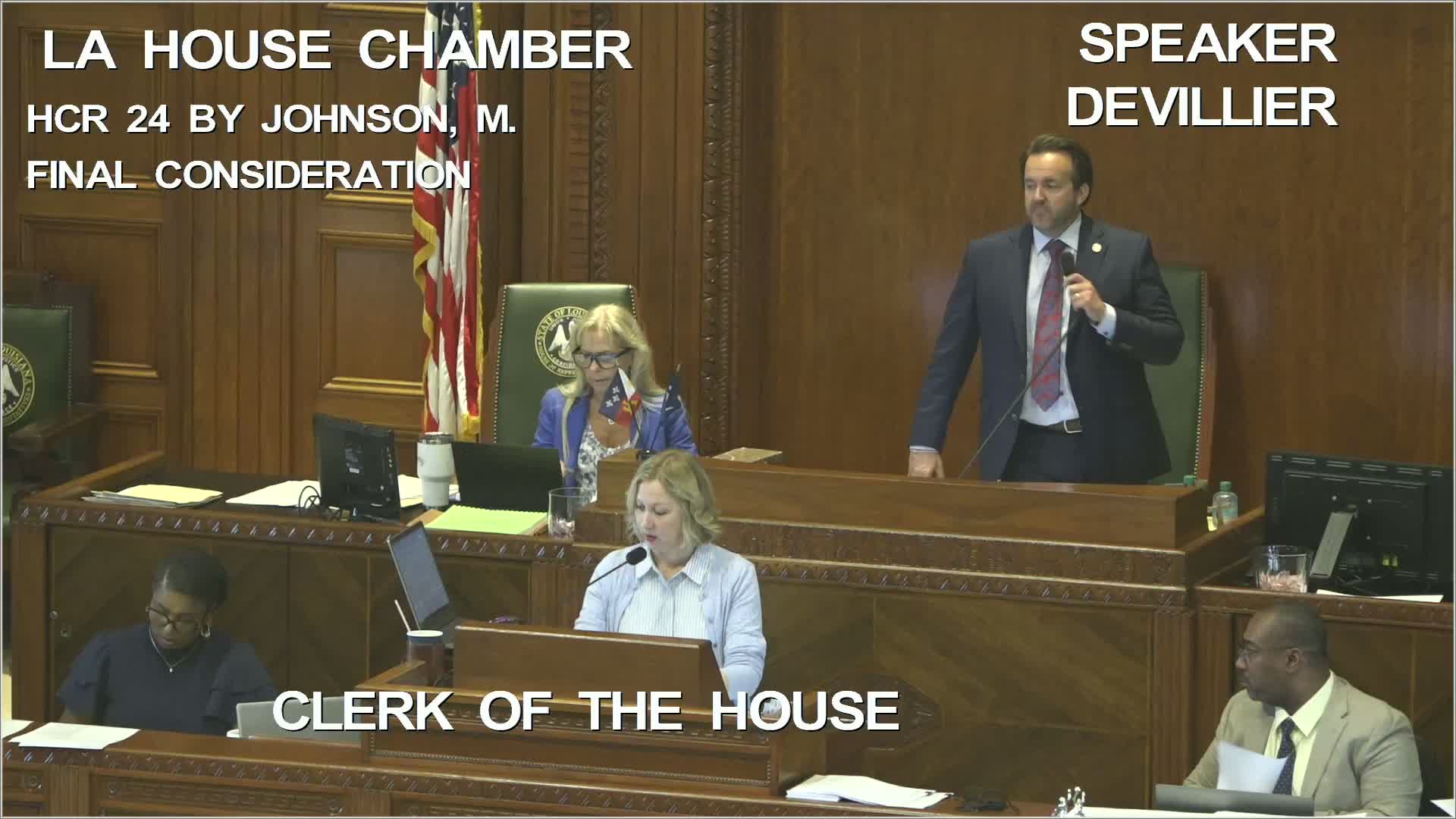
The Louisiana House of Representatives on May 7 adopted a concurrent resolution to create a special legislative committee to study the Louisiana High School Athletic Association’s policy, governance and impact on public schools. Speaker Pro Tem Mike Johnson, who sponsored the measure, led the debate and the House approved the resolution 92-2.
Lawmakers said the study is intended to bring transparency and a dialogue between the Legislature and the private association that oversees high school athletics in the state. “This is not a witch hunt,” Speaker Pro Tem Mike Johnson said on the House floor. He told colleagues the goal is to “build a bridge” with the association and avoid piecemeal, “knee-jerk” legislation.
Supporters stressed the association’s statewide reach and the public stakes. Johnson said the organization administers athletics for “approximately 70,000 student athletes” and that members had asked the Legislature to avoid filing a raft of immediate bills without first seeking more information. Lawmakers repeatedly raised three concerns: whether the LHSAA accepts public funds or benefits from public resources, whether it follows its own procedures, and whether its penalty and governance practices are sufficiently transparent.
Members who spoke described specific grievances and examples. Representative Miller said a recent LHSAA rule drew immediate worry, telling the House that he had verified a policy that could bar a school from LHSAA competition “forever” after two lawsuits brought against the association. “They just passed a rule that if any school bring them to court 2 times, that they can kick them out of the LHSAA forever?” Miller asked on the floor. Several members also described past disputes that resulted in litigation and one instance where, they said, LHSAA leadership conceded it had not followed its own constitution.
The resolution was amended on the floor to explicitly include private schools in the committee’s review and to specify that the special committee would operate under the rules of the legislative body of the committee chair (house or senate) so the joint committee could manage procedures. The sponsor described the review period as a limited exchange of discussion — he repeatedly referenced a roughly six-month window for the committee’s work — and said the committee could either foster improved cooperation or inform future legislation.
No subpoena authority or specific reporting deadlines were included in the language adopted on May 7. Members said they expect the LHSAA to cooperate; the resolution also gives the Legislature the power to pursue additional action if cooperation is not forthcoming. The measure drew broad bipartisan support on the House floor, and after adoption the clerk opened the machine for co-authors; the House recorded 60 co-authors on the resolution.
The resolution passed 92 yays to 2 nays. With the vote, the House directed formation of the special committee and asked the association to participate in the review; the measure is a concurrent resolution, meaning the Senate will also be invited to participate in the study. Next steps include formal appointment of committee members and scheduling public meetings and information requests to LHSAA officials.