Get Full Government Meeting Transcripts, Videos, & Alerts Forever!
Get email alerts on the Reproductive Health topic
No spam. Unsubscribe anytime.
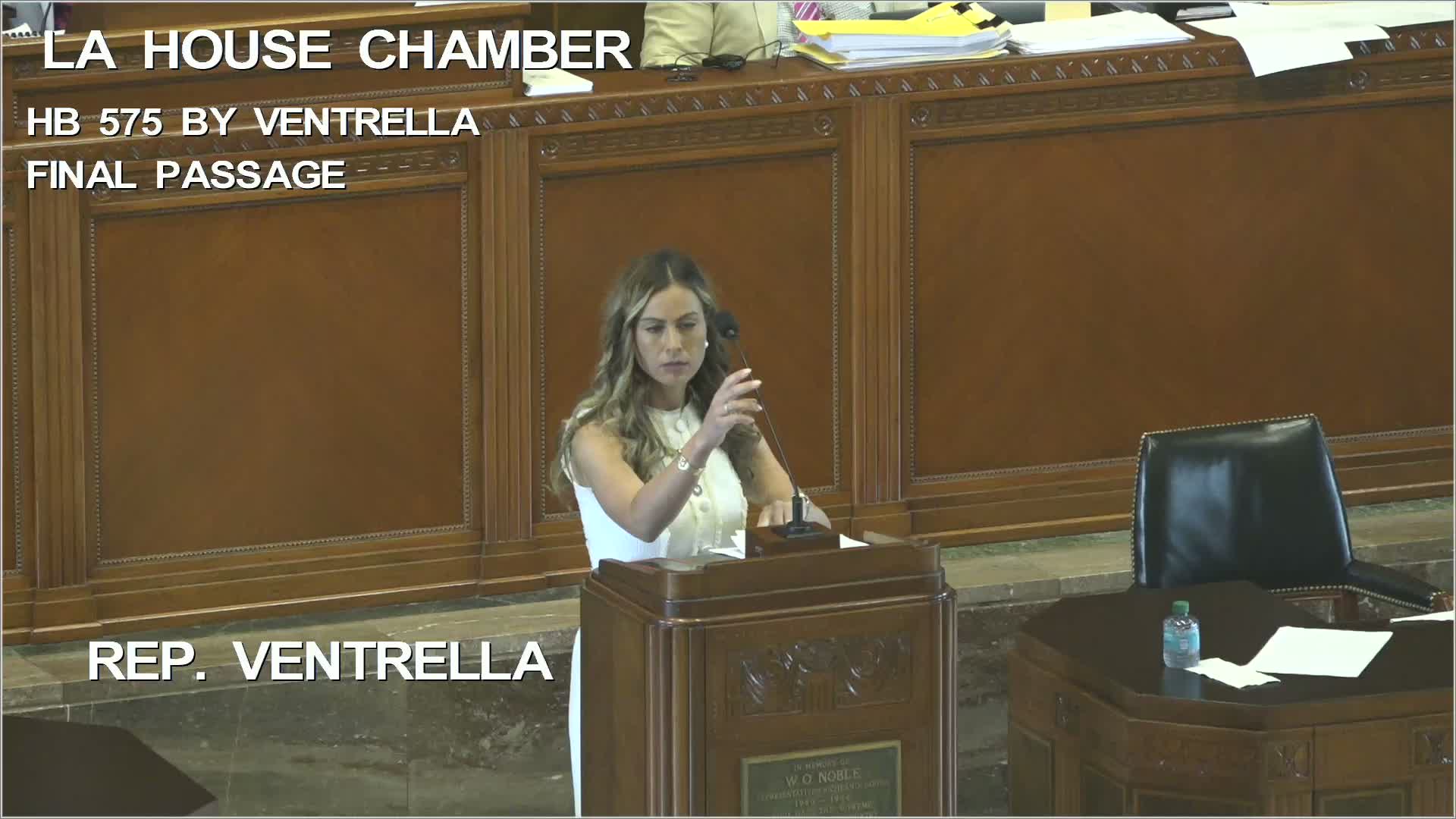
House approves civil damages for out-of-state abortion drug prescriptions; bill sparks lengthy debate
Summary
The Louisiana House on Tuesday passed legislation that creates a civil cause of action against medical providers who prescribe abortion‑inducing medication in violation of state law.
The Louisiana House on Tuesday passed legislation that creates a civil cause of action against medical providers who prescribe abortion‑inducing medication in violation of state law.
Representative Ventrella’s bill, described by supporters as a tool to hold out‑of‑state prescribers accountable when criminal prosecution is impractical, allows the mother of an unborn child, the natural father and certain grandparents to sue for statutory damages of up to $100,000 per qualifying plaintiff.
Supporters said the measure fills a gap exposed by recent cases in which doctors outside Louisiana prescribed medication that caused abortions for residents of the state but declined to submit to Louisiana criminal process. "If you're prescribing abortion pills within the borders of the state of Louisiana, then perhaps you should not be prescribing them," Representative Ventrella said during floor debate.
The bill's core provisions, as amended on the House floor, limit the targets of civil suits to persons who "prescribe or substantially facilitate" abortion‑inducing drugs and remove manufacturers from the list of defendants. The bill also extends the civil limitations period from three years to five years and allows courts, where appropriate, to protect plaintiffs' identities in closed proceedings.
Opponents raised legal and practical objections during more than an hour of questions and answers on the floor. Lawmakers asked how plaintiffs would prove claims without access to a woman's medical records, whether the law would apply when a woman travels out of state to obtain medication and returns to Louisiana to take it, and whether the measure could invite frivolous litigation by relatives or others with strained relationships.
Representative Marcel asked how a plaintiff could prove a claim when medical records are not discoverable; Ventrella replied that a plaintiff bears the burden of proof and that courts already have procedures to screen and dismiss frivolous suits. Representative Newell pressed the author on whether the bill could expose counselors or others who assist survivors to liability; Ventrella pointed to explicit exemptions in the text for counselors who do not "promote" abortion referrals.
Representative Emerson, a co‑author, said the bill is intended to "close that loophole" and to send a state policy signal: "If you violate the laws of Louisiana, we intend to use everything at our disposal to hold people accountable." Opponents including Representative Landry and Representative Freeman warned the measure could chill care, complicate discovery in miscarriage cases and produce extensive litigation.
Amendments adopted on the floor narrowed the defendant class and clarified several procedural protections. The House approved the bill on a recorded vote of 59 yeas and 25 nays.
What happens next: HB 5 75 now proceeds to the Senate. Supporters said they expect further legal questions in committee and possible court challenges if the law becomes effective.