Get Full Government Meeting Transcripts, Videos, & Alerts Forever!
Get email alerts on the Capital Outlay Policy topic
No spam. Unsubscribe anytime.
School board revises facility-project approval policy, sets lower committee threshold and reports process
Summary
The Tangipahoa Parish School Board policy committee approved revisions to Policy FE to define capital projects and set approval thresholds; members amended the draft to lower a $500,000 committee threshold to $200,000 and discussed court and public-works limits.
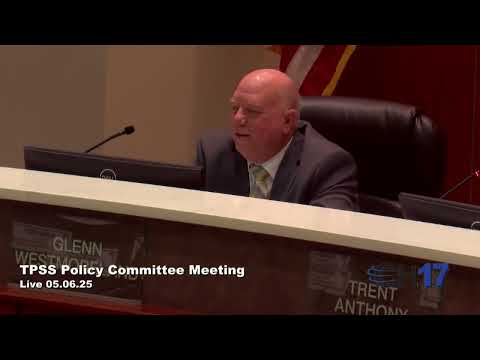
Tangipahoa Parish School Board policy committee members approved revisions to Policy FE (facility projects) that define which capital projects require board or administrative approval and set dollar thresholds for different review levels.
The committee approved the policy after an amendment to lower a proposed $500,000 threshold for capital projects requiring full capital outlay committee review to $200,000. The amendment and the final policy passed unanimously.
The revised policy defines capital projects to include new construction, equipment, infrastructure projects, and renovations that “significantly increase the value or extend the life of existing buildings or equipment,” distinguishing them from routine repairs and maintenance. Under the updated process, projects estimated under $10,000 are approved by the director of operations and the chief financial officer and reported to capital outlay; projects over $10,000 up to $50,000 require superintendent and local board-member involvement; projects between the mid-tier threshold (as amended to $200,000) and higher thresholds come to the capital outlay committee; and projects above the highest threshold require full committee review. The policy covers all capital projects, not only pay-as-you-go capital outlay.
During debate, committee members proposed and discussed alternative numeric thresholds. Board members noted an existing court requirement that certain projects require court approval at the $125,000 level as part of a court oversight process tied to the district’s unitary-status proceedings; several members recommended drafting the policy so the numeric cap could be adjusted without extensive rewording once unitary status changes. One member recommended including language referencing current court-approval limits, with an option to increase the local cap after unitary status is achieved. Another member cited the public-works bidding threshold (approximately $250,000) when discussing what level of review triggers public bidding rules.
Committee members emphasized that even projects handled administratively will be reported to capital outlay so board members are aware of improvements at their schools. The committee asked staff to prepare a five-year capital-outlay plan and to coordinate with the long-term committee chaired by a board member so major projects can be vetted before reaching capital outlay.
The committee recorded the amendment motion to change the $500,000 threshold to $200,000 and then approved the amended policy. Members asked staff to include court-approval language in the policy draft to make it straightforward to revise the numeric threshold later if unitary status changes.