Get Full Government Meeting Transcripts, Videos, & Alerts Forever!
Get email alerts on the Public Restrooms topic
No spam. Unsubscribe anytime.
Council backs pilot Portland Loo downtown and moves funds for traffic-signal upgrades
Summary
Fort Wayne City Council gave a due-pass recommendation to an ordinance that would appropriate $280,000 to pilot one Portland Loo downtown and $1.3 million toward traffic-signal controller upgrades, with a 9-0 committee vote and plans for public bidding and monitoring.
Fort Wayne City Council’s finance committee voted to give a due-pass recommendation for an ordinance (A250124) that would appropriate $280,000 from the general fund to purchase and install one Portland Loo public restroom and $1.3 million from the cumulative capital development fund toward a traffic-signal controller project.
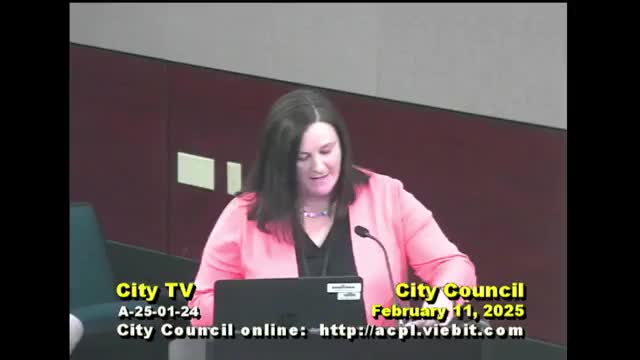
The proposal, presented in committee by Kelly Lundberg of the Office of Housing and Neighborhood Services and by Valerie R., deputy controller, outlines a pilot restroom sited on Barr Street, between Wayne and Washington streets, and a separate upgrade program for signal controllers citywide.
Kelly Lundberg said Community Development staff have spent a year consulting downtown business groups and other stakeholders and returned with specific locations, engineering estimates and a maintenance plan. “Community Development staff have been attending meetings for the last year with our downtown business community,” Lundberg said, and she described the Portland Loo as a stainless-steel, plumbed unit designed to discourage loitering and to allow drive-by visibility through angled bottom louvers. She told the committee Downtown Fort Wayne proposed to provide maintenance, “3 cleanings a day, 7 days a week,” with additional cleanings as needed and a posted phone number for on-call problems.
Lundberg said staff identified a roughly 6-foot-by-10-foot installation zone on Barr Street where the existing sidewalk is 18 feet wide and would not remove parking. She described a procurement timeline: release a bid by the end of the first quarter, 4–6 months fabrication, and installation targeted for late fall or early winter if funded. Lundberg said the funding source for the Portland Loo would be “supplemental lit” and that staff would track usage metrics including flush counts and incidents requiring Downtown Fort Wayne’s response.
Philip Rass, the city’s traffic engineer, described the signal work as two linked efforts: replacement of hardware in intersection traffic cabinets and replacement of the system that ties signals together, improving central monitoring and corridor coordination. Rass said the total project cost is about $2.3 million and that $1.3 million was being appropriated now while other funds were included already in the Public Works budget.
Council members asked about safety, maintenance, alternatives and precedents. Councilwoman Michelle Chambers asked whether the restroom funding came from ARPA; Lundberg said it was “supplemental lit.” Councilman Mark Hensley pressed for criteria that would trigger removal if the pilot failed; Lundberg cited other communities that removed units because of isolated locations and said the city had chosen a well-traveled site. Councilman Marty Bender asked whether the new signal equipment would remain compatible with state-maintained signals; Rass said the project covers city-jurisdiction signals and that the Indiana Department of Transportation (INDOT) would need a separate project to upgrade state-owned signals.
Committee members who spoke said they were cautious but supported a limited pilot rather than a larger initial outlay. After discussion, the committee voted to give A250124 a due-pass recommendation by a roll-call vote of 9-0.
The ordinance would authorize staff to solicit bids (the request for proposals would allow equivalent units), secure a contract if bids fall at or below the engineering estimate, and bring contracts back to council for approval. Staff said bids may return a different cost than the $280,000 estimate and that the administration favored a single pilot unit and planned to work with the Arts Commission on an exterior wrap or public-art treatment if the unit is installed.
The council’s action in committee is a recommendation; any contract or final purchase would return to the council for formal approval and appropriation adjustments if needed.