
Terre Haute council tables rezoning, after residents raise historic-preservation and TIF concerns
Get AI-powered insights, summaries, and transcripts
Subscribe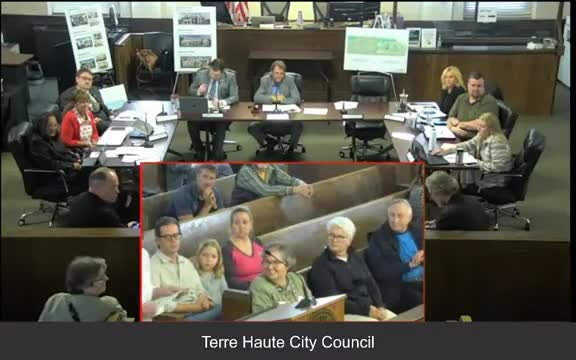
Summary
The Terre Haute City Council on a voice vote moved to table Resolution 14, a developer-backed rezoning and Tax Increment Financing (TIF) plan for property near Edgewood Grove and Farrington's Grove, after multiple residents and council members sought more data on housing density, infrastructure costs and historic preservation rules.
The Terre Haute City Council voted to table Resolution 14 — a proposed rezoning and TIF-backed development near Edgewood Grove and Farrington’s Grove — until the council’s June 12 meeting after extended public comment and council questions about density, infrastructure funding and historic-preservation protections.
Residents told the council the proposal risks harming nearby historic neighborhoods and that more data is needed. “What I am is exhausted. I'm exhausted at the lack of vision, the lack of attention to historic buildings and sites in the city,” Carrie Youssef, president of Farrington Grove Historical District, Inc., told the council during the public-comment period.
The council moved the item to the second June meeting after several council members said they wanted more time to review project details. “There's been no effort by the part of anybody at this table to hide this proposal,” said Council President Anthony, noting the item was introduced to start the public-review process and that an ordinance to create a historic preservation commission is expected to be heard next month.
Public speakers said the plan would add what one resident described as “1,500 people” to a corner of the neighborhood and could increase crime and traffic through Denning Park and Edgewood Grove. Elizabeth Kendall, who identified herself as an Edgewood Grove resident, said Terre Haute’s historic character is an asset and urged the city to reconsider zoning and require developers to meet infrastructure and sidewalk standards rather than rely on expediency.
Council members and city staff described how the TIF and state loan tools would work for the project: the full development was described as a roughly $70,000,000 project. City representatives told the council a state loan amount being pursued is between about $5 million and $10 million, and that the TIF structure under consideration would run for 20 years for residential portions and up to 25 years for commercial portions. Eddie, the developer’s representative, confirmed those timelines and said that if revenues are insufficient the developer would be responsible for payments tied to the pledged financing.
Council members also clarified what would happen if the rezoning were not approved: individual builders could still develop single-family lots under existing R-1 zoning (minimum lot size discussed in the hearing was cited as about 6,600 square feet), and rough estimates presented in the meeting put potential buildout at “over 200 homes” on a roughly 40-acre site if the developer were to subdivide without the rezoning. Council members emphasized those outcomes would be subject to building codes, state inspections and other approvals.
Discussion during the meeting touched on procedural and oversight safeguards for TIF dollars: city staff said redevelopment-commission approval is required before spending TIF revenues and that the council oversees the redevelopment commission’s budget. Council members also pointed to an ordinance in progress to create a local historic-preservation commission; the council president said legal staff are preparing that ordinance for a future hearing.
The motion to table Resolution 14 was made and seconded during the meeting and passed on a voice vote; the item is scheduled for further consideration on June 12. Council members encouraged continued public comment and said they would hold additional stakeholder meetings and information sessions before the next vote.
The council did not adopt any rezoning or TIF commitments at the meeting; action was limited to tabling the resolution for more review.