Get Full Government Meeting Transcripts, Videos, & Alerts Forever!
Get email alerts on the Property Tax Budget topic
No spam. Unsubscribe anytime.
Denton ISD hears big preliminary property values, warned state bills could cut district revenue
Summary
District staff told trustees preliminary property values are high this year and built-in assumptions have so far absorbed rising construction costs, but proposed state bills such as measures to increase the homestead exemption and further compress tax rates could reduce local tax collections and affect bond and debt plans.
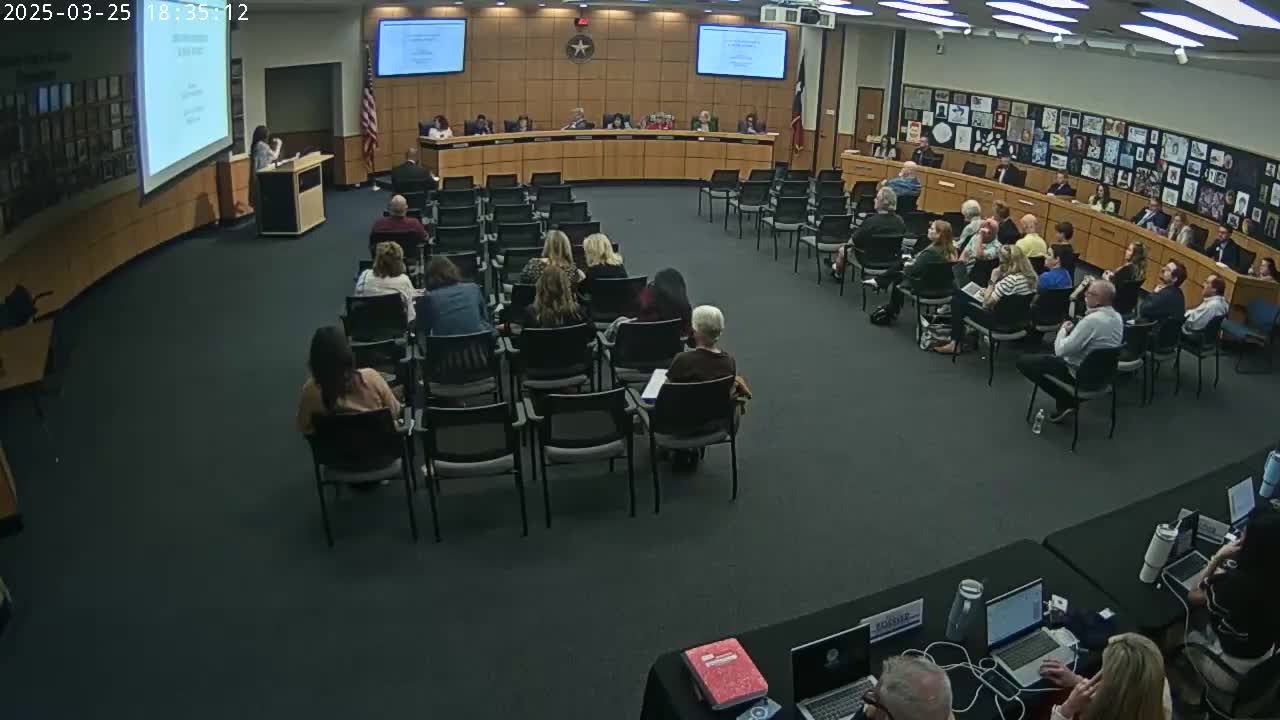
Denton ISD trustees heard a budget briefing Tuesday that showed large preliminary property-value growth for fiscal 2024–25 and warned that several bills pending in the Texas Legislature could reduce the district’s future local revenue.
The report, presented by Mrs. Stewart, a district finance staff member, said Denton County Appraisal District preliminary numbers are “very high” and that certified (taxable) values — which the district uses to set its tax rate — will be finalized on or before July 25. “Our certified values are taxable values. And that’s what we use to determine our ultimately determine our tax rate and what our property tax collections are gonna be for the next school year,” Stewart told the board.
Trustees were shown detailed charts of value growth and how the district uses those figures to build next year’s revenue forecast. Stewart said certified values and the Comptroller’s market-value series (used by the state) typically grow at similar rates; over the last 10 years Denton ISD’s certified-value growth averaged 11.14% while the Comptroller series averaged about 10.8%.
District staff also flagged several pending bills that could lower local property-tax collections. The presentation named Senate Bill 1 (a $3.5 billion property-tax reduction package that could include additional tax-rate compression or larger homestead exemptions) and Senate Bill 4 (a proposal that would raise the residential homestead exemption to $140,000, which requires a constitutional amendment). Staff warned those changes would reduce the district’s taxable base and could require higher debt-service tax rates to raise the same bond proceeds. Stewart noted some bills include a state “hold harmless” provision for maintenance and operations (M&O) or interest-and-sinking (I&S) revenues while others do not.
Stewart also reviewed local tax-rate compression since House Bill 3, showing Denton ISD’s Tier 1 rate had fallen to the statutory floor (0.6169) in recent years. She told trustees the district is already at the minimum M&O rate permitted by law and that more districts are reaching the statutory floor as values rise statewide.
Why it matters: property values determine how much revenue Denton ISD can raise locally and shape the district’s budget for classrooms, staff and facilities. If the Legislature adopts broad homestead increases or additional tax-rate compression without full hold-harmless replacement, school districts could see meaningful losses to local revenue gathered for debt service and operations.
Supporting details from the meeting: - Staff reported roughly $3.0 billion in total value growth for 2024–25, of which about $2.0 billion was new value added this year and under $1.0 billion came from value on the existing tax roll. - Over the prior five years the district reported about $5.95 billion in value growth on existing property and about $6.75 billion in new value additions. - Stewart and trustees discussed several bills to watch, including SB1, SB4, HB8 (additional M&O compression), and HB9 (raising the exemption for business personal property). Stewart cautioned some bills lack a hold-harmless mechanism for lost revenue.
Trustee discussion and next steps: board members asked staff how proposed changes would affect the district’s ability to prepay debt or fund bonds; staff said some draft bills would restrict prepayment without explicit reporting or approvals. The presentation and slides will be used to inform upcoming budget work and the board’s advocacy to state legislators.