Get Full Government Meeting Transcripts, Videos, & Alerts Forever!
Get email alerts on the Budget Finance topic
No spam. Unsubscribe anytime.
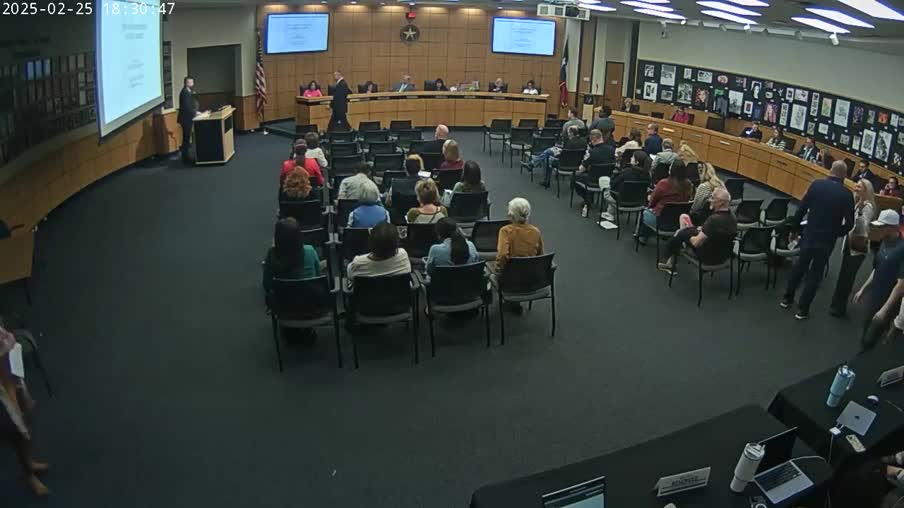
Denton ISD officials outline budget shortfalls driven by enrollment weights and lost Medicaid reimbursement
Summary
District staff told trustees the budget planning now underway must account for a multi‑million dollar shortfall driven by special-education costs, lower federal Medicaid reimbursements (SHARS), and declines in growth-related allotments.
Denton ISD staff told the school board on Thursday that the district is facing persistent revenue shortfalls tied to rising special-education costs, a drop in federal Medicaid reimbursements commonly called SHARS, and declines in several weighted allotments that have supported growth.
In a workshop presentation, Doctor Thompson said the district has seen ‘‘about $8,000,000’’ in lost SHARS reimbursements over the last two fiscal years and described an ongoing special-education funding gap. ‘‘I believe it's $9,000,000 plus that we're in a shortfall in special education funding,’’ Thompson said, adding that the district continues to budget without relying on uncertain federal reimbursements.
Thompson framed the budget discussion around student subgroups that drive state weighted funding — bilingual learners, compensatory education and Title I‑eligible students, career and technical education (CTE) participants, early‑education students and special-education placements. He told trustees that the district’s average daily attendance (ADA) and other enrollment measures feed revenue calculations and that certain allotments have not kept pace with costs or enrollment shifts.
Trustees and staff discussed specific revenue pressures that factor into the district’s planning: a roughly $2.5 million shortfall tied to full‑day pre‑K requirements versus half‑day pre‑K funding; several million lost from the fast‑growth allotment compared with 2019 levels (Thompson cited about $3.3 million lost since 2019–20); and the SHARS decline that Thompson said has contributed materially to the deficit picture. Doctor O'Bara and other administrators said the combined impacts were part of the district’s explanation for the multi‑million dollar deficit trustees are currently addressing in budget work.
Board members asked for clarifications about special-education and related federal offsets. Thompson said the special-education allotment has grown substantially and noted that many subcategories (resource room, self‑contained, residential placements) have increased in recent years; he cautioned that the state’s formula recognizes varying costs across placements but that the district’s expenditures remain higher than the revenue the state provides. "We have to be very careful both about how we calculate those revenues and also where we spend those dollars," Thompson said.
The presentation was framed as a high‑level overview to inform later budget decisions; no formal action was taken at the meeting.
District staff said they will continue to present budget options during the spring calendar, and trustees pressed staff to return with more granular scenarios tying programmatic changes to dollar savings and risks.