Get Full Government Meeting Transcripts, Videos, & Alerts Forever!
Get email alerts on the Workers Compensation Insurance topic
No spam. Unsubscribe anytime.
Denton ISD reviews workers'comp options after claims decline linked to district clinic
Summary
District staff presented data showing fewer and lower-cost workers' compensation claims after use of an on-site clinic, and outlined renewal and self-fund options including aggregate-deductible and administrative-service-only (ASO) models for 2025-26.
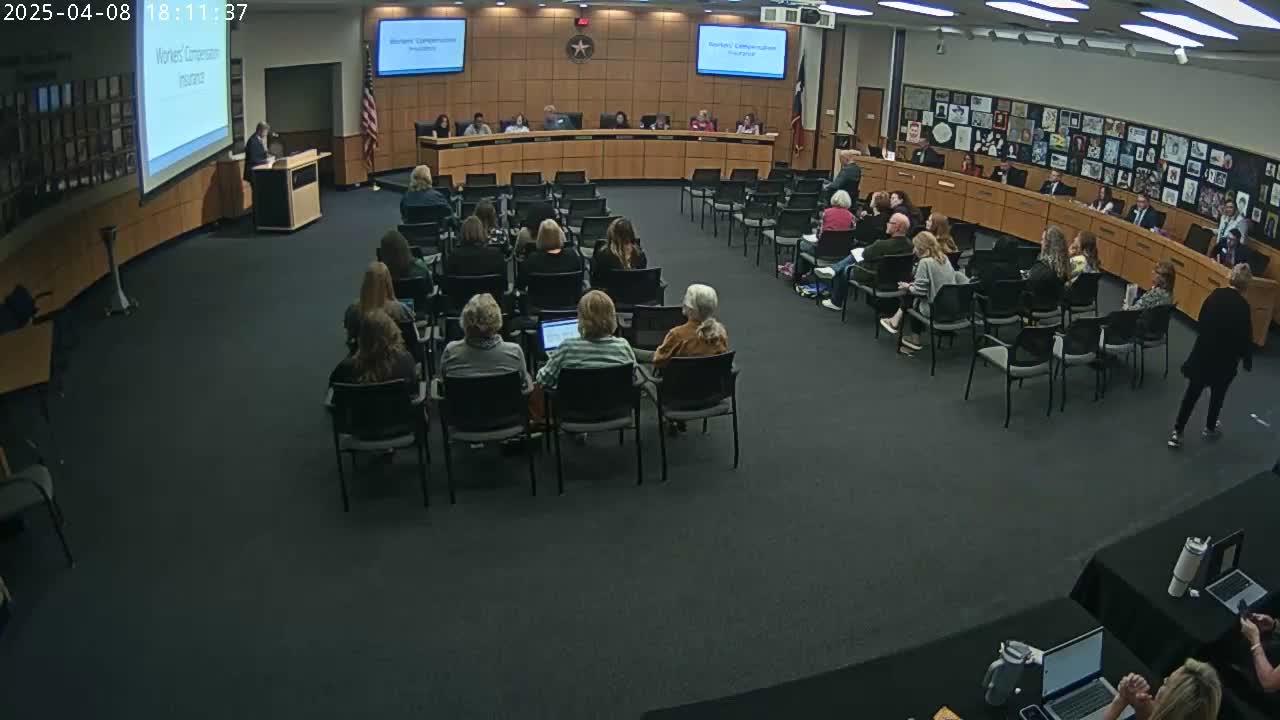
DENTON, Texas — Denton ISD staff on Tuesday reviewed the district's workers' compensation claims history and insurance options, saying on-site occupational-health care has reduced outside medical spending and that trustees will be asked to consider a procurement recommendation at a future meeting.
At a workshop presentation, Chris Bomburger, the district's insurance presenter, told the board the district has had only one lost-time workers' compensation case in the current year and that employees returning to work after injury are returning about three days sooner, on average, than in prior years. "This year, we've only incurred 1 lost time, over this whole year," Bomburger said.
Bomburger said Denton ISD currently uses a mix of coverage types and vendors and has been evaluating quotes and administrative models with its broker, Roche Howard. He reviewed two broad paths: stay with an aggregate-deductible program (where the district pays claims up to an annual aggregate threshold) or move to a self-funded ASO model with a third-party administrator and an excess-per-occurrence policy.
Why it matters: The board must choose whether to keep an aggregate deductible program, which Bomburger described as conservative and predictable, or move toward a self-funded ASO model that could offer near-term premium savings but adds administrative fees and different stop-loss triggers.
Key details from the presentation
- Policy and claims history: Bomburger said the district previously carried an excess workers' compensation attachment point at $500,000; the district later used an aggregate deductible (he cited a historical aggregate at $644,000). He said a severe winter-storm day produced about 30 claims in a single day and contributed to a year where claims exceeded the aggregate deductible.
- Current exposure and costs: For the most recent year Bomburger cited, the district was charged about $270,000 for the excess/aggregate policy and had cumulative claims near $274,000 to date; he said the aggregate deductible for the coming year was estimated as high as $859,000 under one proposal. He also said one large claim in the district's recent past exceeded $100,000 but that most larger claims were in the $50,000 range.
- Clinic impact: Bomburger credited the district's occupational-health clinic for lowering external medical spend and said roughly 80% of the district's workers' compensation encounters run through the clinic. "Because we have the clinic in place, the cost per claim actually [is] $0," he said, meaning the visit does not generate external claim costs in many cases.
- Options considered: Bomburger summarized quotes from multiple carriers and administrators, naming TASB (a risk pool and third-party administrator used historically by the district), CAS (quoted with a standard $1,000,000 aggregate option and a multi-year rate guarantee), Midwest (which proposed a per-occurrence excess that would begin at about $450,000), Sedgwick (noted as a model used in partnership by Keller ISD) and Safety National. He said Midwest's per-occurrence option showed potential savings of about $155,000 versus staying with an aggregate program in one modeled example, but he cautioned the board that administrative fees and other trade-offs remain.
Board discussion and next steps
Trustee Miss Price questioned the ASO medical-only administrative fee and whether that fee could exceed medical costs for particular claims; Bomburger acknowledged that is possible in individual cases but said the district models current-year claim counts and estimated the total claims exposure under an ASO path at under $30,000 for the current year. "Part of the medical filing and the fee charge has to do with the state responsibility and it going into Austin," Bomburger said, describing the paperwork and first-report-of-injury functions handled by an ASO.
Bomburger said staff were still finalizing quotes from TASB and Safety National and would present a formal procurement recommendation at the board's April 22 meeting. "I'm not presenting a procurement option tonight. You'll see that on the 22nd," he said.
No formal action was taken during the workshop; trustees asked for a procurement item to return on the April 22 consent or action agenda.
Ending note
Bomburger and district staff emphasized the clinic's role in reducing outside medical spend and returning employees to work sooner; trustees thanked staff for the update and asked that a complete procurement recommendation and final quotes be returned to the board at the April 22 meeting for a decision.