Get Full Government Meeting Transcripts, Videos, & Alerts Forever!
Get email alerts on the Public Finance topic
No spam. Unsubscribe anytime.
Denton ISD officials outline plan to sell remaining 2023 bonds without raising debt tax rate
Summary
District staff and financial advisors told the school board the district can sell the remaining $382 million of its 2023 voter-approved bonds under the current $0.48 interest-and-sinking (I&S) tax rate, proposing a mix of fixed-rate and variable-rate sales and warning that pending state legislation could change the plan.
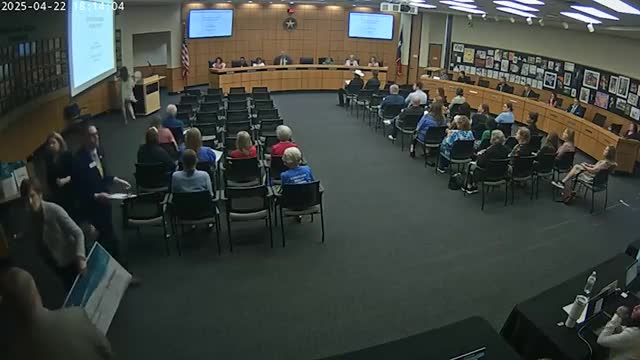
DENTON, Texas — Denton ISD officials and the district’s financial advisor told the Board of Trustees on April 22 that the district can issue the roughly $382 million left from the 2023 bond authorization without raising the I&S (interest and sinking) tax rate above the current $0.48.
At a workshop, district finance staff reviewed debt-service cash flows and fund balances and Josh McLaughlin of BOK Financial outlined a parameters plan that would split the remaining authorization into about $182 million of fixed-rate bonds and roughly $200 million in variable-rate bonds, with no increase to the district’s $0.48 debt-service tax rate.
The plan would preserve capacity for future bond elections while managing near-term payments, McLaughlin said. He estimated the proposed mix could save the district about $5.7 million in initial interest cost under current market assumptions; he also noted market rates are volatile and built a cushion into the assumptions.
Why it matters: The district must have cash in its debt-service fund to make bond payments in mid-August, a period when most property-tax collections are not yet posted. Finance staff told the board the debt-service fund balance is projected to end the 2024–25 fiscal year at roughly $145.5 million, and district officials stressed maintaining liquidity for scheduled August payments.
Details and context
Finance staff presented adopted and amended debt-service budgets for the current year and walked trustees through revenue and expenditure drivers. The district’s adopted debt-service budget initially assumed about 10% property-value growth and a $159.8 million revenue projection; certified values raised that projection, and the amended revenue estimate was about $170.7 million. That enabled a larger plan for debt prepayments in the current year and a total bond-payment obligation around $169.5 million in the current fiscal year, the staff presentation showed.
McLaughlin said voters approved about $1.4 billion in the 2023 bond program, and the district has sold about $1.036 billion to date. Roughly $352 million of the remaining authorization is tied to Proposition A (facilities and buses) and about $30 million to Proposition B (technology). After the planned issuance, McLaughlin projected the district would have roughly $2.48 billion of debt outstanding, with about $2.0 billion callable.
On structure and timing
The advisory plan presented to trustees calls for one tranche of fixed-rate bonds (the “A” series) and one tranche structured as variable-rate bonds (the “B” series). McLaughlin described the variable-rate portion as a tool to borrow at shorter-term rates while placing those obligations on the long end of the repayment schedule to preserve capacity and reduce near-term interest expense. Under the assumptions shown, the fixed-rate sale would carry an illustrative true interest cost below 5 percent; the combined plan assumes a market-rate cushion and projects a net borrowing cost intended to preserve future capacity for new elections.
McLaughlin outlined a timeline that would bring a parameters resolution back to the board at the May 13 meeting, price the fixed-rate series in early June (market permitting) and the variable-rate tranche later in June, with closing in June/July. He emphasized that market movement or changes in state law could alter the timing and economics.
Legislative watch and risks
Both the district finance staff and McLaughlin warned trustees that pending state legislation — primarily proposals to expand the homestead exemption and measures that would restrict prepayment or require a supermajority to prepay bonds — could materially change the district’s financing capacity and the frozen-levy (“frozen levy”) calculations the state provides.
McLaughlin said the district is modeling scenarios that include a possible increase to the homestead exemption (citing Senate Bill 4 as an example) that would remove taxable value from the district’s roll and reduce available revenue tied to the current I&S rate. He recommended moving forward with a parameters order if the board wanted the option to sell under the current assumptions but highlighted the potential need for subsequent budget amendments if laws change.
What trustees asked and directed
Trustees asked whether prepaying bonds in the current fiscal year could offset effects of new law; staff clarified that prepayments would affect the next fiscal year because the current year’s tax rate already reflects adopted prepayment plans. Trustees also asked about replacing M&O reserves that were previously drawn down; staff noted M&O and I&S funds are separate and cannot be commingled.
Next steps
No formal bond sale was approved at the April 22 meeting. Trustees were presented a financing plan and told they would be asked to consider a parameters resolution at the May 13 meeting that would authorize issuance within stated limits and timelines, subject to market conditions and final legal requirements.
Ending
District officials framed the proposal as an effort to balance taxpayer protection, future bond capacity and current capital needs while continuing to monitor fast-moving market conditions and pending legislation that could change the district’s options.