
Supreme Court hears Nagel v. Nagel appeal over property equalization after brief remarriage
Get AI-powered insights, summaries, and transcripts
Subscribe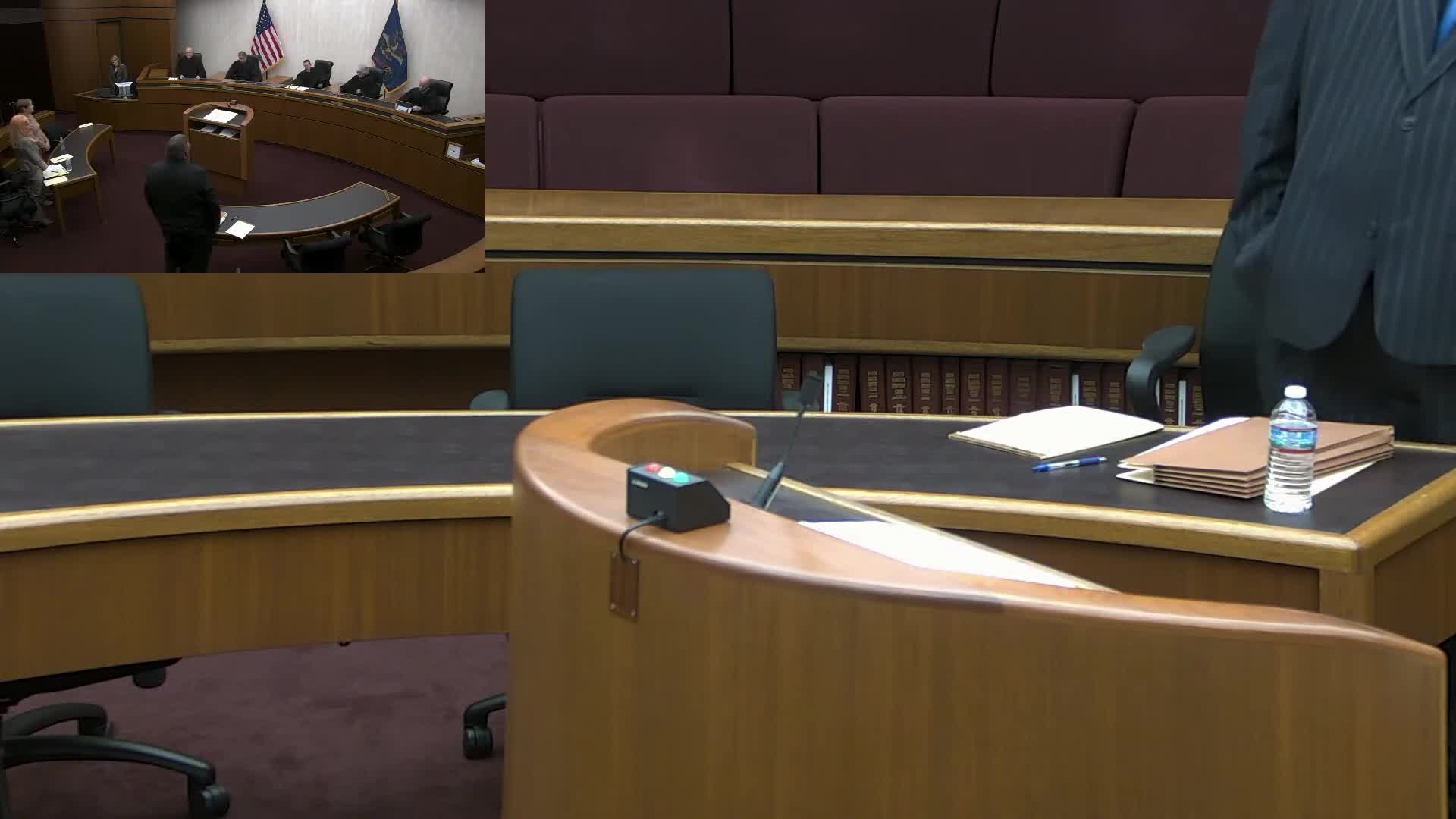
Summary
The Supreme Court heard oral argument in Nagel v. Nagel (file no. 20240260), an appeal in which Jean Nagel asks the court to reverse and remand a district court judgment that equalized marital property after a five-month second marriage.
The Supreme Court heard oral argument in Nagel v. Nagel (file no. 20240260), an appeal in which Jean Nagel asks the court to reverse and remand a district court judgment that equalized marital property after a five-month second marriage.
Why it matters: The case asks whether Nelson v. Nelson and related precedent require a long-term-marriage equalization when spouses remarry after a previous long marriage and an intervening divorce — even where the second marriage was brief and the first divorce had been fully implemented years earlier. The decision could clarify how lower courts weigh prior divorce judgments, the lapse of years between marriages, and short subsequent marriages in property divisions.
Appellant's argument
Justin Hager, counsel for appellant Jean Nagel, told the court the appeal has two main points: whether the lower court correctly applied Nelson v. Nelson as controlling law and whether the district court's equalization of assets is clearly erroneous. "This is an appeal of a divorce judgment, and we are asking that this matter be reversed and remanded," Hager said. He emphasized that the parties were married originally in August 1982, divorced by stipulation on Dec. 31, 2018, then remarried in August 2022 and separated by Feb. 2, 2023 — a second marriage of roughly five months following about four years apart.
Hager argued the prior divorce was "fully implemented," that Suzanne Nagel "did receive all the benefits of the first divorce," and that Nelson was misapplied when the district court treated the second marriage as effectively a long-term marriage. Hager said the district court calculated roughly $1.5 million in net assets for one party and about $1.0 million for the other, then ordered his client to pay "over 230 some thousand dollars" to equalize the difference. He urged the court to account for the length of time between marriages and the fact the second marriage was short, calling the resulting award a "windfall" to the appellee: "Just because she was married for 5 more months, she got to go in and basically attack that judgment, go after assets she could have never gone after without the remarriage, and has secured herself a windfall in this case."
Hager also highlighted other facts the district court found: Jean Nagel was age 65, disabled and retired at the time of the second marriage; Suzanne was about 62 and capable of returning to the workforce. Counsel noted the malpractice settlement that produced funds during the second marriage was subject to an NDA so exact sums were not disclosed in the record and argued the district court did not identify which Fisher (Rolph/R. Fisher) factors supported equalization beyond the parties' long relationship history.
Appellee's argument
Theresa Kellington, counsel for appellee Suzanne Nagel, asked the court to affirm the district court's findings and judgment entered Aug. 1, 2024 and Aug. 27, 2024. Kellington told the justices that when the same two people remarry, "that previous stipulation, that previous judgment is basically set aside," unless the original stipulation explicitly contemplates remarriage. She cited North Dakota and out-of-state decisions she said treat remarriage between the same parties as placing the parties back on "a new footing." Kellington said the district court produced a 29-page findings-of-fact and conclusions-of-law order that evaluated the relevant factors and that the court could infer from that analysis the rationale for equal distribution.
Kellington also pointed to the district-court record on incomes and finances presented there: she summarized evidence the appellant received disability payments and Social Security and rental income totaling about $9,778 per month, and she noted the court denied a request for spousal support. Kellington argued the record does not support Hager's suggestion of fraud or an intent to obtain a windfall and stressed that the district court has broad discretion in dividing property.
Court proceedings and next steps
Justices Daniel Crothers, Lisa Fairmachevers, Jared Tufte, Douglas Barr and John Jensen presided over the arguments. Counsel reserved time for rebuttal and exchanged hypothetical questions from the bench about how courts should balance prior settlements, intervening time between marriages, and short remarriage periods.
The court took the case under advisement. The bench announced the matter will be considered and the court adjourned; the matter was set on the court calendar for Monday, Feb. 24, at 10:45 a.m., when the court will reconvene.
Context and background
The dispute turns on competing interpretations of Nelson v. Nelson and related cases (Stevenson v. Stevenson and others cited in the lower-court order). Appellant contends Nelson should not operate as a per se rule requiring equalization whenever parties who once had a long marriage remarry; appellee contends prior rulings treat remarriage between the same parties as grounds to set the prior stipulation and judgment aside absent explicit language preserving the earlier settlement.
What the record shows and does not show
The transcript and the district-court order reflect the parties' first marriage began in August 1982 and the first divorce judgment was entered by stipulation on Dec. 31, 2018. The parties remarried in August 2022 and separated by Feb. 2, 2023. The district court described the total span of the couple's relationship as roughly 30-plus years and ordered a property equalization that offset roughly a half-million-dollar difference in net assets by a payment of about $230,000 from Jean to Suzanne. The record also shows referenced settlement proceeds and disability and Social Security income but — because of NDA terms and evidentiary limits — the transcript does not disclose the precise malpractice settlement amount.
No final decision was issued from the Supreme Court at oral argument; the matter remains under advisement.