Get Full Government Meeting Transcripts, Videos, & Alerts Forever!
Get email alerts on the Earned Sick And Safe Time topic
No spam. Unsubscribe anytime.
Committee hears broad ESST changes in House File 1325; members split over carve‑outs and implementation
Summary
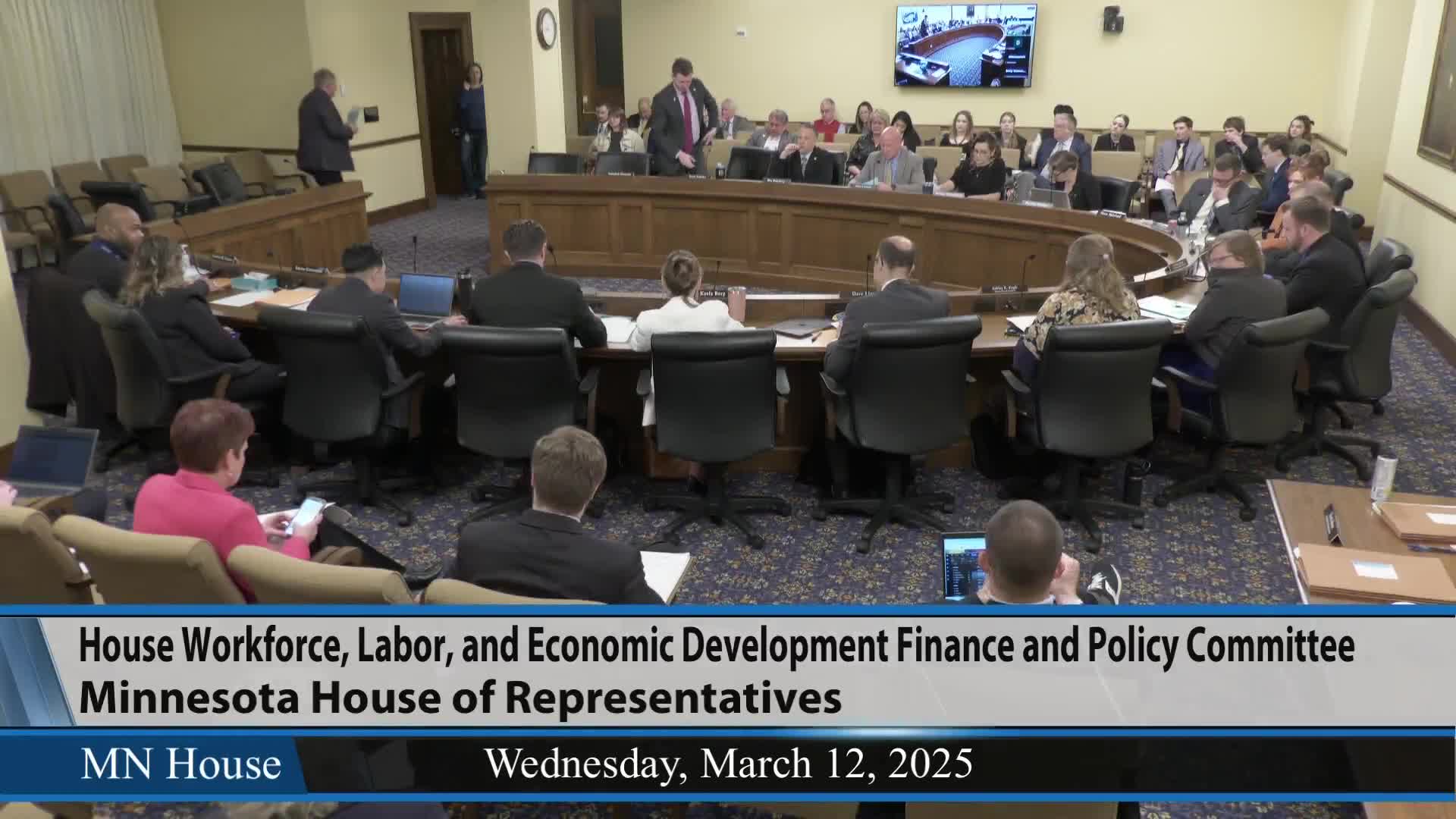
The Workforce, Labor, and Economic Development Finance and Policy Committee on March 12 considered House File 1325, sponsored by Representative Kelly Schultz, a package of changes to Minnesota’s earned sick and safe time law that would add exemptions, proration options and new documentation and waiting‑period rules.
The Workforce, Labor, and Economic Development Finance and Policy Committee on March 12 considered House File 1325, sponsored by Representative Kelly Schultz, a package of changes to Minnesota’s earned sick and safe time (ESST) law intended to address administrative and operational challenges raised since the law took effect Jan. 1, 2024.
Schultz told the committee the bill is aimed at making ESST “workable and flexible” for small businesses, schools, public employers and taxpayers. The proposal includes multiple changes: redefining covered employees (carving out certain minors, part‑time and seasonal workers), permitting employers with fewer than 25 full‑time equivalent employees to pay ESST at half the employee’s regular hourly rate, allowing prorated front‑loading of hours and an optional 90‑day waiting period for new hires, and clarifying treatment of more generous employer leave policies and weather‑related exemptions for emergency employees.
Nicole Lisonbee, commissioner of the Minnesota Department of Labor and Industry, opposed the bill. She said removing coverage for minors, part‑time and seasonal workers would strip protections from approximately 800,000 Minnesotans — roughly 30 percent of the workforce, according to the department’s testimony — and could leave many workers with weaker rights than they had before ESST’s enactment. Lisonbee also warned that employer‑size thresholds and seasonal fluctuations would complicate compliance and enforcement and criticized a provision delaying DLI civil penalties until Jan. 1, 2026.
Business groups, local governments and school districts supported parts of the bill. Lauren Schotchorst of the Minnesota Chamber of Commerce told the committee that many members lack HR capacity and that broad documentation and notice provisions have created operational challenges. The League of Minnesota Cities, St. Louis County and school district human‑resources witnesses asked for clarifications on how the statute interacts with more generous, preexisting leave policies and requested changes to the bargaining requirement tied to weather‑related emergency exemptions so essential public services can be maintained during severe weather.
Labor and worker advocates urged rejecting the bill. Brian Elliott of SEIU Minnesota State Council described ESST as a ‘‘short‑term insurance policy’’ that protects workers from losing wages or jobs for brief illnesses; he warned that the proposal would create “a baroque new set of rules” that complicate enforcement and could take coverage away from hundreds of thousands of workers. Nurses, public‑sector employees, union representatives and Take Action Minnesota witnesses offered personal testimony about the law’s benefits and urged the committee to leave ESST unchanged.
Members debated the balance between operational burden and worker protections. Some legislators — particularly those representing rural and small‑business constituencies — said modifications were needed to prevent undue administrative cost or service‑delivery problems for towns, counties and small employers. Other members warned the bill would roll back core protections and disproportionately affect low‑hour and younger workers.
The committee approved an author’s A2 amendment by voice vote that amended several provisions and then the chair moved to lay House File 1325 over for further consideration. No roll‑call tally appears in the transcript. Representative Schultz said she welcomed continued bipartisan conversations to refine the bill.
Votes at a glance: House File 1325 — A2 amendment: approved (voice vote). Motion to lay over: moved by Chair; outcome: laid over (voice vote; no roll call recorded).