Get Full Government Meeting Transcripts, Videos, & Alerts Forever!
Get email alerts on the Vrs Funding Legislation topic
No spam. Unsubscribe anytime.
Lawmakers hear testimony for Representative Hicks’ bill to plug VRS budget gap
Summary
Representative Tina Hicks introduced House File 2838 to seek funding to shore up Vocational Rehabilitation Services; counselors, union representatives and program staff testified about caseloads, potential layoffs and the impact on services for Minnesotans with disabilities.
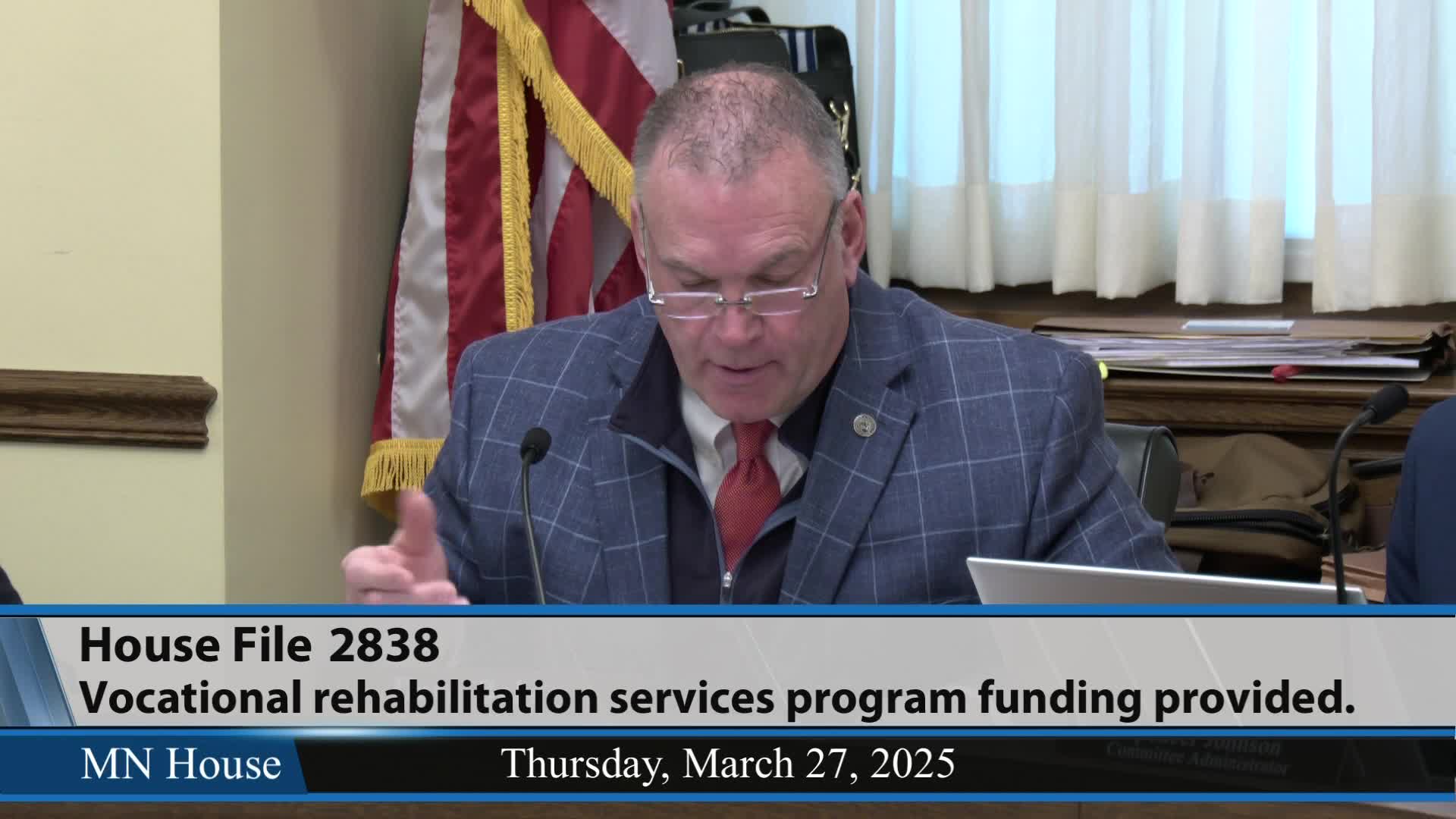
Representative Hicks introduced House File 28 38 to the Workforce, Labor and Economic Development Finance and Policy Committee on March 27 as legislation aimed at "plugging the hole" in Vocational Rehabilitation Services funding. Hicks framed the bill as an attempt to preserve services that support employment for Minnesotans with disabilities.
Hicks said VRS enables people with disabilities to obtain competitive integrated employment and that proposed cuts would harm clients, employers and communities. "Voc rehab is a good thing. It is a proactive service that benefits people with disabilities in our communities," Representative Tina Hicks said, urging lawmakers to find money in the budget to avert service reductions.
Multiple VRS staff and counselors testified in support of the bill. MAPE union members described staffing and caseload impacts: Renata Schultz, a vocational rehabilitation counselor in North Minneapolis, said the Ticket to Work component helps beneficiaries explore employment without immediately losing benefits and cited a $61 million federal savings the State received from 2021 to 2023 related to returned-to-work outcomes. Chandra Peterson, a career counselor who serves deaf Minnesotans across southern Minnesota, said staff had been told of budget concerns in an October 2024 all-staff meeting and that the program had begun offering early retirement and other measures; she said more than 30 staff had already taken early retirement or had positions eliminated.
Sheena Jewison, a rehabilitation counselor who recently left VRS for another state position, said her departure left roughly 70 youth without a dedicated counselor and described caseloads that can be 70 to 100 clients per counselor. "With existing caseloads already at capacity, it is unrealistic to expect remaining staff to absorb these cases without significant consequences like decreased quality of services and delayed responsiveness," Jewison said.
Members thanked testifiers and signaled support for exploring funding options. Vice Chair Mecklen and other members noted VRS services are provided statewide and are critical in many districts. Representative Hicks asked the committee to hold the bill for further consideration. The committee laid House File 28 38 over for later consideration.