Get Full Government Meeting Transcripts, Videos, & Alerts Forever!
Get email alerts on the Vrs Budget Crisis topic
No spam. Unsubscribe anytime.
DEED outlines pressure on Vocational Rehabilitation Services as members press for clarity
Summary
Deputy Commissioner Evan Roe presented Vocational Rehabilitation Services funding trends and program pressures to the committee; members raised concerns about timing, hiring, and contingency planning after DEED described a projected shortfall and changes to federal funding outlook.
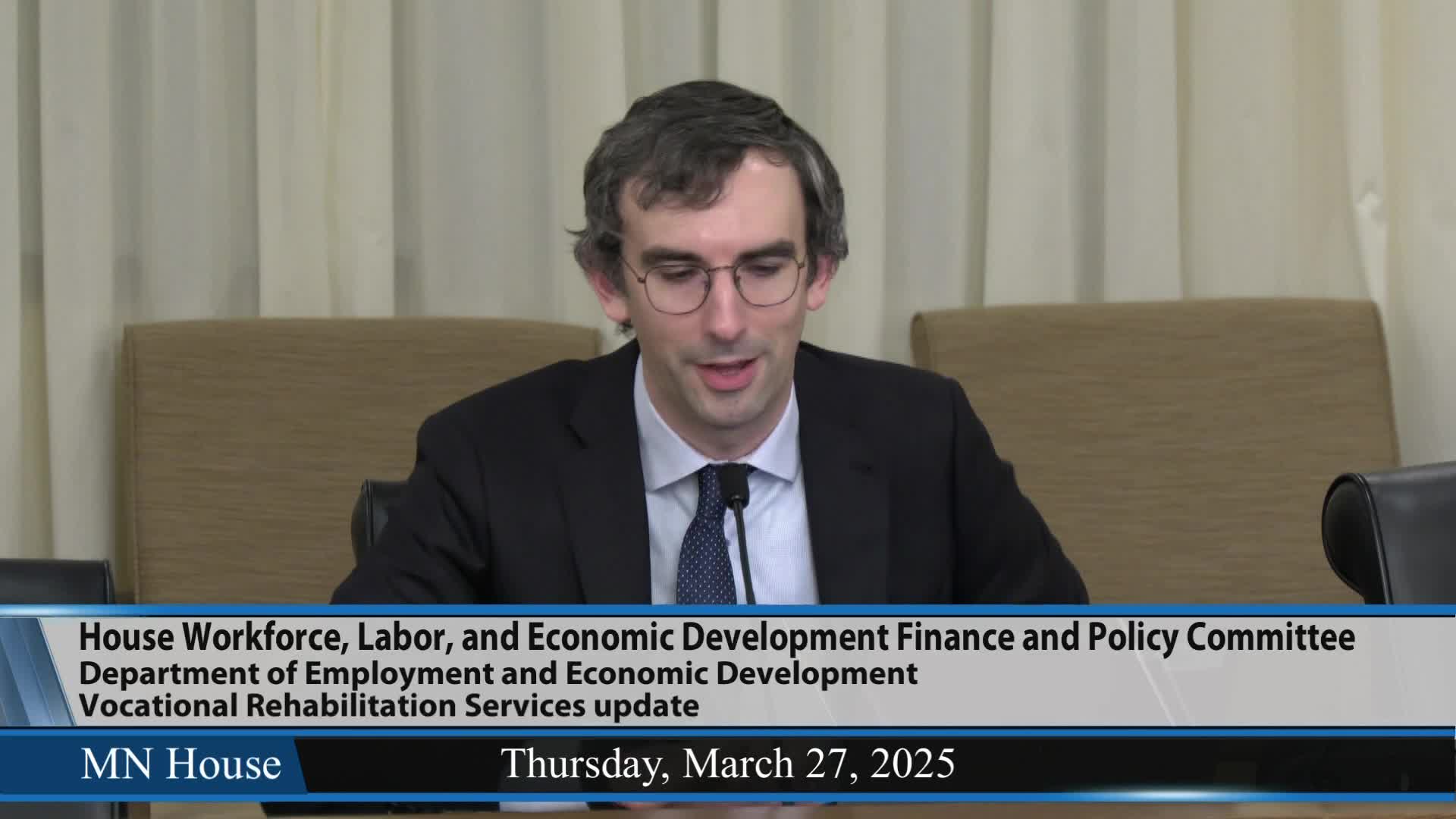
Deputy Commissioner Evan Roe of the Department of Employment and Economic Development gave a detailed briefing to the Workforce, Labor and Economic Development Finance and Policy Committee on March 27 about financial pressures affecting Vocational Rehabilitation Services (VRS).
Roe described VRS as a federal–state partnership that helps Minnesotans with disabilities prepare for, find and keep competitive integrated employment. He said approximately 80% of VRS funding comes through a U.S. Department of Education grant and roughly 20% is state match. "VRS is a federal state partnership with most of the funding coming through a federal grant," Roe told the committee.
Roe summarized several drivers of the program’s budget stress: flat federal base grants, a negative outlook for reallotment funding that previously supplemented VRS, growing case-service costs as providers serve more complex client needs, higher unit staff costs, increased applications (Roe said applications have risen about 50% annually since 2020) and spending tied to Pre-Employment Transition Services that federal rules require.
Roe said the department has taken internal steps including a hiring freeze, early-retirement incentives, and more scrutiny of external contracts to manage the gap. He also noted that the governor’s revised budget proposes roughly $5 million in additional state match funding to stabilize VRS operations.
Committee members pressed for specifics about timing and ownership of the shortfall. Chair Baker and members said they had expected earlier alerts and raised concerns about hiring and staff increases in 2024. Representative Frazier and Representative Mueller emphasized federal uncertainty; Representative Frazier said the missing element was "certainty" from the federal outlook, and Representative Mueller argued the program retained its base federal funding and that reallotment was not a reliable revenue source to count on.
Members also discussed downstream programs and appropriations, including Individual Placement and Support (IPS), which the governor proposed reducing; members expressed concern about abrupt changes and the effects on students and providers. Roe acknowledged the evolving federal context and said DEED would continue monitoring federal guidance and managing expenditures while working with stakeholders and the state rehabilitation council to preserve access.
No final budget decision was made during the presentation. Roe said the department would provide follow-up numbers; members asked for clearer timelines and the precise projected deficit. Roe said initial signs emerged in summer 2024, with more definitive projections in the fall and early 2025, and that the department’s projections had produced a significant shortfall that was being managed down through internal measures and the governor’s supplemental proposal.
What’s next: Members requested follow-up material, including the department’s reports and the IPS report referenced during the hearing, and asked staff to circulate documents to committee members ahead of forthcoming budget deliberations.