Get Full Government Meeting Transcripts, Videos, & Alerts Forever!
Get email alerts on the Facility Financing Iaas topic
No spam. Unsubscribe anytime.
Sustainability Partners pitches "infrastructure-as-a-service" to St. Louis County committee
Summary
A private funder, Sustainability Partners, told the St. Louis County Public Improvements Committee that it can finance facility repairs and new construction as an "infrastructure-as-a-service" offering that the speaker said is not public debt. Committee members asked follow-up questions about fees, scope and procurement rules.
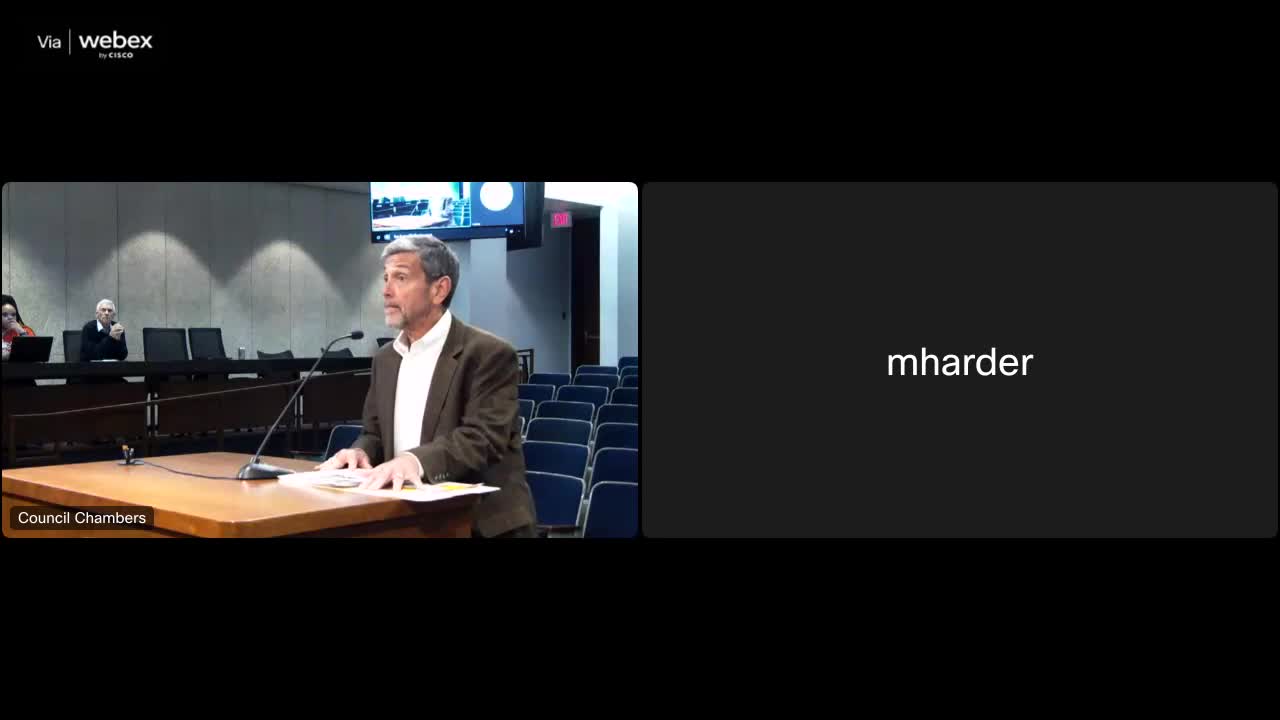
Madam Chair opened the Public Improvements Committee meeting Thursday and invited Michael Pappas, a representative of Sustainability Partners, to present a financing alternative for county facilities.
Pappas, Sustainability Partners' representative, described his firm's model as “infrastructure as a service,” saying the approach treats capital as an operating-style utility rather than public debt. “It's not public debt,” Pappas said. “It's infrastructure as a service.” He explained the model borrows investor capital to pay for design, construction and ongoing maintenance, and bills the owner as a usage- and availability-based charge after a facility is commissioned.
The presentation outlined three core features: no charge until a facility is placed into service and accepted, amortization tied to the useful life of individual assets (for example, 25 years for an HVAC plant or 35 years for a roof), and a standing engineer or infrastructure-service person supplied by the firm to oversee maintenance, upgrades and emergency repairs.
Why it matters: County officials are addressing aging facilities and a deadline tied to the City of Clayton that requires either retrofitting the existing building or vacating it. Pappas said his model could avoid adding public debt on St. Louis County’s balance sheet and could provide a reserve structure to avoid “running to fail.” He cited a national need—“$3,000,000,000,000 of crumbling infrastructure,” in his words—to frame the service's market relevance.
Committee members pressed for details. Council member Days asked whether county Public Works and Transportation staff had followed up after an earlier presentation; Pappas said he had coffee with some council members and spoken with Stephanie from the county but had not had a formal procurement conversation with the department. Pappas said his firm charges an up-front service fee that is typically 4–8% of project cost and an ongoing service fee of about 0.8% per year (80 basis points) for the infrastructure-service role. He also described an alternative his firm calls a “capital recovery service,” in which a facility can be appraised and sold back to the funder with the county continuing to occupy it, an approach he said can provide cash liquidity.
County staff cautioned the committee about procurement rules. Stephanie, identified in the meeting as a member of Public Works and Transportation staff, reminded members that the county must follow competitive procurement and cannot use outside proposals without following that process. “You cannot engage them unless you go through competitive procurement,” she said.
Several members asked for follow-up material, including a clearer copy of a chart Pappas referenced and details about the capital recovery service. Pappas said he would return with additional documentation and that the arrangement can be tailored—part of a project or the whole project.
Ending: The committee did not take action on the Sustainability Partners proposal. Members asked staff to review the materials and to proceed according to county procurement rules if the county wishes to evaluate the model further.