
Committee advances overhaul of Rental Housing Revolving Fund amid concerns over loss of lowest-income set-aside
Get AI-powered insights, summaries, and transcripts
Subscribe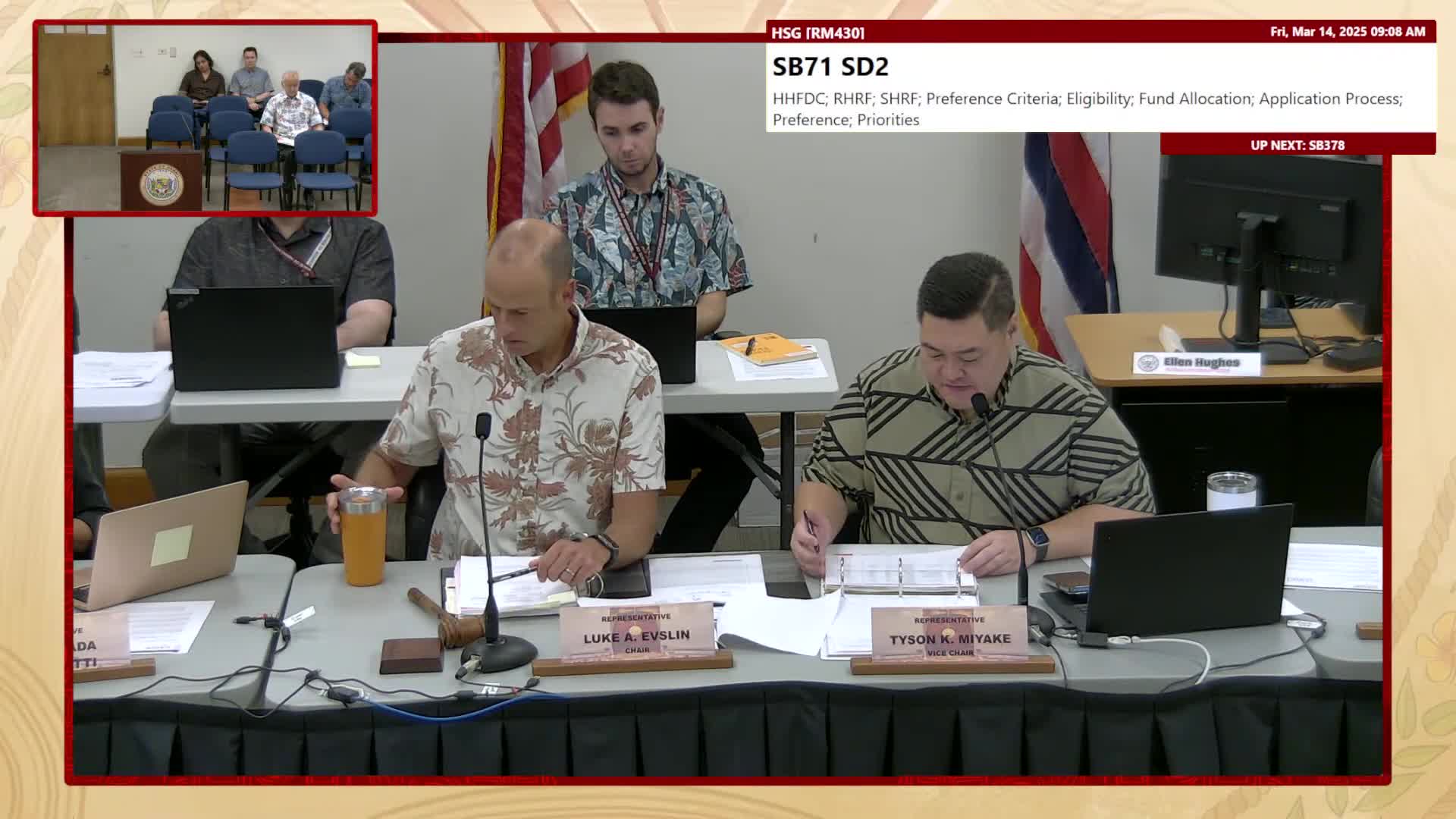
Summary
The House Committee on Housing voted to move SB71 SD2 with major amendments after testimony warned the bill would remove a 5% set-aside for households at or below 30% of area median income and create a coverage gap between 60% and 120% AMI.
HONOLULU — The House Committee on Housing on March 14 voted to advance SB71 SD2, a measure that would change how the state prioritizes and funds rental housing projects, adopting an amendment that replaces the bill’s contents with the House companion (HB432 HD1) and recommends a $75 million appropriation to a new mixed-income subaccount in each of the next two fiscal years.
The committee’s action followed extended testimony from housing advocates and developers who said the bill, as drafted, would delete a 5% set-aside for households at 30% area median income (AMI) and favor projects that can meet shorter, five-year loan terms — changes they said would push resources away from the lowest-income households and create a gap between households at about 60% and 120% AMI.
Why it matters: The Rental Housing Revolving Fund and related tools are among Hawaii’s primary financing sources for price-restricted rental housing. Witnesses and committee members said removing the low-income set-aside and privileging rapidly revolving loans could reduce production of units for people at the lowest incomes while shifting focus to projects that serve higher-AMI tenants.
Catholic Charities Hawaii’s Betty Lou Larsen, who identified herself as representing Catholic Charities Hawaii, told the committee the fund has been “a very successful program” and urged the panel not to eliminate the 5% set-aside for households at or below 30% AMI. “That’s the only way the state is able to produce those units, and they're critical units,” Larsen said, adding that a five-year loan term would demand very high rents to repay loans and could screen out lower-income residents.
Arjuna Heim of Hawaii Appleseed said award and demand figures show significant funding shortfalls in existing programs and argued the state should preserve allocations for lower-AMI rental housing. Heim cited 2023 demand that outstripped awards and urged either deferral of the bill or modification to keep allocation priorities intact.
Josh Wish, representing Holomua Collaborative, said the amendment language as drafted could leave a “pretty important gap” between 60% and 120% AMI, affecting workers such as teachers and first responders who may not qualify for traditional assistance but cannot afford market housing.
Evan Oye, testifying for NIAAA Hawaii, opposed changes that would exclude private development from access to the fund and warned that shorter loan terms and altered prioritization could deter private partnerships the state has used to build housing.
HHFDC staff and other state witnesses filed support or comments on the measure; committee discussion noted concerns raised by the Department of Planning and Permitting and county councils earlier in the hearing that local amendments can increase project costs.
Committee recommendation and next steps: The committee chair recommended deleting SB71’s contents and inserting HB432 HD1 language to create a mixed-income subaccount and recommended appropriating $75 million in each of the next two fiscal years to that subaccount. The committee voted to pass SB71 SD2 with amendments (HD1), advancing the revised measure to subsequent legislative steps.
The committee record shows the panel adopted the amendment and moved the bill forward; the exact appropriations and final statutory language will be determined in conference with other committees and the full Legislature.
Closing note: Testimony and committee discussion emphasized preserving funding to produce deep-affordability units while also addressing affordability gaps for moderate-income households. Further hearings and bill language refinement were anticipated as the measure advances.