
House Higher Education committee hears bills on Promise scholarships, athletics, mental health, CTAHR, nursing and tobacco tax; committee advances all measures
Get AI-powered insights, summaries, and transcripts
Subscribe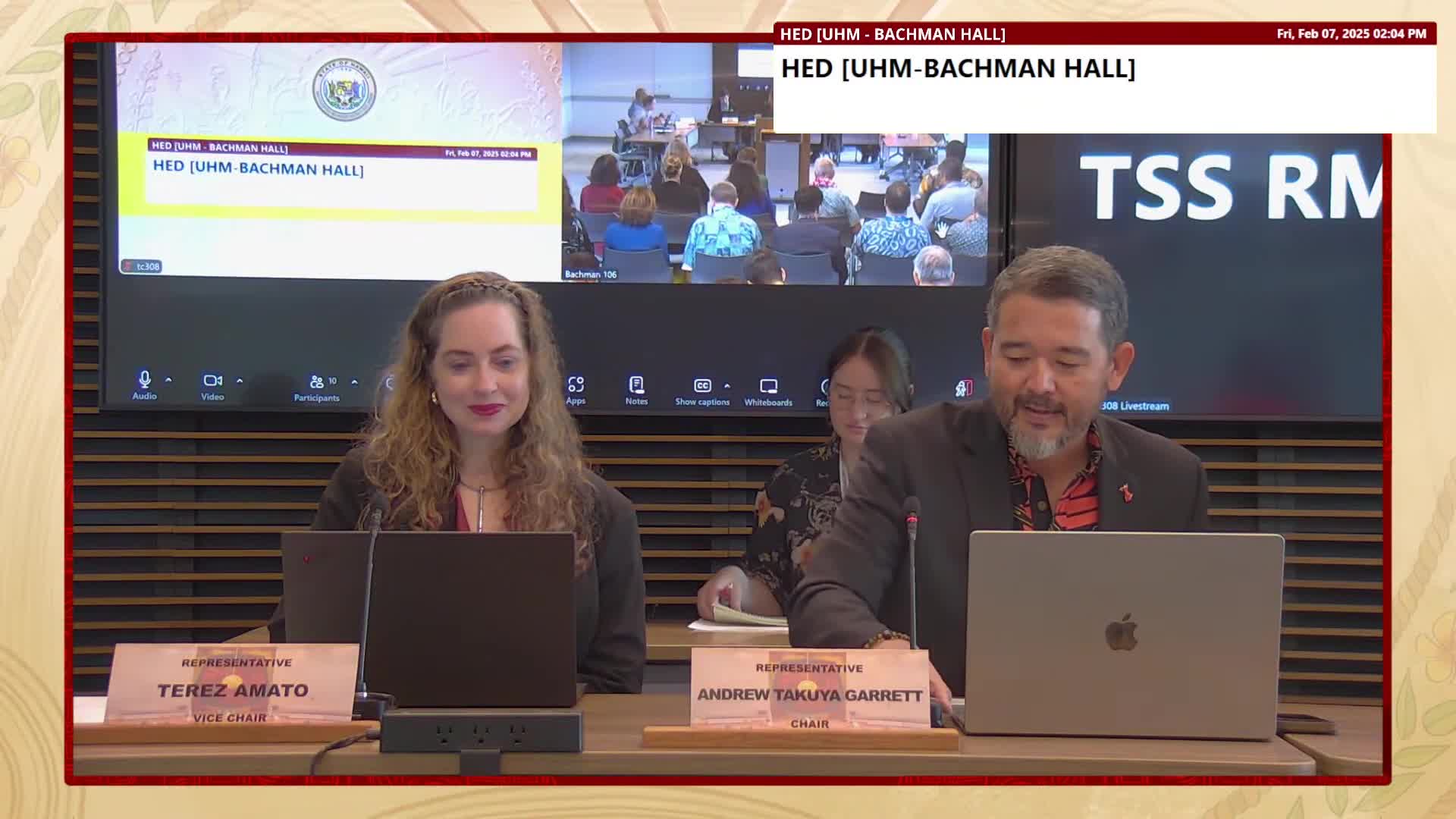
Summary
The House Committee on Higher Education & Technology convened Feb. 5, 2025, at Bachman Hall on the University of Hawaiʻi at Mānoa campus for a two‑hour hearing on 11 bills covering student aid, campus services, agriculture research facilities and tobacco taxation.
The House Committee on Higher Education & Technology convened Feb. 5, 2025, at Bachman Hall on the University of Hawaiʻi at Mānoa campus for a two-hour hearing on 11 bills covering student aid, campus services, agriculture research facilities and tobacco taxation. Chair Representative Gene Garrett opened the session and the committee heard in-person and virtual testimony from university officials, student leaders, campus athletic directors, faculty representatives and community groups.
Why it matters: Lawmakers advanced measures that would expand the Hawaiʻi Promise scholarship to four‑year campuses, seek recurring funding for University of Hawaiʻi athletics, add mental‑health clinicians at Mānoa, waive tuition for certain teacher‑education terms, and redirect tobacco tax revenue to public health beneficiaries including the Hawaiʻi Cancer Research Special Fund. The committee also advanced funding requests for nursing programs and CTAHR research and infrastructure; it considered an emergency relief authority for student aid; and it approved a short‑term coconut rhinoceros beetle response program.
University leaders and student advocates urged passage of bills they said would remove cost barriers and strengthen workforce pipelines. President Wendy Hensel told legislators that the campus welcomed the committee and that lawmakers “have in your hands the power to assist or to harm the people in the room,” and asked them to consider the university’s requests in that light.
Hawaiʻi Promise expansion (HB542) University and student witnesses described HB542, a proposal to extend the state Hawaiʻi Promise last‑dollar scholarship beyond community colleges to eligible students at four‑year UH campuses. Ronald Sturgess, chair of the University of Hawaiʻi Student Caucus, testified in “strong support,” saying cost is a “huge barrier” and the program could help retain graduates in the state’s workforce. Vice President Halbert and university staff said they will provide campus‑level data on the number of students with unmet need; the university estimated that a full expansion could reach as many as about 5,000 eligible students and gave a preliminary statewide cost estimate of roughly $12,000,000. University staff also noted 10% of current Hawaiʻi Promise recipients transfer from community colleges to four‑year campuses and that about 3,000 students currently accept Promise at community colleges. The committee moved HB542 forward as amended.
Athletics funding and operations (HB840) Athletic directors from UH Mānoa and UH Hilo described HB840, which would seek recurring appropriations to help cover operations, travel, recruiting, nutrition and awards for student athletes. UH Mānoa’s AD said the $3.2 million recurring request has covered travel, recruiting and 43 positions historically funded outside the base; $400,000 was described as a partial request toward Austin awards (student athlete awards) and $857,000 for a fueling/nutrition station in the renovated weight room. ADs said moving football back to campus produced some new revenue but also new on‑campus costs. The committee advanced the bill for further consideration by finance.
Student mental‑health staffing (HB842) HB842 would appropriate funds for three permanent mental‑health practitioner positions at UH Mānoa’s counseling center. Interim Vice Provost Katrina Kapaa Olivero and union speakers said counseling demand far exceeds capacity; the university reported an FTE shortfall and noted recommended practitioner ratios of roughly one clinician per 1,000–1,500 students versus current staffing closer to one per 4,000 students. The committee advanced the bill with amendments for additional review.
Residency, emergency relief and teacher education (HB1170, HB1171, HB1345) An administration bill, HB1170, would require UH to grant resident tuition for former Hawaiʻi high‑school graduates under specified conditions; the Department of Education and student leaders supported the measure. HB1171 would permit the Board of Regents to dedicate tuition and fee special‑fund money to student aid in response to governor‑declared emergencies; student witnesses described situations — such as wildfire response — where targeted aid could avoid disrupting other financial‑aid awards. HB1345 would require the Board of Regents to waive tuition and mandatory fees for resident students enrolled in state‑approved teacher‑education programs for terms when they are in that program; HSTA and UH officials supported the goal but asked the committee to assess the fiscal impact. The committee advanced these measures for further fiscal review.
Nursing programs and workforce (HB442) UH deans and the Hawaiʻi State Center for Nursing supported HB442, a request to expand undergraduate nursing program capacity across Manoa, West Oʻahu and Hilo and to fund instructors and program needs. Testimony noted local capacity to train more nurses and urged support for graduate‑level tuition waivers as well; Academic Labor United urged reinstating DNP tuition waivers to protect the pipeline of advanced practitioners. The committee advanced the bill and asked budgetary committees to consider the appropriate appropriation.
CTAHR facilities and food‑security research (HB843) The College of Tropical Agriculture and Human Resources requested funds for repair and renovation at the Waimanalo Research Station, a new controlled‑environment agriculture research and production facility, and positions for extension center staff statewide. Dean Bridgewell (transcribed as "Bridal") described a prioritized plan and said a facilities study estimated a minimum statewide need of about $17 million; committee members pressed for details on island allocations and timelines for land transfers for new facilities. The measure moved forward for further fiscal deliberation.
Coconut rhinoceros beetle response (HB643 HD1) CTAHR and agricultural partners requested short‑term funding and positions to sustain a federally supported CRB response; testimony described statewide detection and management work and the drafting of interagency memoranda of understanding to assign responsibilities for new detections. The Department of the Attorney General offered technical language to clarify statewide authority and to require standards for grants; the committee adopted AG‑recommended clarifications and advanced the bill.
Tobacco and e‑product taxation (HB441 HD1 and HB1085 HD1) Two related measures would increase cigarette taxes and expand dispositions of tobacco‑product tax revenue to beneficiaries including the Hawaiʻi Cancer Research Special Fund, the trauma system and tobacco‑prevention programs. The University Cancer Center, Department of Health, American Cancer Society and public‑health groups supported dedicating new revenue to cancer research and cessation programs; the Deputy Attorney General and Department of Taxation described coordination among beneficiaries and a preference to address all tobacco product taxes in a single vehicle. Opponents (small retailers and an Americans for Tax Reform filing) called the increases regressive and warned of contraband. The Attorney General’s Tobacco Enforcement Unit noted the state’s obligations under the 1998 Master Settlement Agreement and said strong enforcement is necessary to avoid arbitration risk if enforcement weakens. The committee advanced an administration tax bill that captures e‑products and other tobacco‑product taxes and asked finance to consider the final rate and disposition.
Votes at a glance (committee action) - HB542 (Hawaiʻi Promise expansion to four‑year campuses): Passed with amendments (committee recommended HD1); advanced to finance for appropriation review. - HB840 (UH athletics funding): Passed with amendments; advanced to finance for position and appropriation review. - HB842 (UH Mānoa mental‑health positions): Passed with amendments; advanced for fiscal review. - HB1170 (resident tuition for graduates of Hawaiʻi high schools): Passed with amendments; advanced for further discussion. - HB1171 (Board of Regents emergency student relief authority): Passed with amendments. - HB1345 (tuition/fee waiver for teacher education terms): Passed with amendments; committee asked UH to provide cost estimates. - HB442 (nursing program expansions): Passed with amendments; advanced to finance for appropriation sizing. - HB843 (CTAHR facilities, Waimanalo and controlled environment agriculture): Passed with amendments; advanced for fiscal detail. - HB643 HD1 (CRB response program): Passed with amendments including AG‑recommended grant standards and statewide‑concern language. - HB441 HD1 (cigarette tax to Hawaiʻi Cancer Research Special Fund): Passed with amendments to let finance set final rates. - HB1085 HD1 (administration tobacco tax package including e‑products): Passed with amendments; advanced to finance to reconcile rates and beneficiary dispositions.
What’s next: Committee members repeatedly blanked dollar amounts and FTEs from the committee reports and asked the Finance Committee to determine final appropriation levels and the appropriate vehicle for tobacco tax changes. The committee moved each bill forward with technical and drafting amendments and requested additional campus and fiscal data where testimony indicated large, uncertain cost impacts.
Quotes from the hearing President Wendy Hensel, University of Hawaiʻi at Mānoa: “You have in your hands the power to assist or to harm the people in the room.” Ronald Sturgess, chair, University of Hawaiʻi Student Caucus: “Cost is a huge barrier to education … anything that can help aid that issue with the rising costs is going to be a massive benefit to our students.” Dr. Daniel K. Ueno, University of Hawaiʻi Cancer Center: “The cancer center is not simply about system or Manoa, but it’s really the stakeholder. It’s you and all of us.”
Ending: Committee chair Garrett recessed the hearing after advancing all 11 bills and thanked the university for hosting the session on campus. Finance and other committees will receive the measures with requests for campus specific data and budget‑impact estimates before final floor consideration.