Get Full Government Meeting Transcripts, Videos, & Alerts Forever!
Get email alerts on the Guthrie Development Appeal topic
No spam. Unsubscribe anytime.
Bozeman commission hears appeal of Guthrie site plan, COA and demolition approval; decision continued to April 15
Summary
City staff conditionally approved the Guthrie apartment project (application 24493) at North Fifth and Villard; appellants argued the project violates the Neighborhood Conservation Overlay District (NCOD) and site-plan criteria. After five hours of testimony, the commission continued deliberation to April 15.
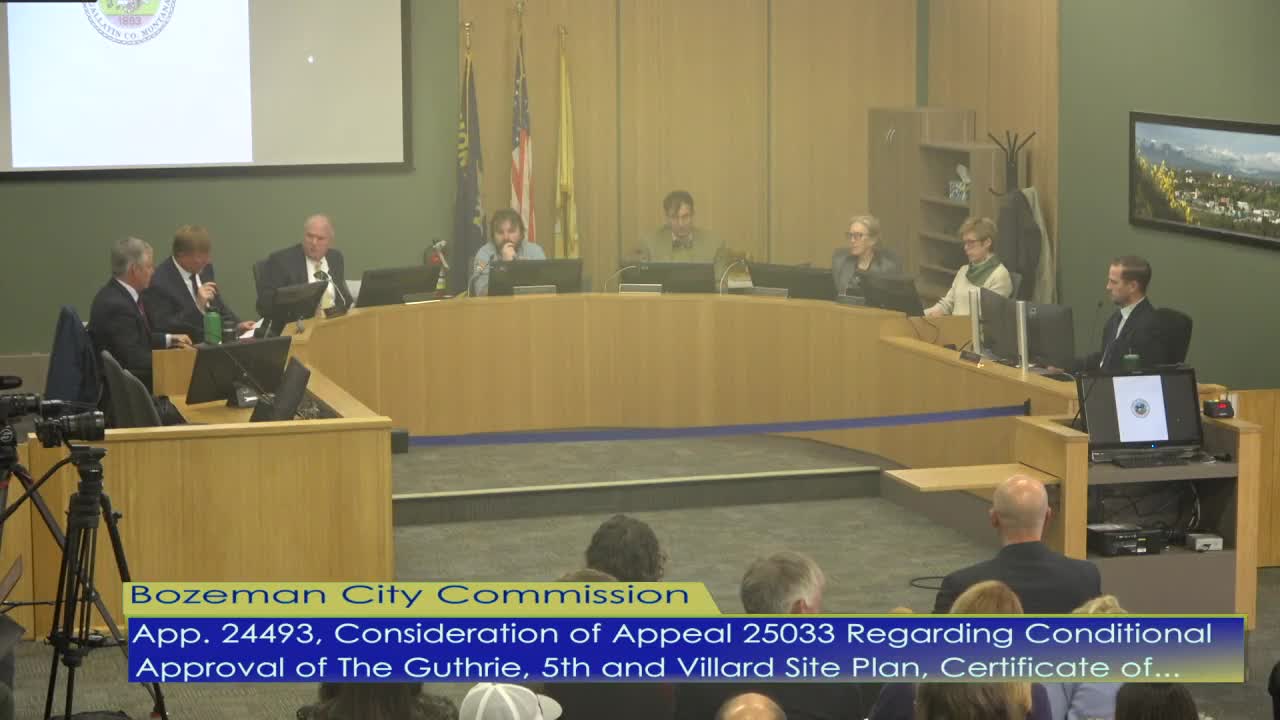
The Bozeman City Commission on April 1 heard an administrative appeal of the development director’s conditional approval of the Guthrie project, a proposed four‑story, 91‑unit apartment building at North Fifth Avenue and Villard Street that includes demolition, a site plan, and a certificate of appropriateness (application 24493). The commission took public testimony and heard technical presentations from city staff, the appellants and the applicant, then continued the matter for decision to April 15.
The appeal (25033) was filed after Community Development Director Aaron George conditionally approved the Guthrie application; appellants argued the approval ignored mandatory NCOD requirements, undervalued compatibility with adjacent residences and failed required site‑plan and traffic standards. Staff recommended the director’s approval be upheld, saying the application met compulsory code standards and that design guidelines are a required review reference but are not themselves code. Applicants said the revised Guthrie (from a prior 5‑story proposal) reduced height and unit count, improved materials and tenant amenities, and met code requirements.
City staff framed the hearing as an administrative appeal limited to the issues raised by the appellants rather than a full re‑review of the project. Staff lawyers and planners told the commission that the NCOD guidelines (adopted 2006) are design guidance referenced by code (38.3.40) and must be considered, but they are not strictly regulatory in the way base UDC standards are. Staff also said the project vested to standards in effect at the time of application and that technical reviewers (transportation, fire, waste collection, building) found the proposal met the applicable mandatory requirements. Transportation staff said the Guthrie would add a relatively small share of trips to nearby intersections and that a signal warrant study had been provided and considered.
Appellants, represented by attorney Kiersa Scheelke and the Bozeman Home Advocacy Group, argued the director’s decision contains legal and factual errors: they said demolition of an existing convalescent facility requires strict NCOD review, compatibility must give “meaningful” weight to adjacent single‑family structures and church nearby, and the site plan’s open space, refuse collection layout and traffic impacts do not meet standards cited in the UDC. Appellants asked the commission to overturn the director’s conditional approval. The appellants also emphasized the 2‑year demolition stay applied after the prior Guthrie denial and said staff relied on the alternate proposal to terminate the stay without sufficient analysis of alternatives or of the NCOD criteria.
Applicants said they had revised the project after prior commission review: they removed one story (from 5 to 4), reduced units from 111 to 91, increased the parking ratio, enlarged unit kitchens, added indoor bike storage and a fitness room, refined materials to include brick and covered porches, and provided a signal warrant study. Applicant Andy Holleran said adaptive reuse had been studied, that substantial engineering and design work showed the existing building was not feasible to retrofit, and that the revised proposal better responds to neighborhood concerns while delivering 50% of units as price‑restricted under the city’s Affordable Housing incentives.
Technical witnesses answered commissioners’ questions on code interpretation, compatibility, demolition criteria and traffic. The city’s historic preservation planner and legal counsel noted distinctions between mandatory code standards and advisory design guidance in the NCOD guidelines; appellants countered that the NCOD provisions in the UDC (38.3.40.50) impose compulsory COA and demolition review obligations and that compatibility analyses should focus on adjacent block‑level context.
After more than five hours of staff, appellant, applicant and public testimony, the commission voted 5–0 to continue formal deliberation and decision to a subsequent commission meeting on April 15. Staff advised that the record is closed and that no new evidence should be submitted for the April 15 decision; commissioners were also reminded to avoid ex parte communications about the appeal during the closed record period.