Get Full Government Meeting Transcripts, Videos, & Alerts Forever!
Get email alerts on the Wetlands Dredging topic
No spam. Unsubscribe anytime.
Marine Resources Commission approves small dredge cut to connect proposed Pleasure House Point mitigation bank after weeks of public protest
Summary
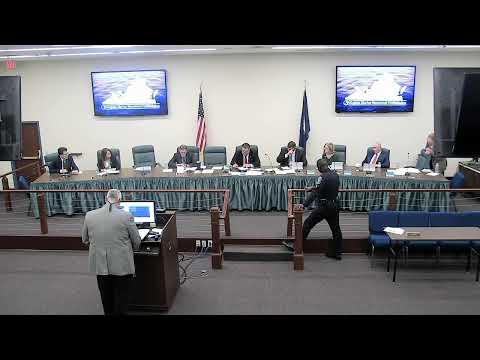
The Virginia Marine Resources Commission on Feb. 25 approved a permit allowing the City of Virginia Beach to mechanically dredge a 19-foot-by-63-foot subtidal channel in Pleasure House Creek to create a tidal connection to a proposed Pleasure House Point mitigation bank, saying the limited cut is within the commission’s jurisdiction and should be conditioned to protect nearby resources.
The Virginia Marine Resources Commission on Feb. 25 approved a permit allowing the City of Virginia Beach to mechanically dredge a 19-foot-by-63-foot subtidal channel in Pleasure House Creek to create a tidal connection to a proposed Pleasure House Point mitigation bank, saying the limited cut is within the commission’s jurisdiction and should be conditioned to protect nearby resources.
Why it matters: The proposal and a months-long public debate spotlighted tensions between a city-led plan to restore tidal wetlands and residents and conservation groups who said the project risks trees, oysters, and hydrology on the 16-acre bank site. The commission’s approval—conditioned on pre-dredge coordination, turbidity controls and other measures—allows the city to proceed with the narrow dredge cut the staff described as necessary to flood the bank site and establish tidal marshes used for mitigation credits.
Staff summary and recommendation: VMRC staff told commissioners the dredge cut is limited to state-owned submerged lands and would re-establish a hydrological connection between a stormwater outfall and the inland bank site. Staff recommended approval and proposed specific permit conditions: a pre-dredge meeting, turbidity curtains and silt booms around the dredge cut, relocation of any shellfish found in the immediate footprint, and a time-of-year restriction on in-stream work aimed at protecting shellfish resources. Staff also recommended measures to avoid harming northern diamondback terrapins and other species during construction.
Public objections and concerns: More than a dozen speakers urged the commission to delay or deny approval. Concerns raised included possible destruction of mature trees and upland riparian buffers, mobilization of unknown spoil and contaminants from decades of historical dumping on the spoil site, damage to nearby oyster reefs, negative effects on bird and bat habitat, and uncertainty about the bank’s financing and need.
Residents and conservationists asked for more testing and an environmental assessment before dredging began. Several speakers said previously performed Phase I and Phase II sampling did not characterize soils inside the proposed excavation area and urged a complete reassessment before any material is disturbed or moved offsite. Speakers also asked that any permit explicitly document how dredged or upland material will be handled and whether it could affect an existing loan or grant associated with prior restoration work.
Applicant and agency responses: City representatives and the project consultant said the bank site was historically marsh and that the small dredge cut is intended to restore tidal circulation necessary for wetland creation. The applicant indicated a willingness to follow the interagency review team’s (IRT) recommendations, comply with time-of-year windows for work to protect spawning and shellfish, and install erosion and turbidity controls. Staff said other state and federal agencies have reviewed or are reviewing aspects of the broader bank project and that the Corps of Engineers is processing the federal permit.
Commission action and conditions: After public comment and discussion, the commission approved the staff recommendation with additional conditions suggested during the hearing. The motion included (1) a required pre-dredge meeting to confirm scope, boundaries and timeline; (2) functioning silt fence and perimeter turbidity booms; (3) relocation of any shellfish within the dredge footprint prior to work; (4) a plan and temporary measures to limit sedimentation while new wetland plantings establish; (5) the staff’s standard dredging conditions (turbidity curtain, etc.); and (6) a time-of-year restriction that the commission modified during debate to begin June 1 through Sept. 30 to better align with local shellfish timing. The commission also agreed that representatives of the Chesapeake Bay Foundation (CBF) and Lynnhaven River Now (LRN) may be present during dredging if they wish to monitor.
What the approval does and does not do: The commission’s jurisdiction covers only the small subtidal dredge cut on state-owned submerged lands; staff and commissioners reiterated that upland impacts, tree removal and financial arrangements for the mitigation bank fall under other local, state and federal authorities and are not matters the commission can directly control. Several commissioners said those broader concerns remain important to local decision-making bodies and the Corps’ continuing review of the overall mitigation-bank permitting.
Next steps: The permit is conditioned on the stated erosion- and turbidity-control measures and the pre-dredge meeting. The Corps of Engineers’ federal review continues in parallel for the broader mitigation-bank project; some opponents urged the city to seek an individual Corps permit and additional environmental study before any upland clearing or major earthmoving, a course the Corps may require.
Speakers quoted or referenced in this report are listed in the article’s speaker section.