Get Full Government Meeting Transcripts, Videos, & Alerts Forever!
Get email alerts on the Water Adequacy Housing Initiative topic
No spam. Unsubscribe anytime.
Bozeman staff warn water-adequacy ballot measure could reduce housing supply and raise costs
Summary
City staff told the commission that a citizen-drafted “water adequacy” initiative, which ties cash-in-lieu water payments to a 33% affordable-housing requirement, would likely delay projects, push development outside city limits, and increase housing prices and municipal costs.
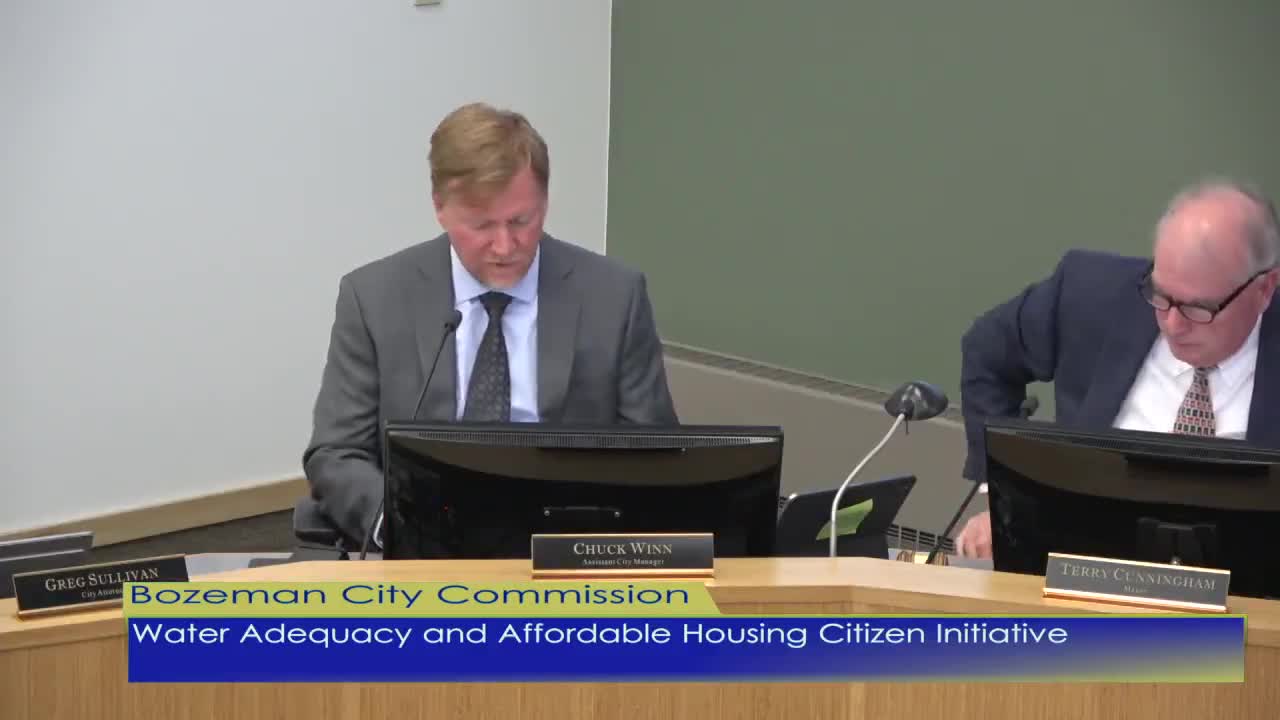
City officials and technical staff told the Bozeman City Commission on April 22 that a citizen-drafted water adequacy and affordable housing initiative circulating for signature could have the opposite effect of its stated goals: reducing housing production, raising prices, and encouraging development outside Bozeman where water and sewage use are often less efficient.
City Manager (name not specified) opened a staff presentation noting the initiative links two complex topics — water supply and housing affordability — and said the city had invited the initiative authors to present but they declined. Greg Sullivan, the city attorney, and senior staff then outlined legal, technical and operational concerns.
Sullivan said the city attorney’s office reviewed the initiative for the narrow, ministerial requirements tied to citizen petitions (single‑subject and ballot statement drafting) and forwarded it to the elections administrator, but did not complete a deeper legal analysis of how the measure would interact with the Unified Development Code or state law. He flagged technical terms in the initiative — including references to “deed restrictions” and a 99‑year restriction period — that may not translate cleanly into Montana land‑use practice and could require additional municipal legislation or administrative rules if the measure passes.
Utilities Director Sean Coats told the commission Bozeman currently holds about 16,500 acre‑feet of legal water rights and uses roughly 43% of that in a normal water year; in a 1‑in‑50‑year drought the city would be using about 60% of its supply. Coats said the city tracks approved but unbuilt development demand at about 993 acre‑feet and that the city’s five‑year capital plan anticipates adding roughly 1,575 acre‑feet of supply. He said Bozeman’s per‑person water use is lower than many comparably sized Western cities and that the city uses a mix of conservation, cash‑in‑lieu payments and acquisition of supply to meet growth.
City staff explained the initiative would limit developers’ ability to use off‑site conservation or other demand‑reduction measures, and would require developments of three or more residential units to provide 33% of units as deed‑restricted affordable housing (at 120% AMI for ownership or 60% AMI for rentals). That change, staff said, would effectively eliminate the cash‑in‑lieu option for many projects and force developers either to bring costly, time‑consuming water rights and infrastructure to each project (a process that can take three to eight years) or to build outside city limits where municipal systems and conservation measures are not required.
David Fine, the city’s housing and economic development manager, told the commission the city’s recent affordable housing ordinance had been modeled on feasible targets and incentives; by contrast, he said the 33% target in the initiative is substantially higher than what market and subsidy tools typically yield without major public subsidy. Fine noted the community has produced zero completed units tied to the new affordable housing ordinance so far because projects take multiple years to deliver, but he said pipeline projects will begin to appear in the coming months. He said most deeply affordable rental projects in Bozeman have relied on layered subsidies such as low‑income housing tax credits or tax increment financing.
During the staff presentations and the Q&A that followed, commissioners pressed staff on specifics: how much of single‑family water demand is lawn irrigation (staff said irrigation drives about half of single‑family household outdoor use), how the cash‑in‑lieu rate is set (the city currently uses $6,000 per acre‑foot as a working figure), and whether the initiative would be allowed under state law (Sullivan said the 2021 House Bill 259 narrowed municipal authority on inclusionary zoning but does not clearly bar a citizen initiative on housing type requirements; other legal questions would require deeper review).
Public commenters and community groups were split. The Southwest Montana Building Industry Association, the Gallatin Association of Realtors and others urged rejection of the initiative, arguing it would act as a de facto moratorium on many infill and multifamily projects, remove the city’s most efficient tool to acquire supply, and push sprawl and septic systems into the county. Supporters and petition organizers, including members of the Ward working group, said they brought the initiative because voters deserve a voice on how a finite resource is allocated and because existing policies are not producing housing affordable to many local workers.
Commissioners did not take formal action at the meeting. Several commissioners and the city manager said they would welcome continued dialogue with citizen groups and noted the office of the city attorney stands ready to advise the commission on options if the measure qualifies for the ballot. Staff said it will continue work on the integrated water resources plan, update water‑supply and housing analyses, and provide additional briefings and draft implementation options should the initiative move forward.
Why it matters: Bozeman staff told the commission that tying a high mandatory affordability requirement to the city’s water adequacy rules would add time, cost and legal uncertainty to development approvals, which staff say are likely to reduce — not increase — the total number of new units produced inside city limits. That dynamic would affect housing supply, municipal budgets and long‑term water‑quality outcomes because development driven outside the municipal service area tends to rely on individual wells and septic systems rather than municipal treatment and consolidated water‑use planning.