Get Full Government Meeting Transcripts, Videos, & Alerts Forever!
Get email alerts on the Tenant Counsel topic
No spam. Unsubscribe anytime.
Bozeman commissioners direct staff to develop tenant right-to-counsel options; seek narrow, data-driven pilot
Summary
At a lengthy May 13 work session the commission asked staff to return with program options, funding scenarios and stakeholder outreach plans for a tenant 'right to counsel' program — with commissioners generally favoring an initial focus on eviction prevention, city-limited scope and prioritized eligibility such as families with dependents.
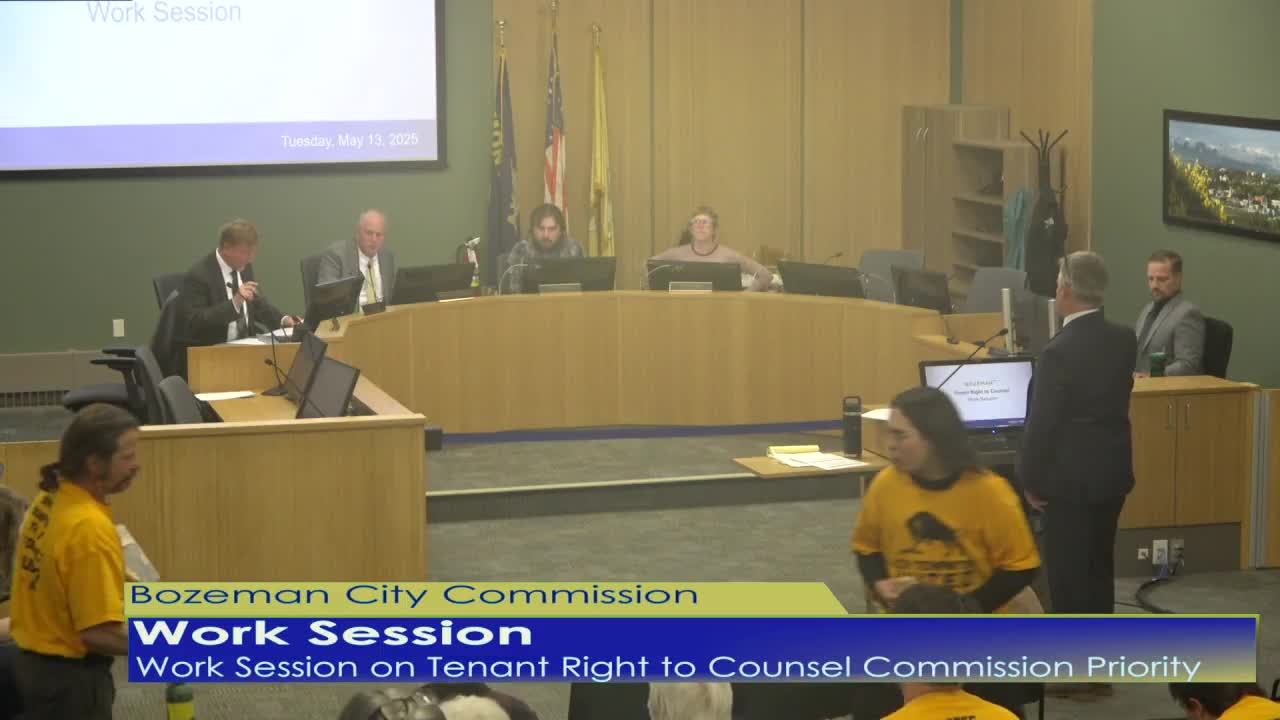
The Bozeman City Commission on Tuesday opened a wide-ranging work session on a tenants "right to counsel," asking staff to develop program options, cost estimates and community outreach plans and to return this fall with recommended models and budgets.
City Attorney Greg Sullivan and attorney Anna Sabarude briefed the commission on the legal background, options used elsewhere and how a local program could be structured. Sullivan emphasized Montana has no court- or statute-based constitutional right to counsel in possession or eviction proceedings: "Important for tonight is that there has not been established a constitutional either through the courts or statutory right to counsel for tenants in type of possession and eviction proceedings in Montana," he said, adding cities can create locally funded programs that permit tenants to access city-supported legal services so long as the program does not attempt to halt or substitute statutorily mandated processes.
Why it matters: Local right-to-counsel programs have been adopted in several states and cities as a tool to prevent evictions and reduce the downstream costs of homelessness. Commissioners said they want a practical program that prevents evictions and keeps families housed while avoiding unintended consequences for smaller, local landlords.
What staff presented: Anna Sabarude summarized program types used nationally: codified "right to counsel" ordinances (the highest-tier model), access-to-counsel programs (city-funded legal services without embedding an enforceable statutory right) and a range of eviction-prevention alternatives including rental-assistance grants, mediation, eviction diversion and tenant education. "What we're referring to is any law, enacted by a state or local government that codifies the right to a tenant within their jurisdiction to receive an attorney, at the cost of the government," Sabarude said when defining the codified model.
Local case data: Staff reviewed 2023–2024 Gallatin County Justice Court filings to show local scale and patterns. In 2023 the county recorded 191 landlord–tenant actions; 115 involved Bozeman properties. Of the 111 landlord-initiated cases in the city, staff reported 94 involved nonpayment of rent; average back rent in filings was roughly $4,800 in 2023. Staff said 87–95% of landlords in those cases were represented by counsel while a small fraction of tenants were represented (under 1%). The staff presentation also flagged statutory considerations, including that Montana requires certain corporate landlords to be represented by counsel in justice-court filings.
Commission guidance and consensus points: Commissioners agreed on several principles to guide staff work: (1) make housing stability and eviction prevention the primary goal; (2) focus first on city-limited eligibility and use program tiers or prioritization to maximize impact given budget constraints (multiple commissioners suggested prioritizing tenants with dependents or families as a first phase); (3) include data collection and reporting requirements to measure outcomes; and (4) explore non-tax funding sources (CDBG, HUD eviction-prevention grants, ARPA) before leaning on property-tax increases. Commissioners expressed interest in adding mediation or eviction-diversion elements to any program to get help to tenants before formal court filings.
No formal decision yet: Commissioners provided directional approval for staff to draft options. The commission did not adopt code language or commit to a funding source: staff were asked to return with a menu of options (pilot-access models and an ordinance-based model), budgets, provider procurement options and recommended eligibility thresholds.
Public comment: More than 80 people spoke during the work session. Speakers included tenants, tenant-organizers (Bozeman Tenants United), landlords and advocates: comments reflected deep division and personal testimony. Tenant advocates urged immediate action to prevent homelessness and asked the commission to fund full representation for tenants; landlords raised concerns about fiscal impacts and urged protections for small "mom-and-pop" landlords. Several speakers suggested tailoring eligibility (for example, prioritizing families with minors) as a practical compromise.
Next steps: Staff said they will conduct stakeholder outreach (judges/justices of the peace, MLSA, HUD/HRDC, tenant groups, landlord organizations), prepare program options with cost estimates and expected outcomes, and return to the commission for policy direction and funding decisions this fall.