Get Full Government Meeting Transcripts, Videos, & Alerts Forever!
Get email alerts on the Historic Preservation topic
No spam. Unsubscribe anytime.
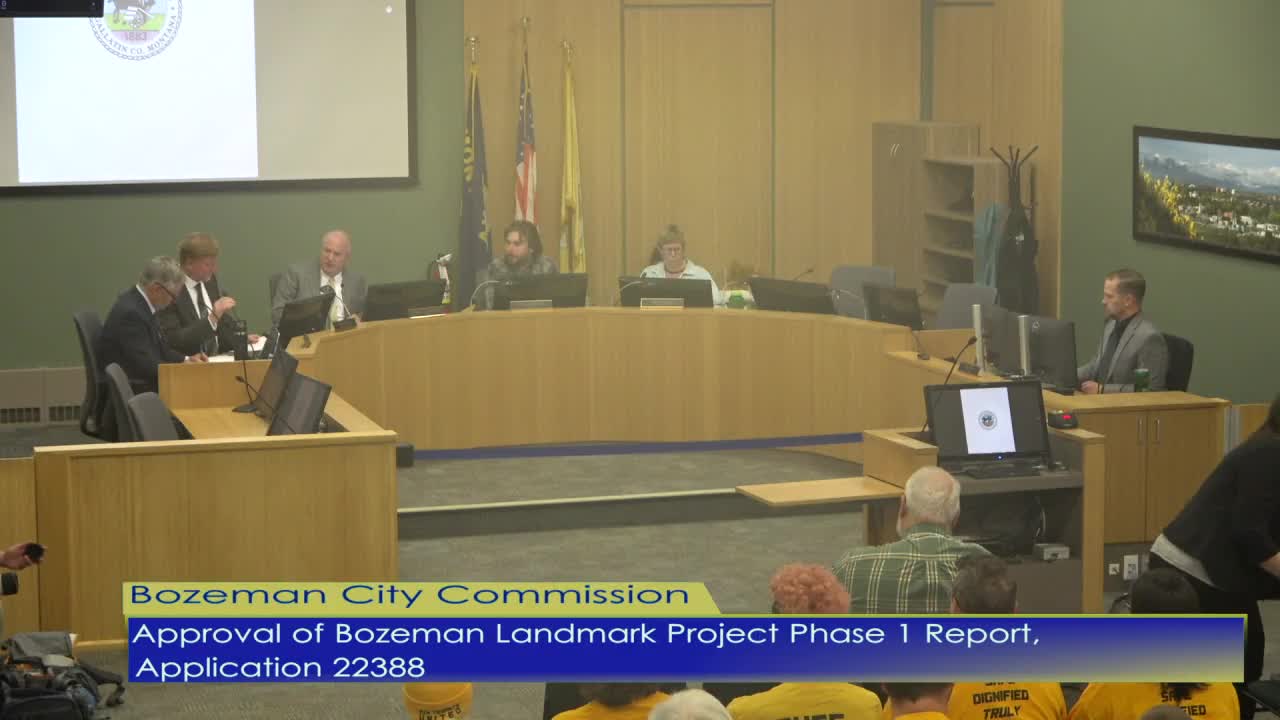
Bozeman commission adopts Phase 1 of landmark project, directs code and guideline work in Phase 2
Summary
The Bozeman City Commission voted 4-0 to adopt the Phase 1 report for the Bozeman Landmark Project, backing the Historic Preservation Advisory Board's recommendations to move the design-guideline overhaul into Phase 2 and to postpone any NCOD boundary changes until after code and guideline updates.
The Bozeman City Commission voted unanimously Tuesday to adopt the Phase 1 report for the Bozeman Landmark Project, allowing staff to start Phase 2 work this summer to draft code changes and update design guidelines.
The Phase 1 report, compiled by consultant Community Planning Collaborative and presented by Community Development Director Erin George and consultant Adrienne Burke, summarizes public engagement, historical surveys and recommendations for updating the Neighborhood Conservation Overlay District (NCOD), revising certificate-of-appropriateness processes and creating a citywide local landmark program. Erin George told the commission the "phase 2 recommendations will be implemented this summer and then future recommendations are for further out and they're dependent on other actions first or additional funding."
Why it matters: The report sets policy direction that will shape how Bozeman identifies and protects historic and cultural resources citywide. Commissioners and advisory boards emphasized that adoption of the report does not itself change code — Phase 2 will draft ordinance language and the design guideline overhaul needed to implement the recommendations.
Most important items and next steps: Consultants recommended updating Section 38 3 40 of the Unified Development Code (UDC) to clarify certificate-of-appropriateness (COA) standards, rework demolition review (including the city’s existing two-year demolition stay), create a local landmark program that can recognize cultural landscapes and sites beyond architecture, and fully update the NCOD design guidelines adopted in 2006. "Certificate of appropriateness is a term that's utilized across the country basically in other words it's a preservation permit," Burke said while explaining the COA process and how it differs from zoning. Staff told the commission they will bring a contract extension to the consent agenda to fund Phase 2 and a separate contract for a historic preservation architect to rewrite the design guidelines.
Public engagement and scope: Consultants reported roughly 292 full survey responses and a mapping tool that collected more than 125 community-identified places of value, including landscapes and cultural sites. The report and advisory-board feedback emphasized widening preservation beyond architecture to include cultural resources and heritage landscapes such as "Pete's Hill" and Bozeman Creek.
Board recommendations and commission action: The Historic Preservation Advisory Board (HPAB) recommended two specific amendments: move the full design-guideline overhaul into Phase 2 and delay any NCOD boundary changes until after Phase 2 code and guideline updates. Community Development Board members backed HPAB’s changes. Commissioner Fisher revised his motion to explicitly include those advisory-board recommendations; the commission approved the amended motion 4-0. The formal motion recorded was to adopt the Phase 1 report as submitted with the HPAB/CD board amendments; Commissioner Fisher moved and the motion carried unanimously (Commissioners Fisher, Bodie, Morrison and Mayor Cunningham voted "Aye").
Debate and concerns: Commissioners and advisory-board members repeatedly underscored the need to distinguish what belongs in the UDC (zoning prescriptions such as height, setbacks and mass) from what should be in design guidelines (style, materials and flexible approaches). Commissioners asked staff to ensure the UDC rewrite underway addresses mass, scale and transitions that residents have raised in recent months. Consultants warned that wholesale elimination of the NCOD in favor of local historic districts would be premature without first creating a viable local district process.
Implementation timeline and costs: Staff and consultants outlined a target to begin Phase 2 in early June and complete it by the end of 2025, while acknowledging scope and staffing needs could push some work into 2026. The report’s implementation table (page 86 of the report) uses short-, mid- and long-term labels; staff said a contract extension for the consultant and hiring a historic-architecture specialist are next steps.
What commissioners asked staff to do next: Commissioners asked staff to (1) return with the Phase 2 scope and contract extension on consent; (2) hire an architect with historic-preservation experience to rewrite design guidelines; (3) bring possible NCOD boundary amendments back only after Phase 2 code and guideline updates and a separate public hearing; and (4) coordinate with forestry on a heritage-tree program or fold that work into the landmark program.
Ending note: The staff presentation and the advisory boards framed the Phase 1 report as policy direction rather than final code language; commissioners approved adoption to allow Phase 2 ordinance drafting and community review to proceed.