Get Full Government Meeting Transcripts, Videos, & Alerts Forever!
Get email alerts on the Stormwater topic
No spam. Unsubscribe anytime.
Bozeman City Commission adopts 2025 stormwater facilities plan, adds vision paragraph
Summary
The Bozeman City Commission adopted a comprehensive 2025 Stormwater Facilities Plan after public comment and a late amendment adding an explicit watershed-stewardship goal. The plan outlines priorities for post-construction maintenance, pipe replacement, water-quality projects and next steps toward funding and implementation.
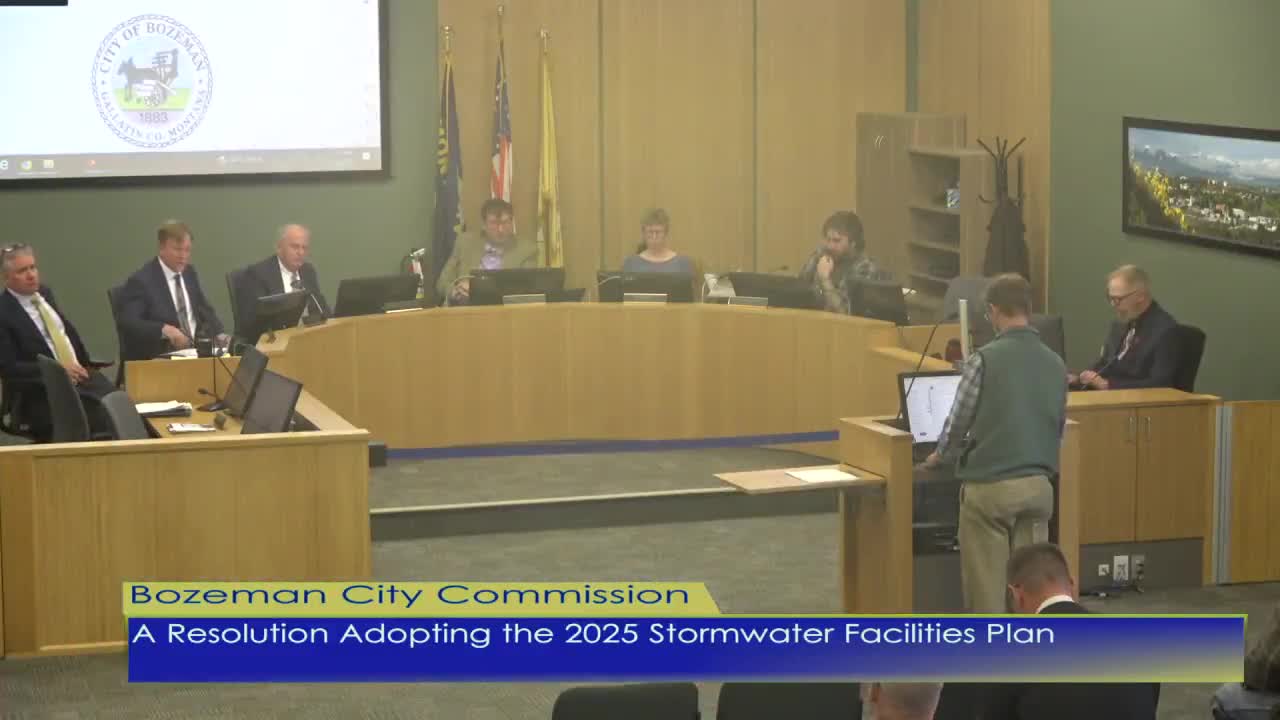
The Bozeman City Commission on Tuesday adopted the 2025 Stormwater Facilities Plan, a comprehensive update that sets priorities for pipe replacements, post-construction pond maintenance and watershed-scale water-quality projects.
The plan, developed by the city’s stormwater division and consultants, lays out policy, a prioritized capital-improvement list, and a recommended program of inspections and maintenance to meet state MS4 permit requirements. Commissioners voted 4-0 to adopt the plan after adding a short, goal-level introductory paragraph — inserted at the commission’s request — that states the city’s commitment to manage stormwater so that water flowing out of the city is “as clean as or cleaner than when it flowed in.”
Adam Oliver, the city’s stormwater program manager, told the commission the 2025 plan updates precipitation and pipe modeling, inventories aging clay pipe (some segments are more than a century old), and quantifies deferred maintenance across different asset types. Oliver said the city has installed 29 water-quality treatment projects and replaced or lined about five miles of pipe since staff capacity grew in the mid-2010s.
The plan identifies as top priorities establishing an inspection and maintenance program and an enforcement response for post-construction stormwater facilities — often called ponds — many of which are owned and maintained by homeowners associations, commercial property owners or the city. The draft notes at least 1,362 such facilities across the city, including roughly 495 associated with HOAs and 742 private commercial facilities.
Commissioners, staff and public commenters discussed whether the city should take over maintenance of some HOA ponds, how to prioritize limited funds, and how to incorporate natural systems and climate resilience into designs. Oliver said other cities have taken over HOA-maintained ponds when pools serve more than one lot, but that doing so requires space, equipment and funding and would be a policy decision for the commission.
Members of the Gallatin Watershed Council urged the commission to include clearer, vision-level language in the plan to prioritize nature-based solutions, wetland protection and watershed-scale thinking. The commission approved an amendment to add such a paragraph before voting on the full plan.
The resolution instructs staff to begin implementing the plan’s initial steps, including developing inspection/maintenance frequencies for post-construction features and preparing a needs-based assessment that could support a later rate study or capital-funding strategy. The plan does not itself establish new rates; commissioners asked staff to return with options for funding and further community engagement.
Public commenters included representatives of watershed and neighborhood groups who supported stronger emphasis on natural treatment systems and clearer outreach to HOAs; the city said it would use staff time and public-facing resources to expand technical assistance.
Commissioner John Fisher moved to adopt the resolution; the motion was seconded and passed unanimously. An amendment adding the goal-level paragraph passed 4-0 before the main vote.