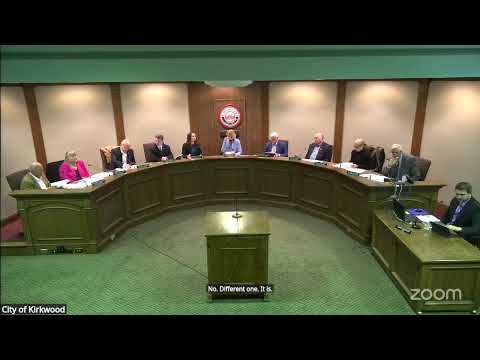
Kirkwood council hears FY 2025–26 budget; officials say reserves and grants will cover shortfall
Loading...
Summary
City Finance Director Mary Sprung presented a balanced proposed budget for fiscal 2025–26 that relies on reserves, grants and enterprise funds; councilors asked about debt service, a potential property-tax exemption for seniors and a planned water-rate increase.
City Finance Director Mary Sprung told the Kirkwood City Council during a public hearing that the proposed fiscal year 2025–26 budget is balanced in accordance with Missouri state statute and is available on the city’s website for public review.
The proposed budget includes total expenditures of $130,296,000, roughly $31,000,000 budgeted for capital outlay (about 24% of the total), $9,300,000 in grant revenues to offset capital costs, $6,300,000 appropriated for debt service payments and a reappropriation request of $1,929,060 for previously approved projects incomplete as of March 31, 2025. Sprung said federal and state grants for street improvements typically cover about 80% of project costs, with local funding covering the remainder.
Why this matters: the draft budget allocates funding across general city services, the electric fund and enterprise funds and uses a portion of reserves to cover gaps between recurring revenues and projected expenditures. Council members pressed staff for clarity on near-term revenue risks and service impacts.
Sprung said the budget process began in the summer, included department updates to five‑year capital plans, and was reviewed by the Citizens Finance Committee before being presented to council. “The proposed budget presented tonight is balanced in accordance with Missouri state statute,” Sprung said. She later confirmed that when general fund expenditures exceed revenues the difference is drawn from reserves: “The balance comes out of reserves.”
Council discussion focused on several items: the city’s $70,000,000 in outstanding obligations (described as COPs, interfund loans and capital leases), uncertainty tied to a recent change in property tax filing for homeowners 62 and older, and a planned water-rate increase. One council member noted that the new senior assessment filing process could reduce assessed values and tax collections, and Sprung said the city had not yet received any definitive estimates from the Missouri Municipal League or the county.
Council members also asked about enterprise funds and the finance department’s recent move to a cloud-based enterprise resource planning (ERP) system. Sprung and councilors described the ERP transition and staff turnover as a multi-year workload pressure that is now stabilizing as positions are refilled.
The public hearing was closed without public testimony. The council chair stated that the bill adopting the budget will appear on the council agenda for first-reading consideration on March 6, 2025.
Next steps: staff will bring the formal ordinance for first reading on March 6 and provide additional detail on revenue assumptions and the water-rate proposal at upcoming meetings.