Get Full Government Meeting Transcripts, Videos, & Alerts Forever!
Get email alerts on the Emergency Management topic
No spam. Unsubscribe anytime.
County emergency operations plan updated; council asked to allow county pre‑authorization to declare emergencies
Summary
Gaston County officials briefed the Gastonia City Council on a nearly four‑year revision to the county Emergency Operations Plan that formalizes 15 Emergency Support Functions, adds active‑violence and cyber sections, and requests municipal signatures to allow the county to declare emergencies on municipalities’ behalf to speed response.
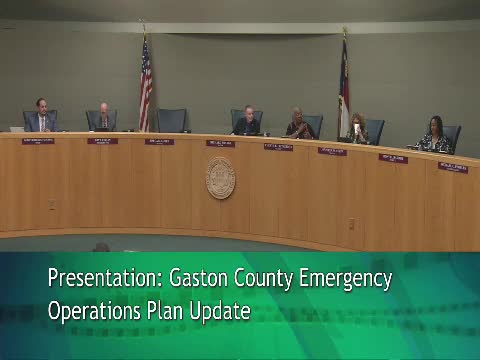
Gaston County emergency management officials presented an update April 15 on a multi‑year revision to the county Emergency Operations Plan and asked municipal leaders to authorize a phase of the plan that would allow the county to declare a state of emergency on behalf of participating municipalities when rapid action is necessary.
“Tonight we do want to provide you with an update on the county's emergency operations plan, which has been in the works for almost four years now,” said Scott Hunter, Gaston County Emergency Management Director and fire marshal, describing the plan as “the 30,000‑foot view” of county hazards, risks, prevention and response. Hunter said the plan is organized around 15 Emergency Support Functions (ESFs) and that the Emergency Operations Center (EOC) structure mirrors those ESFs so subject‑matter experts can manage requests and resource allocation during large incidents.
Hunter said the updated plan is reformatted for readability, adds an active‑violence section and will add a cyber‑terrorism section. He said the next step — “phase 2” — will ask mayors of participating municipalities to sign an agreement that lets the county “pull the red handle” and declare a state of emergency for all participating jurisdictions to speed response when time is critical. Hunter emphasized that municipal leaders retain the ability to rescind or modify any measures after a county declaration.
The council and staff asked operational questions using recent incidents as examples. In response to a question about a recent scrap‑yard fire, Hunter said the EOC was not activated for that response: “The emergency operations center was not activated ... the emergency was being managed on the scene,” though county coordination and tanker task forces were used to move water and resources as needed. City Assistant Fire Chief Matt Young said municipal and mutual‑aid resources — including water‑shuttling tanker task forces, aerial apparatus, drone units and HAZMAT support — operated together during the incident and that mutual‑aid partners came from neighboring jurisdictions.
Council members also asked how the county plan handles incidents involving nuclear plants in the region. Hunter said those events are tested annually with FEMA and would be coordinated through the ESFs for energy and HAZMAT, with utility companies and Duke Energy representatives participating.
Officials said the county will increase training tied to the National Incident Management System, expand written EOC deskbooks for each ESF so decision‑makers know expectations and responsibilities, and hold additional exercises so departments across municipalities are aligned.
No formal council action was taken at the meeting; staff said they will return with the phase‑2 signature agreement and additional materials for council review.