Get Full Government Meeting Transcripts, Videos, & Alerts Forever!
Get email alerts on the Dhs Budget And Policy topic
No spam. Unsubscribe anytime.
DHS seeks savings through pharmacy carve‑out, extends audio‑only telehealth and raises HMO surcharge
Summary
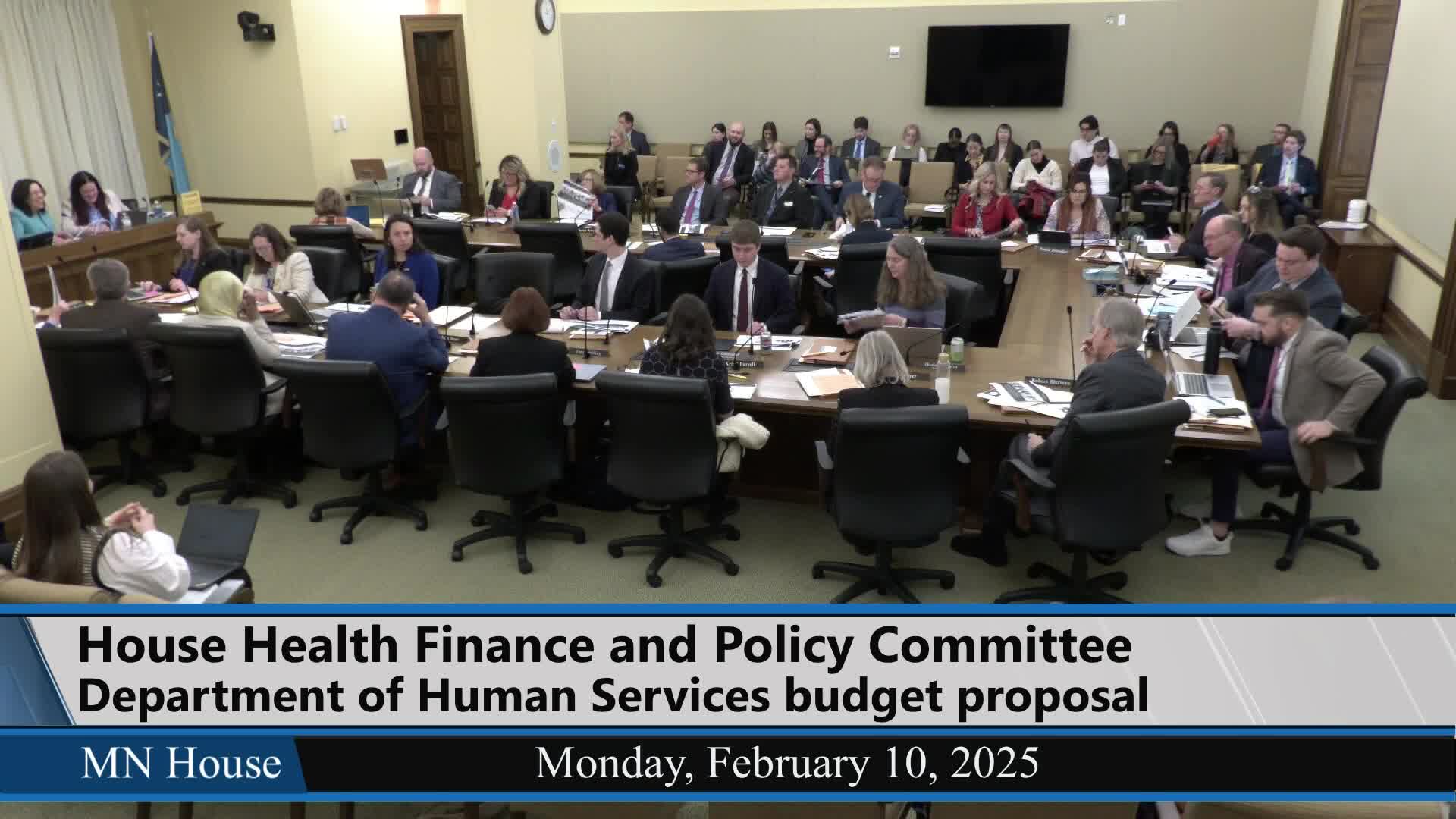
Interim Department of Human Services Commissioner Shereen Gandhi told the House Health Finance and Policy Committee on Feb. 10 that the governor’s budget seeks savings and program changes — including a pharmacy carve‑out, an extension of audio‑only telehealth to mid‑2027 and an HMO surcharge increase — intended to shore up program integrity and slow spending growth.
Interim Department of Human Services Commissioner Shereen Gandhi and DHS budget staff presented the agency’s fiscal proposals to the House Health Finance and Policy Committee on Feb. 10, framing a package designed to strengthen program integrity and limit forecasted spending growth.
“DHS directly impacts more than a quarter of all Minnesotans,” budget director Alyce Bailey told the committee while summarizing program scale and fiscal assumptions.
What DHS proposed
- Pharmacy carve‑out: DHS recommended carving outpatient prescription drugs out of managed‑care plans and covering them in fee‑for‑service so the state can access federal Medicaid prescription‑drug rebate revenues for drugs currently provided to patients through safety‑net providers and the 340B program. DHS estimated the carve‑out would yield roughly a 30% reduction in net drug spending on affected drugs by enabling access to rebate revenue that is otherwise unavailable when drugs flow through certain provider arrangements.
- Extend audio‑only telehealth: The governor’s budget would extend audio‑only telehealth access in Medicaid for two years (through 07/01/2027). Assistant Commissioner Conley told the committee that the department’s 2024 study and remote‑care experience support continued access, particularly for rural residents who lack broadband or reliable transportation.
- HMO surcharge and Health Care Access Fund share: DHS proposed raising the HMO surcharge from 0.6% to 1.25% of premium revenue and increasing the Health Care Access Fund share of Medical Assistance by $25 million to shift some state share from general funds to the dedicated fund.
- Non‑emergency medical transportation (NEMT): DHS proposed moving to a single NEMT administrator to gain uniformity and oversight; the department estimated a vendor model at roughly $3 per member per month and said it would improve rate negotiation and program visibility.
- Other items: DHS proposed extending the drug formulary committee’s authorization, clarifying encounter‑rate methodology for FQHCs after mergers, and identified elimination of the chiropractic benefit as an optional change to reduce spending.
Scale and context
DHS staff described a fiscal 2026 all‑funds budget of about $24 billion and said roughly 54% of DHS funding comes from federal sources. The Medical Assistance (Medicaid) program accounted for the largest share of spending; staff said about 1.3 million Minnesotans were enrolled in Medicaid in FY24 and that long‑term care (nursing homes and waivers) represented about 40% of Medical Assistance dollars. Deputy and budget staff told the committee that the governor’s package is projected to achieve roughly $575 million in savings across the four‑year forecast through a combination of structural changes and targeted reductions.
Lawmakers pushed back on specifics and equity concerns
Committee members asked detailed questions about the pharmacy carve‑out, telehealth extension, the proposed HMO surcharge and the elimination of the chiropractic benefit. Representatives raised concerns about access for Greater Minnesota if services are carved out or benefits removed, and several members requested county‑level or program‑level data on telehealth use, Medicaid enrollment shifts after the federal “unwinding” and which populations would be affected by benefit changes.
Representative concerns included: whether audio‑only telehealth is replacing local capacity or addressing provider shortages in rural areas; how 340B and rebate mechanics would interact with provider revenue; and whether eliminating optional benefits like chiropractic care would shift costs or care patterns for people who use those services for pain management.
DHS responses and follow‑ups
DHS staff said the 340B/rebate interaction is the key driver of the pharmacy carve‑out savings and that savings would materialize because the state would access federal Medicaid rebate revenue rather than paying full managed‑care prices for certain drugs. Staff also said the audio‑only telehealth extension was supported by the department of health’s study and that the extension was intended to remain in place through mid‑2027 to allow further evaluation.
On federal funding risk, DHS officials said they are monitoring federal developments and have internal contingency planning teams; they emphasized that the agency’s large federal match share (54%) creates fiscal uncertainty if federal policy shifts.
What the committee did not decide
No committee votes were taken; DHS’s presentation was informational and several members asked for follow‑up materials, including geographic breakdowns of telehealth use, data on reenrollment after the Medicaid “unwinding,” and technical details on how the pharmacy carve‑out and rebate access would work in practice.
Next steps
DHS staff offered to supply the committee additional program‑level data and technical briefings. The proposals will require statutory changes and negotiation during the legislative budget process.