Get Full Government Meeting Transcripts, Videos, & Alerts Forever!
Get email alerts on the Born Alive Protections topic
No spam. Unsubscribe anytime.
Committee approves born‑alive protections after contested hearing with medical groups opposed
Summary
House File 24, a two‑sentence bill clarifying that infants born alive after an attempted abortion must receive medically necessary care, was recommended to pass by the Health Finance and Policy Committee on Feb. 12 by an 11–10 vote after testimony from survivors, anti‑abortion groups and medical organizations opposing the measure.
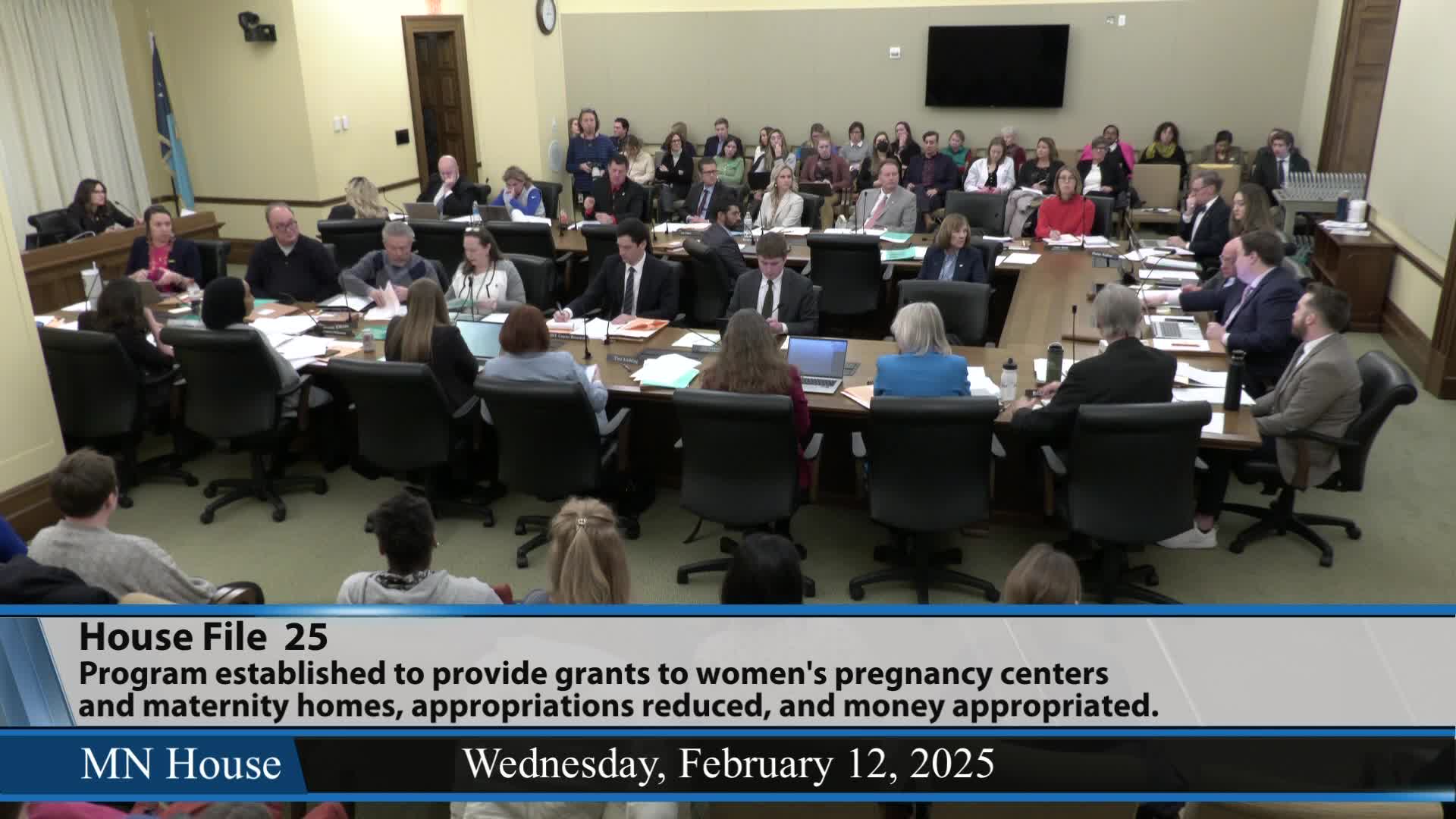
The House Health Finance and Policy Committee on Feb. 12 recommended passage of House File 24, a bill requiring that an infant who is born alive after an attempted abortion be recognized as a person and receive medically appropriate life‑preserving care. The recommendation passed on a roll call vote of 11–10.
Supporters described the bill as a narrow measure to ensure that infants who survive an attempted abortion receive life‑saving medical treatment and reporting. Renee Carlson, general counsel for True North Legal (a project of the Minnesota Family Council), said Minnesota Department of Health records show infants born alive after unsuccessful abortion attempts and argued existing law lacks clarity. Kathy Blaser of Minnesota Citizens Concerned for Life said prior statutory language dated to 1976 and earlier reporting showed ‘‘3 to 5 born‑alive survivors’’ reported in multiple years.
Several individuals who said they survived failed abortions gave in‑person or remote testimony describing their births and urging passage. Sarah Zivorski (remote) recounted being born in New Orleans after a failed induction abortion in 1990 and said her birth mother fought hospital staff to secure care; another testifier, Mikaela Clay, said she was born alive during a failed vacuum aspiration in Saint Paul in 1979.
Medical groups and an OB‑GYN testifying on behalf of the American College of Obstetricians and Gynecologists (ACOG) opposed the bill. Dr. Erin Stevens, an OB‑GYN and legislative chair for ACOG’s Minnesota section, said bills like this arise from misinformation and can interfere with complex clinical decision‑making at the end of pregnancy. Stevens said the bill could force ‘‘fruitless medical interventions’’ and remove choices for patients and clinicians in cases involving severe fetal anomalies or life‑threatening conditions for the pregnant person.
Other physicians and some testifiers described scenarios in which families with a diagnosis incompatible with life choose induction or other routes to have a short time with an infant. Opponents argued that requiring mandatory measures in statute could override patient‑centered palliative care and clinician judgment, and could remove the ability of families to hold a baby who will die shortly after birth.
Committee members pressed authors and witnesses on the bill’s scope and drafting. Representative Ryan Elkins asked whether the bill would require resuscitation or transfer of infants with conditions such as Potter syndrome; author Representative Jennifer Knudson said the bill applies to any infant who is born alive after an abortion attempt and should be provided medically necessary care. Representative Tina Liebling warned that the bill’s narrow focus on infants born after abortions could unintentionally exclude other infants from the broader protections currently in statute.
Despite the close vote, the committee approved the bill and it will move forward in the legislative process. Supporters called the bill a clarification that protects newborns; opponents urged a vote against the bill as written and encouraged more focused language that would not interfere with medical decision‑making or palliative choices in complex perinatal cases.