Get Full Government Meeting Transcripts, Videos, & Alerts Forever!
Get email alerts on the Public Health Funding topic
No spam. Unsubscribe anytime.
MDH asks Legislature to replace federal COVID-era funding, raise fees to sustain drinking water, licensing and inspections
Summary
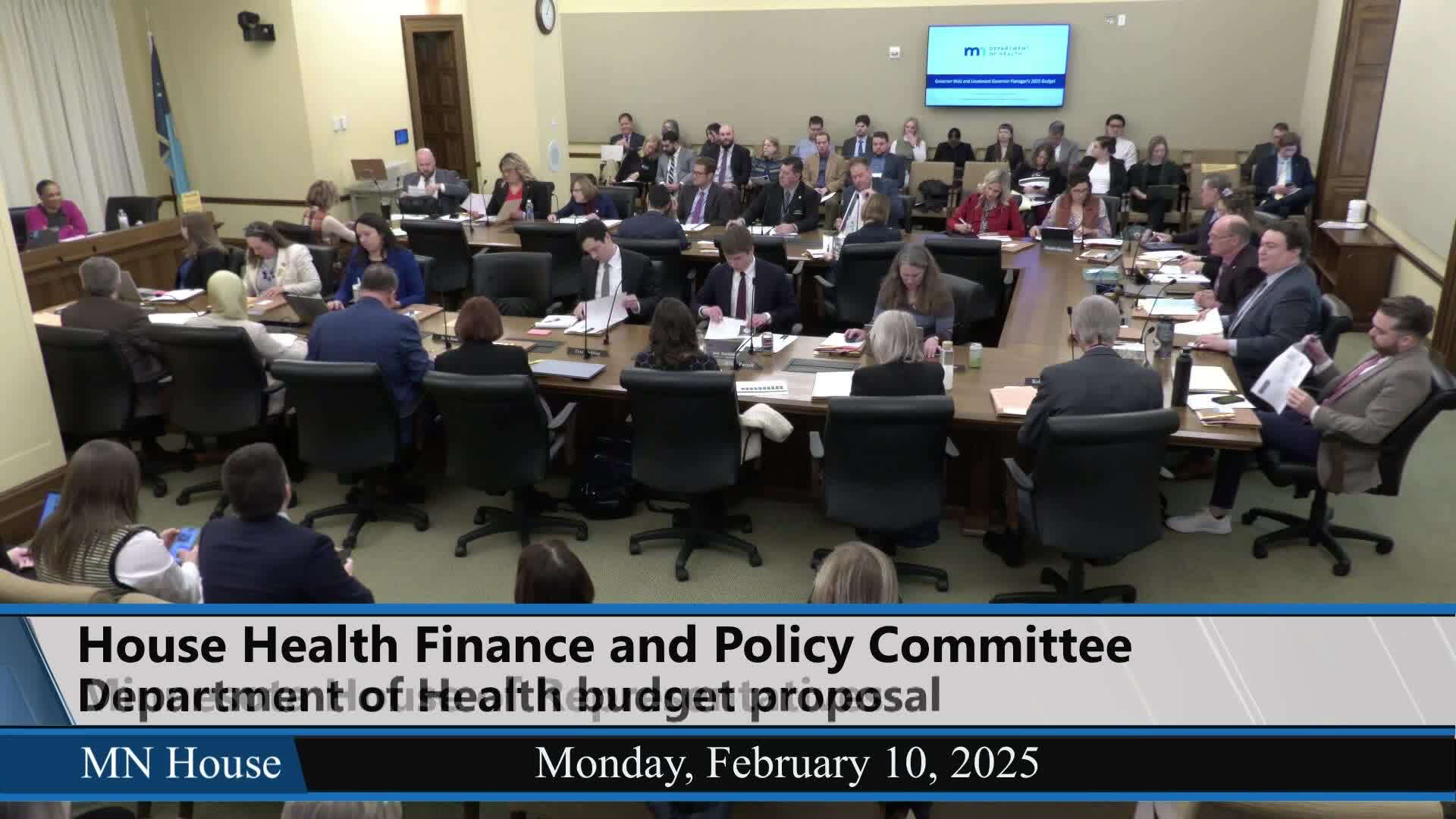
Minnesota Department of Health Commissioner Brooke Cunningham told the House Health Finance and Policy Committee on Feb. 10 that the department needs new state funding to replace federal COVID-era dollars and additional fee authority to sustain core public-health services.
Minnesota Department of Health Commissioner Brooke Cunningham told the House Health Finance and Policy Committee on Feb. 10 that the department needs new state funding to replace federal COVID-era dollars and additional fee authority to sustain core public-health services.
“Our mission is to protect, maintain and improve the health of all communities,” Cunningham said as she summarized MDH proposals in the governor’s budget package.
Cunningham told lawmakers that MDH is seeking two general‑fund cost proposals, several fee increases and a smaller operations adjustment to cover rising personnel and operating costs. Chief items in her presentation included a request to compensate for an expected drop in federal infectious‑disease funding, increases to multiple licensing and inspection fees, and statutory changes affecting asbestos and X‑ray oversight.
Why it matters: MDH and local public‑health departments together handle drinking water protection, immunizations and outbreak response, newborn screening and other population‑level services. Cunningham said those services operate on a small fraction of overall state health spending — local public health accounts for about $400 million statewide compared with roughly $67 billion spent on health care — and that public‑health staffing per capita has declined in recent decades. She told the committee that about half of MDH’s public‑health funding comes from the federal government and that losing COVID‑era infrastructure funding would reduce the state’s ability to detect and respond to new infectious‑disease threats.
Major proposals described to lawmakers
- Infectious‑disease prevention and response: MDH asked the state to make up for reductions in federal funding that have supported testing, surveillance and outbreak response since COVID. Cunningham cited ongoing risks — from influenza and avian influenza to mosquito‑ and tickborne disease — and said an aging population and more congregate settings increase vulnerability.
- Drinking water and well fees: MDH requests fee increases for public water suppliers and well‑related services to offset a projected $60–$70 million reduction in EPA funding over the next three years and to update fees that have not kept pace with workload and cost. Cunningham said about 80% of Minnesotans rely on public water systems and roughly one‑fifth rely on private wells that need technical support.
- Licensing and inspection fees: The department proposes increases for assisted‑living licensure, engineering plan reviews for health‑care facility projects, HMO licensure, and a suite of environmental health fees (food, pools, lodging). MDH told the committee that some fee categories have not been revised for a decade or more and that workload and regulatory complexity have grown.
- X‑ray and radioactive materials oversight: MDH says licensing revenue for radioactive materials and X‑ray oversight has not kept pace with required federal and state oversight. The department proposed a statutory change to move from a fixed four‑year X‑ray inspection cycle to a risk‑based inspection schedule. MDH also requested authority to adjust radioactive‑materials fees to match federal requirements.
- Asbestos statute change: MDH asked for an amendment to Minnesota Statutes §326.72 to remove the word "intending" in a permitting provision; MDH said intent can be difficult to prove and the change would improve enforceability and fee collection.
- Fee collection and process changes: The department wants a statutory change to allow delegated local agencies to collect the statewide hospitality fee at licensing time, and other administrative changes to speed fee collection and inspections.
Budget‑neutral and other items
- MDH proposed several budget‑neutral changes, including eliminating sunset dates for advisory bodies: continuing the Early Hearing Detection and Intervention advisory committee, converting the maternal and child health advisory task force into an ongoing committee, and reauthorizing the State Trauma Advisory Council for 10 years.
- Tribal and community grants: The budget would restore $2.5 million to local and tribal grants for cannabis and substance‑misuse prevention (partially restoring a prior reduction) and allow the American Indian Health Special Emphasis grants to be awarded to tribes without competitive RFPs to reduce administrative burden on tribal governments.
- PFAS biomonitoring extension: MDH requested authority to extend the PFAS biomonitoring project for firefighters to complete the research timeline.
Operational request and risk
Cunningham described an operations adjustment to cover compensation, insurance, IT and legal costs; the package described by staff included an added operations request of roughly $2.4 million. She and staff told the committee that without fee increases and some state funding MDH’s ability to meet statutory inspection frequencies and to sustain technical assistance to local partners could erode. Tom Hogan, director of MDH’s Environmental Health Division, told the committee that well‑related fees are paid through property‑transfer mechanisms and that MDH is discussing automation with county recorders to reduce county burden: “those fees are not paid by the county, they are paid through the property transfer mechanisms,” Hogan said.
Lawmakers pressed for details on fee impacts and operations. Members asked for county‑level breakdowns of the $400 million local public‑health spend, line‑item detail for the food/pools/lodging fee increase (MDH staff said about $5.4 million in additional revenue would be generated and described how the money would be applied to inspections, credentialing and data systems), and specifics about assisted‑living enforcement and whether pandemic-era rules had altered survey expectations. Cunningham and MDH staff offered to follow up with written answers and technical staff.
What the committee did not decide
No formal action or votes occurred; the presentation was informational and committee members asked questions. MDH staff committed to follow‑up on specific data requests and statutory language clarifications.
Next steps
MDH said subject‑matter experts in the room would provide additional details on request and invited legislators to follow up. The committee will consider budget language and proposals through the usual appropriation process in the coming weeks.