Get Full Government Meeting Transcripts, Videos, & Alerts Forever!
Get email alerts on the Opioid Prevention Education topic
No spam. Unsubscribe anytime.
Committee lays over $500,000 request to expand school opioid prevention program
Summary
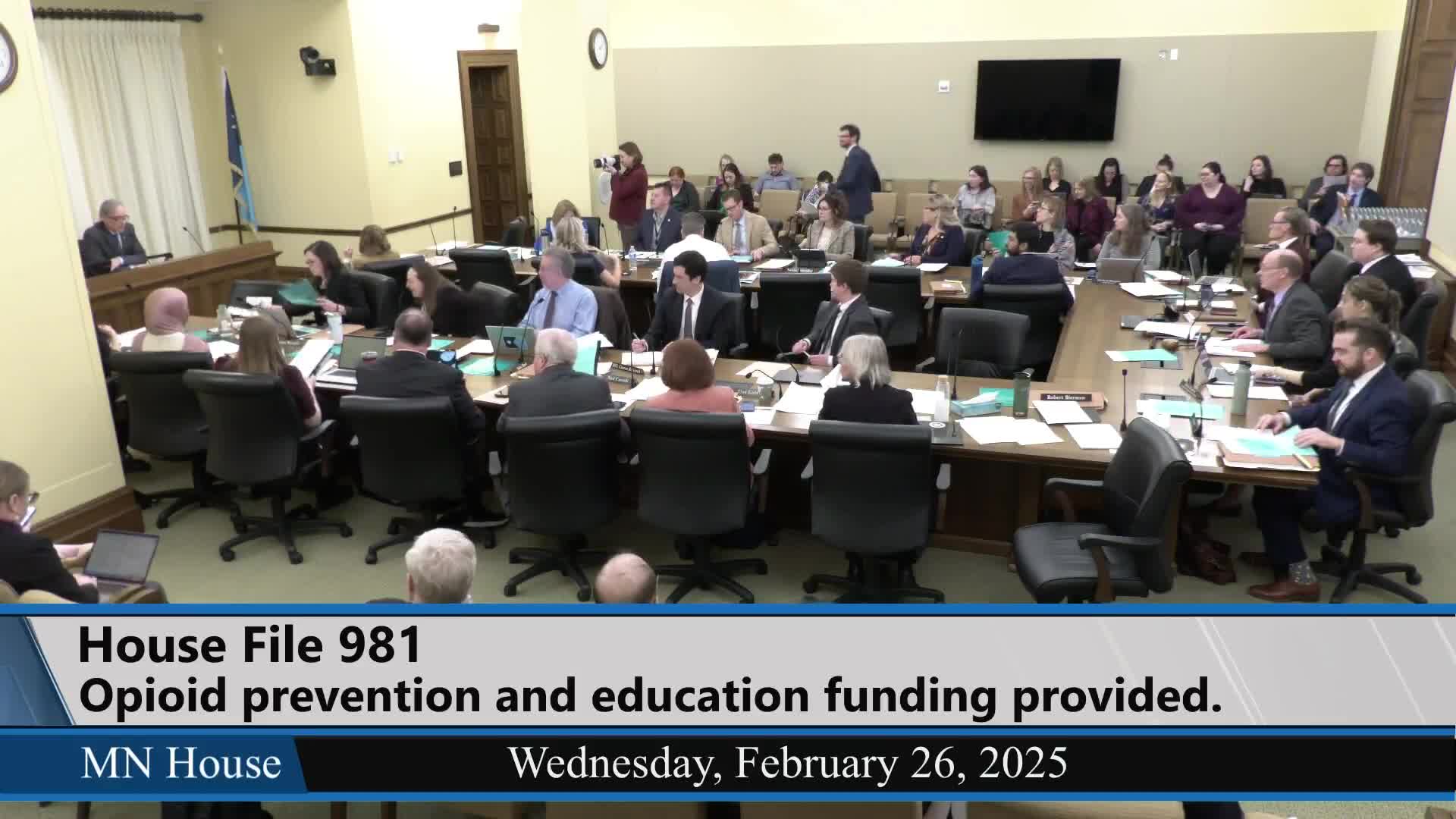
Representative Behrman presented House File 981 to appropriate $500,000 annually to Change the Outcome, a nonprofit that delivers youth opioid-prevention education in Minnesota schools; the committee laid the bill over for potential omnibus inclusion while members questioned funding sources and coordination with existing opioid-response dollars.
Representative Nolling Behrman introduced House File 981, proposing an annual $500,000 appropriation to Change the Outcome to expand opioid-prevention and overdose-response education in middle and high schools. "Education is a dreadfully under utilized tool in our fight against fentanyl in Minnesota," said Colleen Ronny, founder and executive director of Change the Outcome, who testified the nonprofit has reached more than 110,000 students and now serves roughly 140 schools during the current school year.
Change the Outcome staff described their classroom approach: a locally produced documentary followed by testimony from young adults with lived experience, paired with evidence-based information and pre/post surveys to measure impact. Director of programming Megan Wagner said student understanding on key topics increases "40 to 60 percent" after programming; outreach coordinator Sydney Hasted described frequent post-session requests from students for help and resources.
Committee members raised questions about funding sources and coordination. Representative Doe asked why general-fund dollars were requested rather than existing opioid-settlement or Opioid Epidemic Response Advisory Council (ORAC) funds. Witnesses said county and ORAC funding has been inconsistent by county and said Change the Outcome has applied for county funds with mixed success; staff described administrative burdens and said education is often a smaller funding category in ORAC allocations. Representative Bierman said ORAC and settlement dollars exist but argued the program should not wait for county-level processes and that statewide support would help scale the work.
Representatives also probed organizational capacity. Change the Outcome testified it has eight full-time staff, an annual budget of about $650,000 and is at capacity for the school year; committee members asked about sustainability beyond a single-year appropriation. After discussion the chair laid the bill over for possible omnibus inclusion or future consideration.