Get Full Government Meeting Transcripts, Videos, & Alerts Forever!
Get email alerts on the Collaborative Care Medicaid topic
No spam. Unsubscribe anytime.
Committee backs referral of bill to make collaborative care a Medicaid benefit
Summary
The Health Finance and Policy Committee voted to refer House File 958 to Human Services Finance and Policy after a hearing where clinicians urged making collaborative care a reimbursable Medicaid benefit.
Representative Ruth Nadal introduced House File 958, which would make the collaborative-care model a reimbursable Medicaid benefit in Minnesota and provide one-time start-up and training funding. She said the bill would allow specified providers to bill Medicaid using collaborative-care codes, establish a reimbursement rate and provide minimal start-up funding.
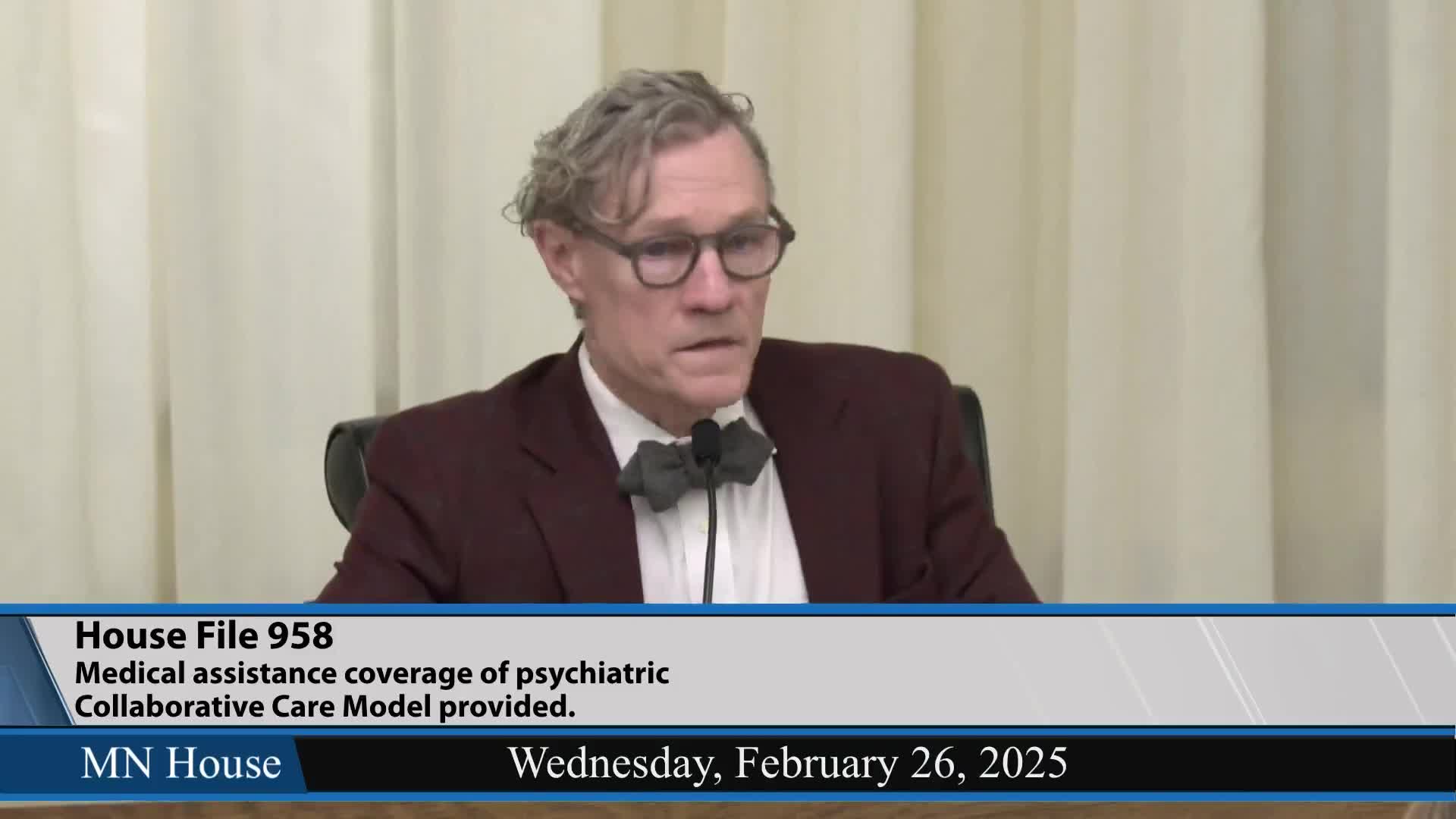
Multiple clinicians and health-system representatives testified in favor. Frank Chadwick, a clinical social worker at Hennepin Healthcare, said collaborative care is "an innovative care model" supported by randomized trials and used by Medicare and many commercial payers; he said 37 states already cover this model under Medicaid and that the aim was to make Minnesota the 38th. Kyle Darnell, a psychologist and CentraCare behavioral health director, and psychiatrist Michael Trangle described how collaborative care integrates behavioral-health clinicians and psychiatric consultants with primary care and highlighted workforce shortages in Greater Minnesota. "For rural healthcare, the collaborative care model isn't just about innovation... It is a necessity. It is a lifeline," Darnell said. Trangle described the psychiatrist's role in weekly case review and wrote that consulting in this model can cover dozens of patients in an hour compared with the low volume of traditional one-on-one visits.
Committee members asked about provider credentials, workforce capacity, telehealth and cost. Witnesses said the psychiatrist consultant can operate by contract and by telehealth and that the model depends on teams of behavioral-health care managers, often licensed social workers or counselors, supervising panels of patients.
Witnesses and sponsor referenced existing payment and coding arrangements: Medicare and many commercial plans reimburse collaborative care through designated CPT codes, but MinnesotaMedicaid did not at the time of the hearing, creating a barrier because many Medicaid patients currently receive services under grant-funded programs. Staff referenced Minnesota Statute 245I when discussing which licensed clinicians can render mental-health services.
Vice Chair Nadeau closed and asked for a fiscal note. The chair renewed the motion and the committee voted by voice to refer House File 958, as amended, to the Committee on Human Services Finance and Policy.