Get Full Government Meeting Transcripts, Videos, & Alerts Forever!
Get email alerts on the Parental Rights Health Records topic
No spam. Unsubscribe anytime.
Committee approves amendment, refers 'Parental Bill of Rights' after heated testimony and close roll call
Summary
The committee adopted an amendment to House File 22 and referred the bill to the Committee on State Government Finance and Policy after a close roll call of 11‑10 following testimony from parents, advocates and health officials.
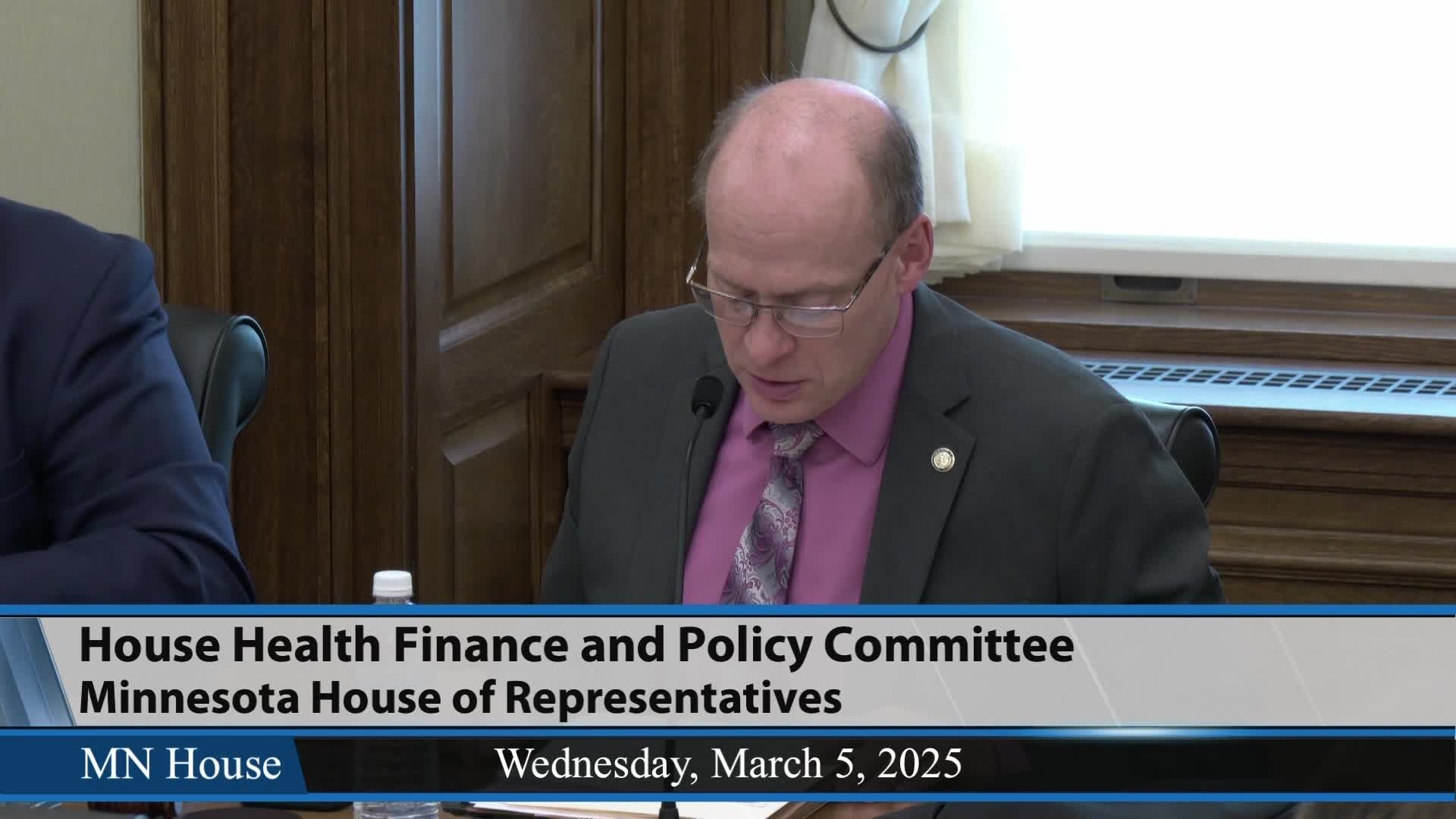
The Health Finance and Policy Committee on March 10 adopted an A5 amendment to House File 22, the so‑called Parental Bill of Rights, and then referred the bill to the Committee on State Government Finance and Policy after a roll call vote that passed 11‑10.
Representative Gilman, the bill author, described the measure as “the Parent Bill of Rights” and said the legislation “seeks to ensure the fundamental rights of parents … the intent of the bill is to love and support our kids while ensuring children receive the guidance and care they need at critical moments in their lives.” The A5 amendment, which the chair moved and the committee adopted, modifies when a parent can access a minor’s health records and requires providers to allow a parent to be in the examination room when a minor is receiving health services, while preserving statutory exceptions for emancipated minors or situations involving suspected abuse.
Several advocates testified in favor of House File 22. Matt Flanders of Citizens’ Council for Health Freedom said the organization “fully supports House File 22, which includes clear protections for parent and guardian rights, including … full access to medical records, consent rights for specimen collection, and more.” Dory Trossen, a parent who said her child has a rare autoimmune disease, described a hospitalization where she said hospital staff “didn’t believe that disease existed” and that staff continued to feed foods that triggered anaphylaxis, and urged lawmakers to support the bill so parents can “have a seat at the table.” Other supporters included Christina Barton, a licensed school counselor, and Abby Yost of Minnesotans for Health and Parental Rights.
Witnesses opposing or urging caution included Megan Beacham, who testified against the bill and described harms that can result when parents are not supportive. Wendy Underwood, deputy commissioner at the Minnesota Department of Health, told the committee the department has “grama concerns about the confidentiality challenges within this bill” (committee staff request to provide data and research was made). Underwood warned that confidentiality affects adolescents’ willingness to seek care for sensitive issues such as mental health, substance use or sexual health.
Committee members asked technical and legal questions about how the bill intersects with federal and state law. Representative Breyer and others raised HIPAA implications and whether the bill’s restrictions or requirements would conflict with federal privacy rules that allow providers in some cases to withhold a parent as a personal representative where disclosure could endanger a child. Representative Liebling and Representative Keeler asked whether the bill would alter existing newborn screening and blood‑spot retention practices; Wendy Underwood said the department would follow up with the committee on technical questions.
Representative Gilman acknowledged the concerns and said the bill includes standard exceptions (emancipated minors, minors living apart and suspected abuse) and said she would work with committee staff and stakeholders to refine language. She said emergency protocols and implied consent for EMS are not altered by the bill.
The committee adopted the A5 amendment by voice vote and later approved referring the bill, as amended, to the Committee on State Government Finance and Policy on a roll call of 11 yes and 10 no. The roll call recorded yes votes from Chair Bakker; Vice Chair Nadeau; Representatives DePel, Franson, Gilman, Knudson, Perryman, Rupinski, Schumacher, Van Binsburgen and Zalesnikar, and no votes from Representatives Bierman, Bonner, Carroll, Elkins, Hemmingsen‑Yeager, Hewitt, Liebling, Mahamud and Purcell and Reyer (the committee clerk recorded 11 yes, 10 no).
Committee members said they would continue to work on technical issues, including HIPAA compatibility, newborn screening rules and definitions such as “private area” and how privacy screens should be implemented in clinical settings.