Minnesota Board of Pharmacy seeks extended legal funding, higher spending authority and support for prescription monitoring program
Loading...
Summary
The Board of Pharmacy asked the Health Finance and Policy Committee to allow remaining one-time legal funds tied to a 2020 lawsuit to be used through fiscal 2027, to increase base spending authority to preserve staffing and operations, and to add recurring funds to maintain and expand the Minnesota Prescription Monitoring Program (PMP).
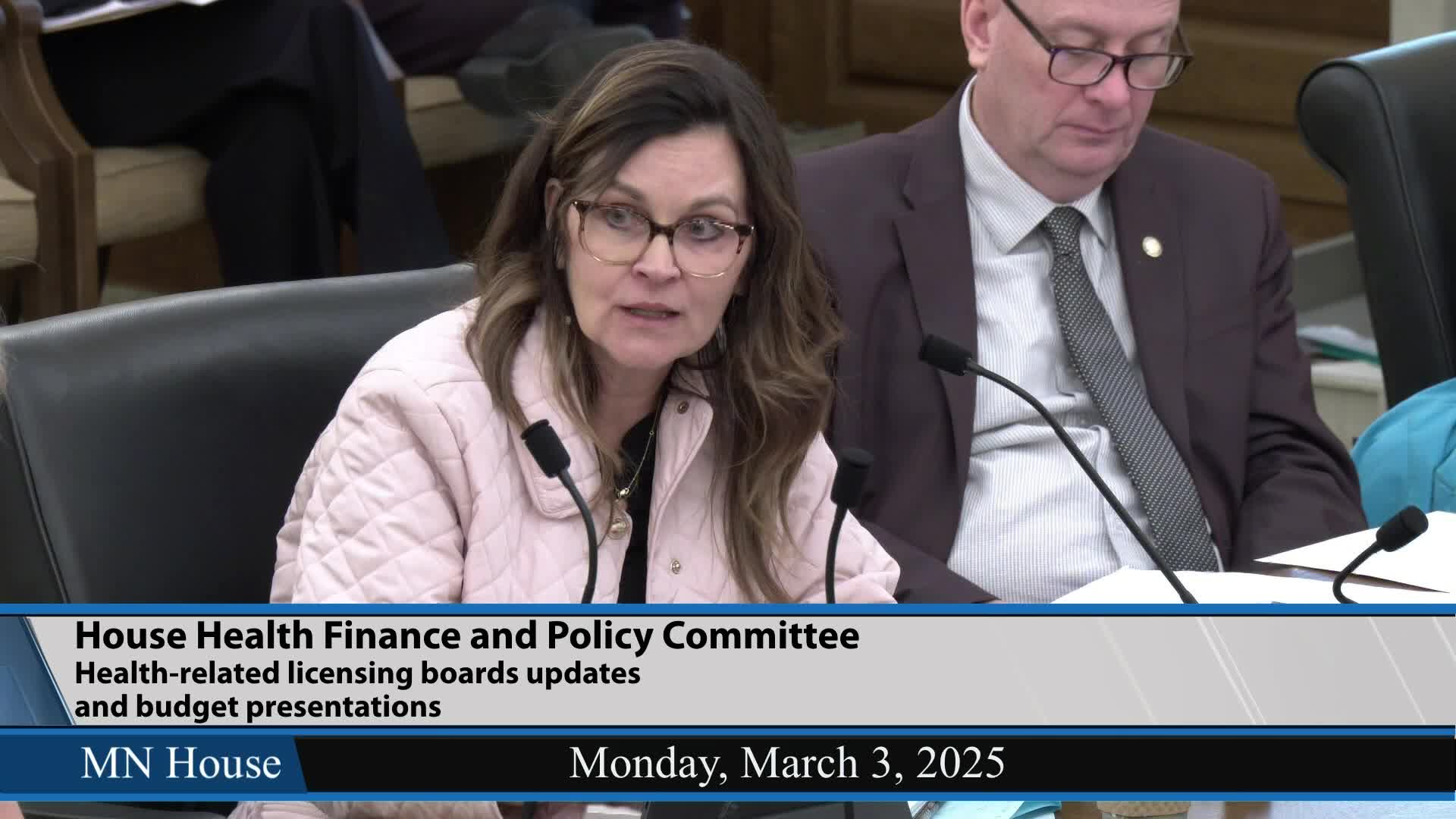
Deputy Director Katrina Howard and Controlled Substance Reporting Section Director Brock Reid testified March 3 that the Minnesota Board of Pharmacy needs permission to extend previously appropriated legal funds, an increase in base spending authority and additional recurring authority for the state’s prescription monitoring infrastructure.
Nut graf: The board said it received a one-time $1.5 million general fund appropriation in fiscal 2024 to cover legal expenses from litigation over the insulin safety net program (litigation identified in testimony as Pharma v. Williams). The appropriation currently expires on June 30, 2025; the board asked to use any remaining funds through fiscal 2027 as legal expenses continue. Separately, the board asked for approximately $1.2 million in additional annual spending authority for operations and a $150,000 annual increase dedicated to maintaining and expanding integrated access to the Minnesota Prescription Monitoring Program (PMP).
What the requests would do
- Extend the remaining one-time $1.5 million legal appropriation through FY2027 because litigation costs are ongoing. - Increase annual spending authority by about $1.2 million to cover rising MNIT IT charges (estimated $151,000/year), rule revision costs, and recent staff additions and backfills; the board noted fixed costs now consume roughly 84% of the current operational appropriation. - Add approximately $150,000 per year for the PMP to renew statewide integration licenses and remove barriers to integrated access for clinical software used by hospitals and providers. The board said integrated access accounted for more than 75% of PMP searches in 2024 and that providers performed about 7 million unique PMP searches in 2024.
Questions and clarifications: Committee members asked about who can access PMP data (direct clinical account holders; not general law-enforcement access through the clinical portal) and how the cost is spread among licensing boards; the board said the PMP appropriation has historically been allocated among the boards that license providers and the per-licensee share is small (roughly $2 or less per provider per year when spread across all licensing boards that contribute).
Ending: Board staff said they would provide further documentation and written fee tables in the committee packet. No committee action was taken at the hearing; the presentation will inform budget deliberations.