Get Full Government Meeting Transcripts, Videos, & Alerts Forever!
Get email alerts on the Hf337 Rural Ems Funding topic
No spam. Unsubscribe anytime.
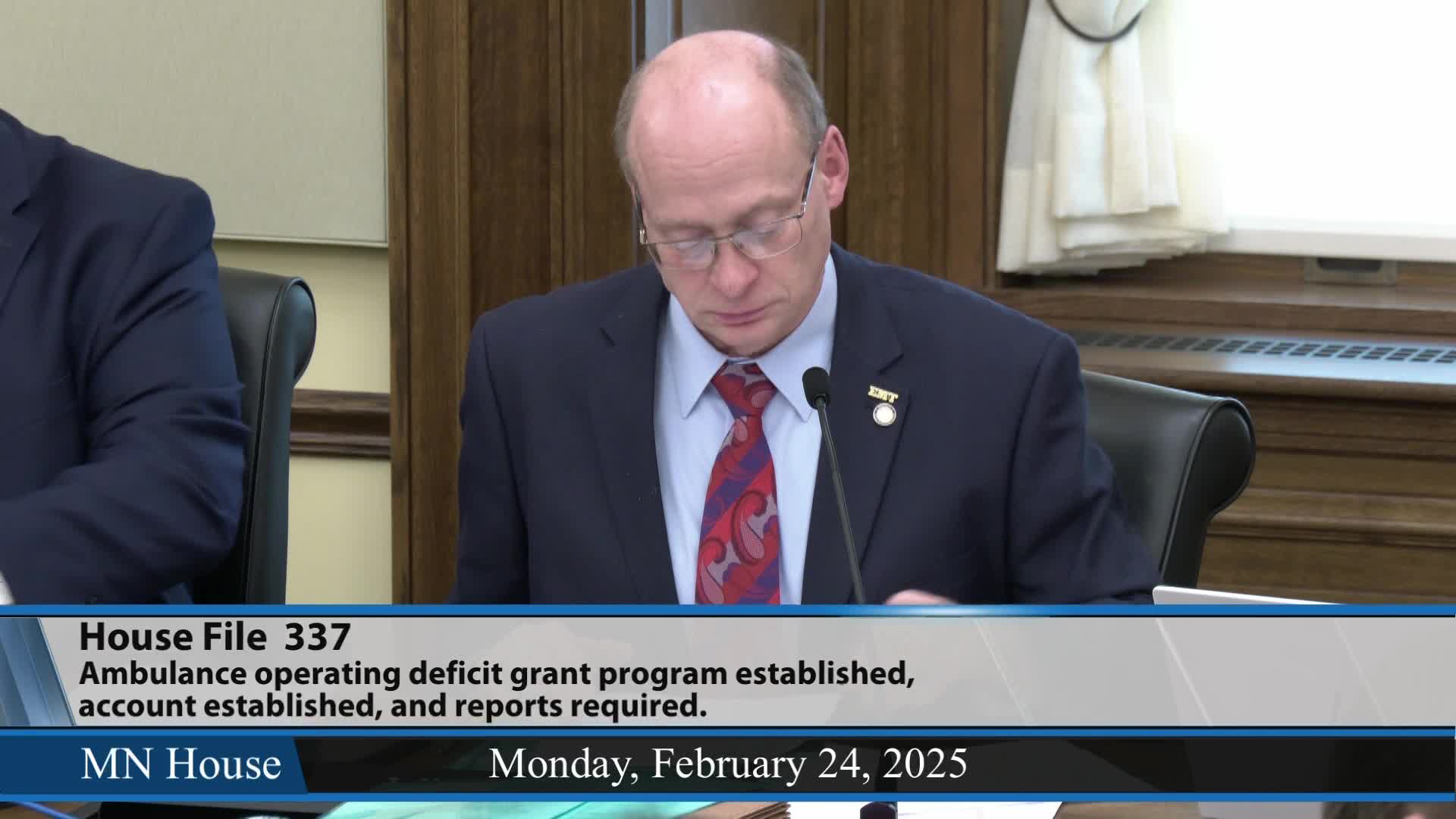
House File 337 proposes grant formula to shore up Greater Minnesota ambulance services; committee lays bill over
Summary
House File 337 would create a grant program to identify ambulance services with operating deficits, require audits of financials and exclude larger metro centers from eligibility; proponents and county/municipal representatives told the committee the bill targets ongoing rural deficits and the committee laid the bill over as amended.
Representative Zalesnikar introduced House File 337 to the Health Finance and Policy Committee on Feb. 24, describing it as a follow-up to last session’s one-time aid and as a proposal for a longer-term funding mechanism to address operating deficits among many Greater Minnesota ambulance services.
“House file 337 addresses several concerns we have heard over the past 2 years,” Eric Simonson, representing the Coalition of Greater Minnesota Cities, told the committee. He summarized the bill’s goals as: addressing operating deficits, creating a data-driven formula to distribute grant dollars where needed, establishing allowable uses and audit authority for the Office of Emergency Medical Services, and reporting back to the legislature. Simonson said nonmetro services reported deficits totaling more than $30 million for the 2023 reporting period when applying the bill’s proposed formula.
Multiple ambulance providers and local-government representatives supported the bill. Mike Warner, fire chief of the Red Wing Fire Department, described a payer mix that he said is “72% government funded” and said government reimbursement often covers about a quarter of actual cost, creating an operating shortfall growing strains on city subsidies. Tim Meyer, senior director for Sanford Ambulance, said low-volume services face particular risk as volunteer models erode and labor costs rise, and urged passage of a long-term funding structure.
Representative Zalesnikar said the bill would create a system to identify service areas with operating deficits, require financial audits and make larger areas — specifically the seven-county metro, Duluth, Mankato, Rochester and St. Cloud — ineligible for the grants. The author’s A2 amendment removed a revenue source from the bill, leaving the measure to set policy and create a fund into which revenue could be directed later. The amendment was adopted by voice vote.
Committee members asked operational questions. Representative Purcell raised concerns about services that straddle metropolitan county lines and how eligibility would apply; a testifier said eligibility is tied to where a primary service area (PSA) is “mostly outside” the metro area. Representative Hewitt and others emphasized local control and cautioned against creating funding that removes local oversight; Hewitt said the bill still requires work on local governance and oversight to guard against fraud, waste and abuse. Representative Reyer asked whether revenue recapture would be rescinded; the author said the committee is at an early stage and will examine multiple financing options.
After testimony and questions, House File 337 as amended was laid over for possible inclusion in the omnibus bill.