Get Full Government Meeting Transcripts, Videos, & Alerts Forever!
Get email alerts on the Overdose Surveillance Data Sharing topic
No spam. Unsubscribe anytime.
Committee okays bill to share de‑identified EMS data with ODMAP for near‑real‑time overdose tracking
Summary
House File 14‑29 would authorize the state Office of Emergency Medical Services to share de‑identified EMS incident data with the ODMAP overdose mapping tool. Committee members approved the measure and referred it to Judiciary and Civil Law.
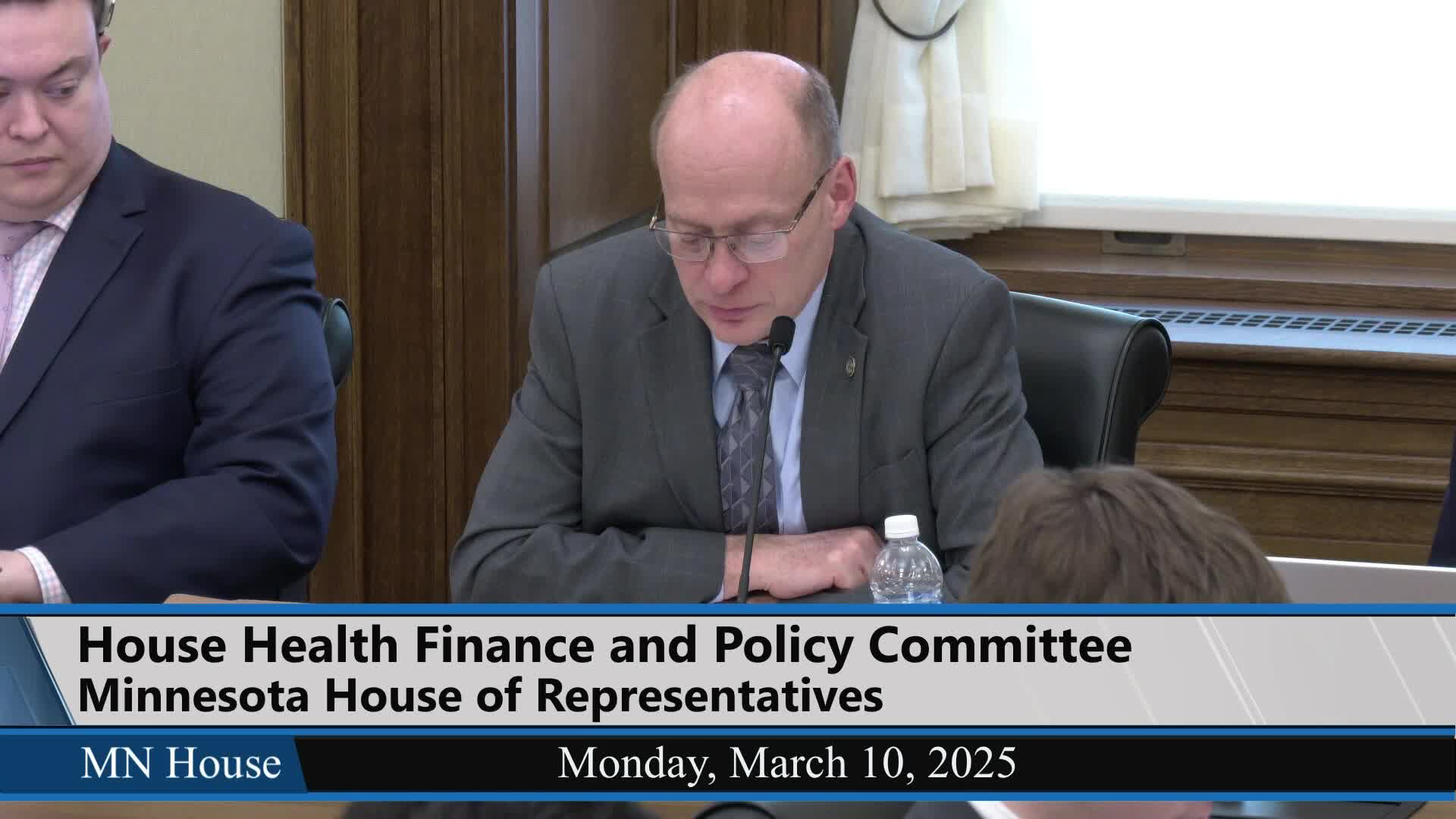
House File 14‑29, an agency bill sponsored by Representative Liebling, would allow the Office of Emergency Medical Services to share de‑identified emergency medical services (EMS) patient care data with the Overdose Detection Mapping Application Program (ODMAP). The Health Finance and Policy Committee voted to refer the measure to the Judiciary and Civil Law Committee March 10.
Jeremy Drucker, director of the Office of Addiction and Recovery, described ODMAP as a near‑real‑time overdose mapping tool already used by 27 other states; it is operated through HIDTA (High Intensity Drug Trafficking Areas) and can show overdoses by ZIP code. Drucker said the bill enables the Office of EMS to transmit location, time, substance involvement, naloxone administration and fatal/nonfatal indicators to ODMAP without sharing personally identifiable information.
Dylan Ferguson, director of the Office of Emergency Medical Services, told the committee that Minnesota’s EMS patient care report repository currently classifies incident‑level data as nonpublic under state law, which limits the ability to share geocoded incident information. He said a number of ambulance services enter incidents into ODMAP manually today; the statutory change would allow the state system to forward de‑identified data automatically and avoid duplicate reporting.
Committee members asked why the bill uses permissive language (“may share”) rather than a mandatory requirement. Director Ferguson said the office is seeking permissive authority under the Minnesota Government Data Practices Act to enable sharing and that the change would reduce administrative burden on ambulance services while protecting patient privacy. Members also discussed ODMAP’s role for law enforcement and public health and how near‑real‑time data would be used for public safety and harm reduction responses.
The committee approved referral to Judiciary and Civil Law. Drucker and Ferguson said only authorized, verified users (first responders, public health and law enforcement) would have access to ODMAP and that no personally identifiable information would be transmitted.