Get Full Government Meeting Transcripts, Videos, & Alerts Forever!
Get email alerts on the Ems Office Update topic
No spam. Unsubscribe anytime.
Minnesota’s new Office of Emergency Medical Services reports transition progress, outlines grant spending and pilots
Summary
Director of the newly created Minnesota Office of Emergency Medical Services told the Health Finance and Policy Committee the office has completed its January 1 transition, distributed $24 million in one-time aid, posted a state EMS medical director job and is standing up two pilot programs funded by the last session.
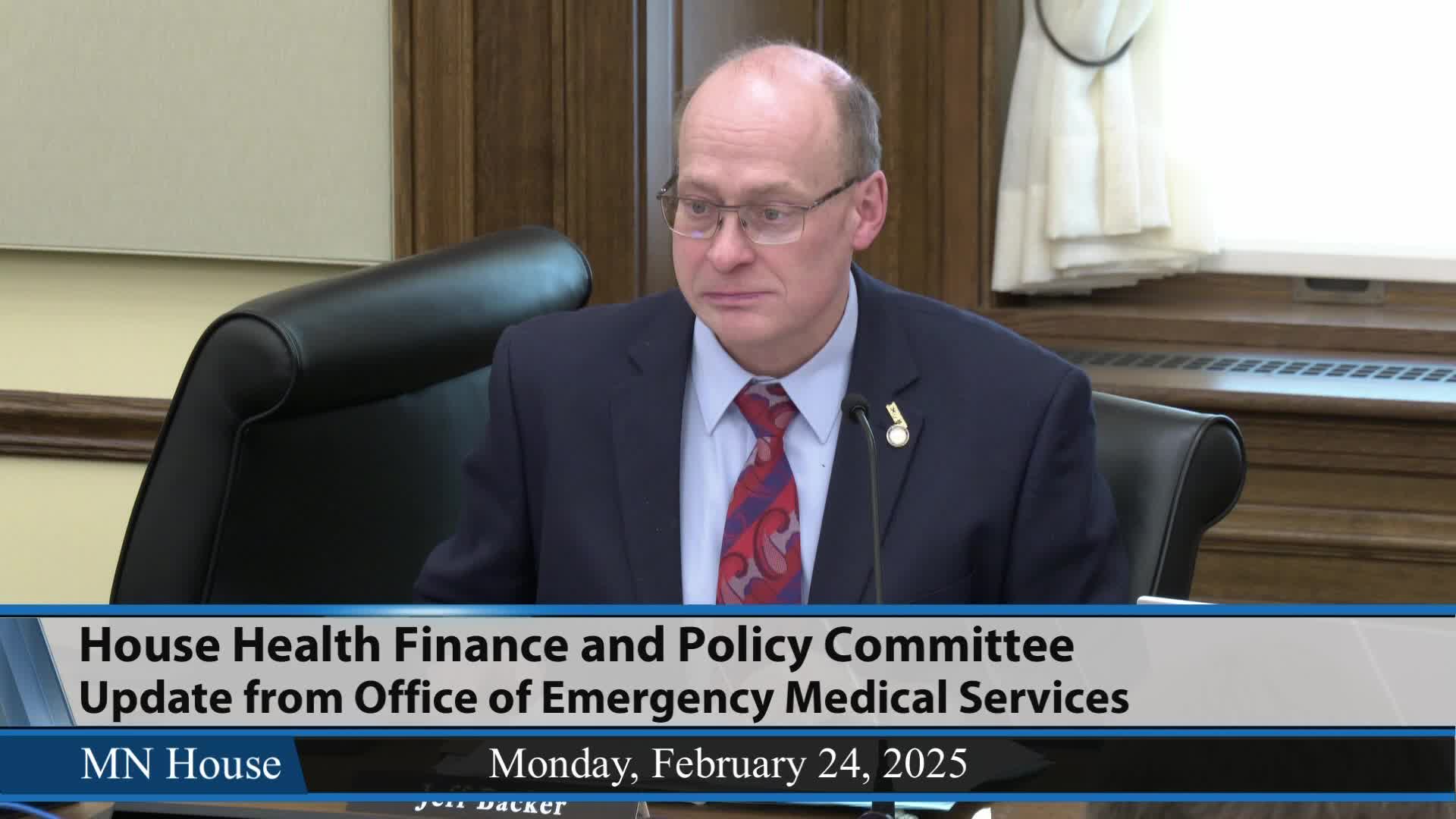
Director John Ferguson, head of the Minnesota Office of Emergency Medical Services, told the House Health Finance and Policy Committee on Feb. 24 that the office completed its transition from the former EMS regulatory board to a state agency effective Jan. 1 and is focusing on maintaining service continuity while implementing new programs.
Ferguson said the omnibus EMS bill passed at the end of the last legislative session created the new office and moved regulatory operations into a traditional agency structure, with the agency head now appointed by the governor. “One of the biggest changes of that organization structure is where the agency head appoints to, reports to,” Ferguson said. He described three divisions in the office — ambulance services, EMS providers, and EMS physicians — each with a required deputy director and advisory council. All advisory councils met by Jan. 31 and have started contributing to a required state EMS strategic plan.
The director summarized financial actions from last session: a $24 million aid program distributed on Dec. 26 by the Department of Revenue and a $6 million legislative appropriation for alternate EMS response model pilots known as the Sprint Medic pilot. According to Ferguson, the $24 million was split with $1 million to qualifying ambulance services within the seven-county metropolitan area and the remaining $23 million to the seven outstate EMS regions. He said the aid must be spent or encumbered by Dec. 31, 2025 and that the office expects to report back to the legislature — including the House and Senate taxes committees — likely in the second quarter of calendar year 2026.
On the Sprint Medic grants, Ferguson said half of the $6 million is allocated to Otter Tail and Grant counties and the other half to St. Louis County. He said Otter Tail has executed a GRAMA contract and is preparing operations; he is awaiting a completed grant application from St. Louis County to begin contract negotiations.
Ferguson said the office will pursue two rulemaking projects: updating ground ambulance vehicle construction standards (not revised since 1983) and adding additional medication options for basic life support ambulances. He also discussed workforce efforts including quantifying recruitment goals tied to bills on the committee’s agenda, supporting EMS education scholarships and grants, and collecting data on violence against EMS professionals in the prehospital setting.
Committee members asked for documentation of the $24 million distribution. Ferguson said he had one hard copy available and that certified distribution amounts are posted on the Department of Revenue website; he offered to provide copies to the committee administrator. Members also asked about the new state EMS medical director position; Ferguson said it has been posted for 21 days and will be a part-time, ad hoc physician advisor to the office and to the state EMS medical directors who oversee Minnesota’s primary service areas.
Ferguson emphasized that while the office will evaluate longer-term sustainability solutions and pilots, the problems facing ambulance services — especially in rural Minnesota— have been developing for years and require both short- and long-term responses. “Perhaps a solution which is able to pass through the legislative process today,” he said, “perhaps we identify a better way in 2 or 3 or 4 years.”
The committee thanked Ferguson and moved on to the day’s bills.