Get Full Government Meeting Transcripts, Videos, & Alerts Forever!
Get email alerts on the Hospital Financing Directed Payments topic
No spam. Unsubscribe anytime.
Lawmakers consider hospital assessment to draw federal Medicaid dollars; authors say program would stabilize hospital finances
Summary
A bipartisan proposal would assess hospitals to draw federal Medicaid matching funds and redistribute them as directed payments to hospitals. Proponents said the mechanism is used in other states and could capture roughly $1 billion in federal funds; DHS and health plans raised implementation and timing concerns. The committee laid the bill over.
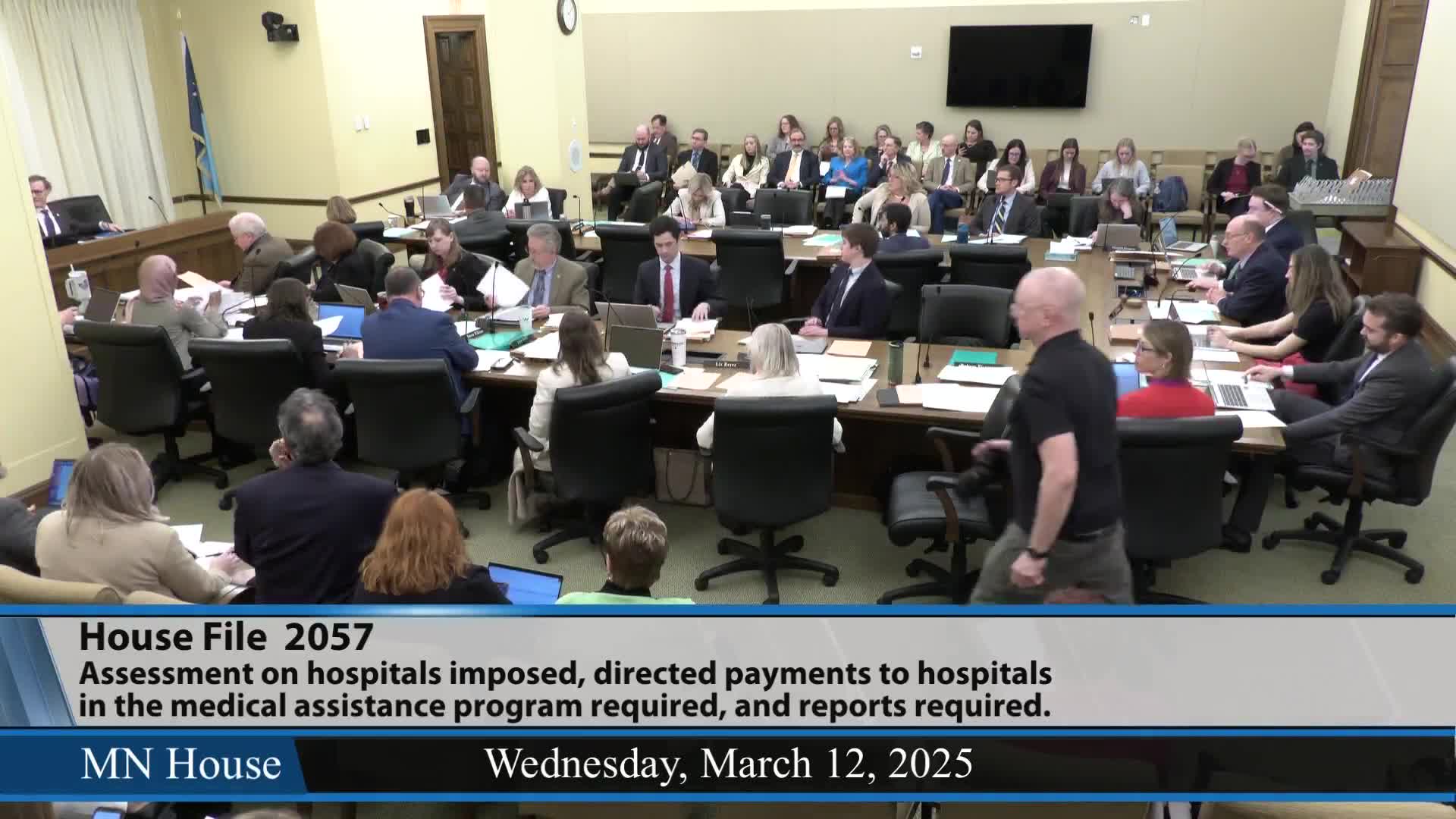
The Health Finance and Policy Committee on Wednesday heard detailed testimony on House File 2,057, a bill to create a hospital assessment and directed‑payment program intended to draw additional federal Medicaid matching dollars to shore up underfunded hospital reimbursements.
Representative Scott Biermann and Representative Nadeau co‑authored the bill and described it as a broad, state‑level mechanism that would assess hospitals on net inpatient and outpatient revenue and use the assessments to claim federal match that would be returned to hospitals through a managed‑care directed payment mechanism. Proponents said the program would not require state general‑fund dollars because hospitals would provide the state share; the proposal was modeled with technical assistance from Health Management Associates and the Minnesota Hospital Association.
Joe Schindler of the Minnesota Hospital Association said Minnesota's Medicaid fee‑for‑service inpatient payment rates cover roughly 68 cents on the dollar of cost (using 2019 costs) and that hospitals collectively were underpaid by an estimated $1 billion for services to medical assistance enrollees. Proponents argued the directed‑payment program — which CMS has approved in other states — could stabilize hospitals, preserve services and prevent service‑line closures.
Several health‑plan representatives and hospitals testified on implementation details. Chelsea Olsen of the Minnesota Council of Health Plans said the concept addresses low MA rates but asked for changes to timing provisions in the bill so managed‑care organizations (MCOs) receive payments on an industry standard timeline (30 days) rather than the bill's shorter schedule and asked for clarification on penalty language. Hospital witnesses from rural and urban systems described immediate financial strain, service closures and risks to labor‑and‑delivery services in rural hospitals. Trevor Swalish of North Memorial said the system faces $187 million in underpayments across Medicaid and Medicare at his organization and said the program is essential to preserving services.
Authors and proponents emphasized the bill will require additional drafting and DHS technical work before implementation. Joe Schindler of MHA said the necessary claims and payment data already reside with DHS and that MHA and HMA stand ready to support DHS technical work. The committee laid House File 2,057 over for possible omnibus inclusion and asked DHS and stakeholders to continue refining operational language.
Why it matters: Minnesota hospitals report that Medicaid reimbursement has not kept pace with costs and that reductions in operating margins threaten service availability across the state. The proposed directed payment program is a mechanism other states use to leverage federal Medicaid match to close payment gaps without a direct state general‑fund appropriation.