Get Full Government Meeting Transcripts, Videos, & Alerts Forever!
Get email alerts on the Individual Market Reinsurance Reauthorization topic
No spam. Unsubscribe anytime.
Committee refers reinsurance reauthorization bill to Ways and Means after extensive debate on funding
Summary
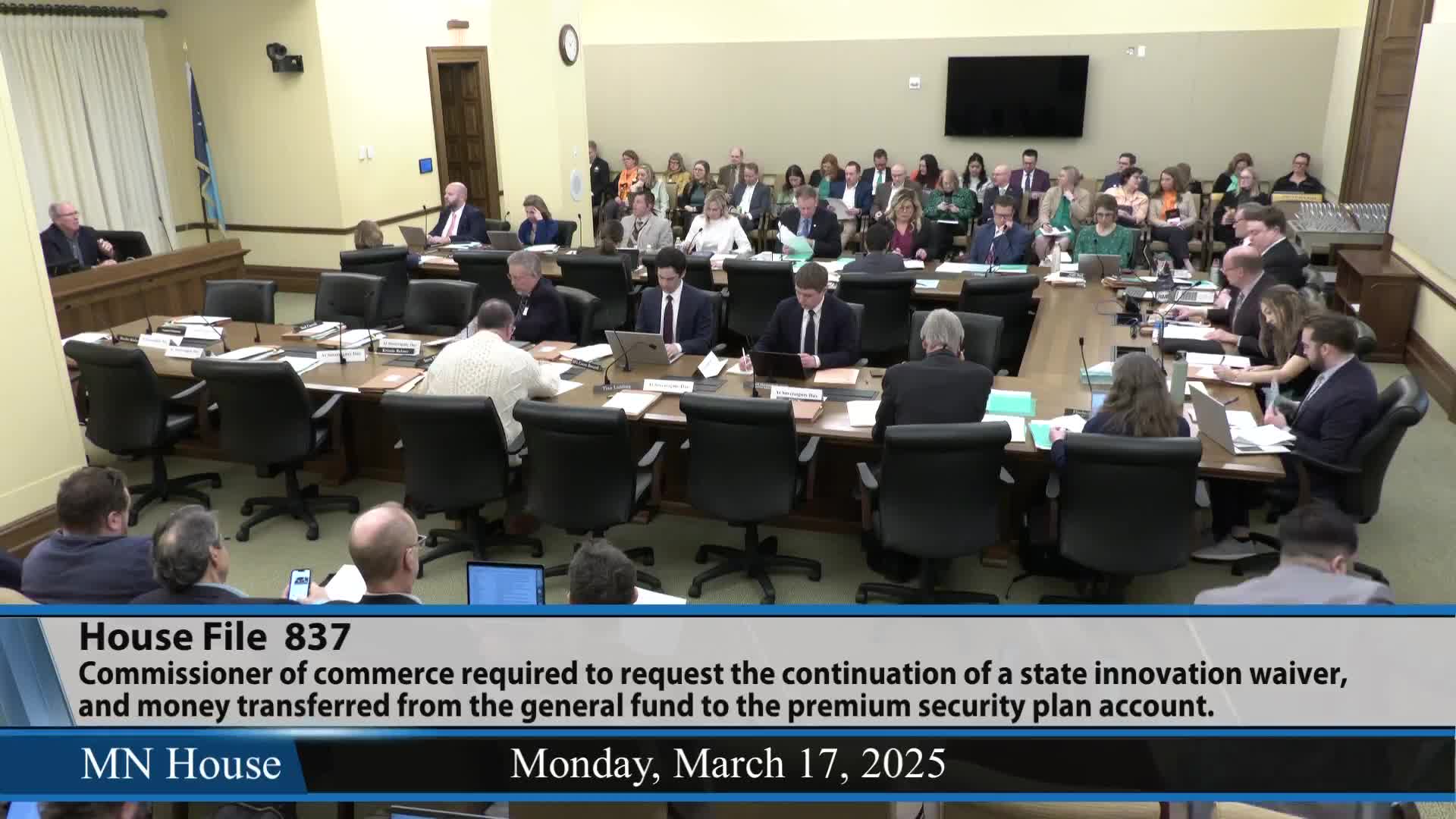
House File 837, a bill to reauthorize Minnesota's individual-market reinsurance program, was referred to Ways and Means after extensive testimony about market stability, federal matching funds, and competing proposals to finance the program.
The Health Finance and Policy Committee on March 17 voted to refer House File 837 to the committee on Ways and Means after a lengthy hearing that featured competing views on reauthorizing Minnesota's individual-market reinsurance program and several financing options.
Representative O'Driscoll, the bill author, described the history and purpose of Minnesota's reinsurance program: created in 2017 to stabilize the individual market, the program reimburses health plans retrospectively for portions of very high claims and has been credited in Commerce reports with lowering premiums in the individual market. Supporters said reinsurance reduces premiums (testimony cited roughly a 20% reduction) and prevents uncompensated care, bankruptcy and provider strain.
Multiple healthcare stakeholders and insurers testified in favor. Dan Andreessen of the Minnesota Council of Health Plans described the program's "attachment point" model (subsidizing 80% of claims between $50,000 and $250,000) and said payments flow to providers for actual medical claims, not to insurers' overhead. Bentley Graves of the Minnesota Chamber of Commerce, the Minnesota Business Partnership and the Minnesota Hospital Association urged continuation to avoid a return to 2016 market instability.
Several witnesses opposed using broad-based general-fund dollars to finance reinsurance. Sydney Spreck of the Minnesota Association of Professional Employees and Dr. Paula Crago, a retired physician, criticized continuing a program they described as a recurring corporate subsidy financed by taxpayers. Spreck called for assessments on insurers instead of general-fund appropriations. Testifiers and members discussed the governor's proposed insurer assessment and alternate options including changes to the healthcare provider tax.
Representative Elkins offered two financing amendments (A3 and A4) during the hearing to surface options: A3 mirrored the administration's assessment proposal on insurers; A4 would increase the provider tax slightly and appropriate funds from the Healthcare Access Fund to partially cover costs. Both amendments were presented, members questioned technical impacts (including on interstate taxation and federally capped directed-payment programs), and Representative Elkins withdrew both amendments to allow further negotiation in Ways and Means.
Deputy Commissioner Julia Dreyer of the Department of Commerce testified about the governor's assessment proposal and state flexibility to design reinsurance. Members discussed federal rules, Centers for Medicare & Medicaid Services (CMS) fixes, and how federal matching or policy changes could affect Minnesota's program and MinnesotaCare/Basic Health Plan calculations.
The committee chair renewed the motion to refer HF 837 to Ways and Means. The motion passed on a voice vote and HF 837 was sent to Ways and Means for further consideration of financing choices; no final appropriation was made in committee.
Votes and motions: Chair moved HF 837 to Ways and Means; voice vote carried. Several financing amendments were offered and withdrawn during the hearing.