Multiple health licensing boards ask Minnesota committee to raise fees, expand spending authority
Loading...
Summary
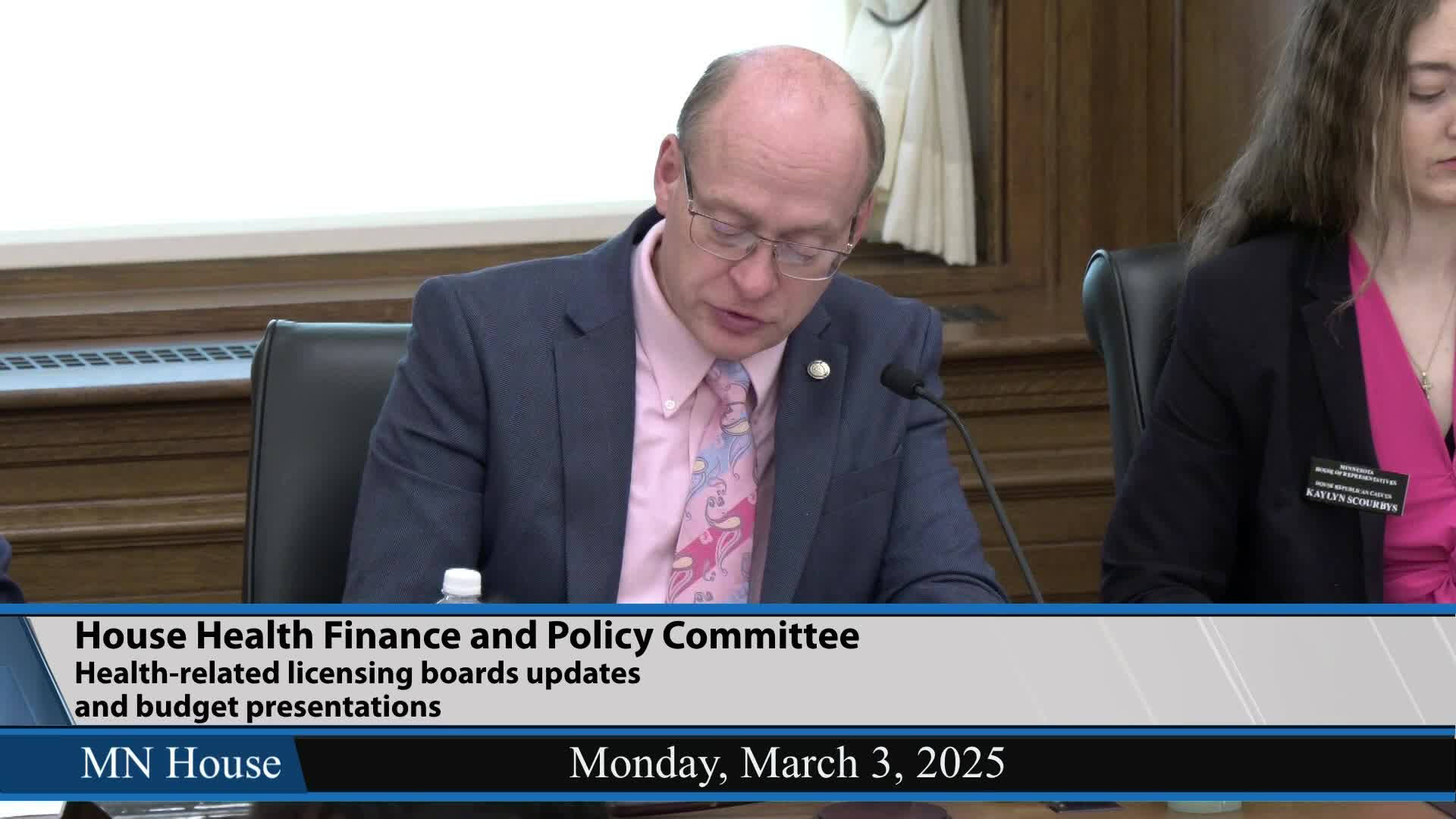
Nine health-related licensing boards told the Minnesota House Health Finance and Policy Committee on March 3 that rising costs and growing workloads have left many boards operating on shrinking reserves and seeking higher fee authority or one-time spending to maintain services.
Several Minnesota health-related licensing boards told the House Health Finance and Policy Committee on March 3 that fee revenue and existing appropriations are no longer keeping pace with operating costs and rising workloads, and they asked the committee to approve higher spending authority or changes to fee schedules.
The presentations covered several separate boards but a common theme: these agencies are fee-funded (not supported by the general fund) and face higher IT, legal and personnel costs. Board directors asked lawmakers to move fee language into statute where necessary, grant temporary spending authority extensions, or approve higher fee ceilings so boards can meet statutory obligations for licensing, complaint investigation and public safety.
Why it matters: Minnesota’s health licensing boards regulate tens of thousands of providers whose licensing and complaint systems are intended to protect patients. Several boards said inadequate fee authority or depleted operating reserves threaten their ability to process applications, perform inspections and close complaints in a timely way.
Details by board
- Minnesota Board of Podiatric Medicine: Paul Bocken, executive director, said the board has not raised fees since 1999 and is running a structural deficit (about $41,000 per year) that has been covered from an operating reserve. He told the committee the board’s reserves will be exhausted in roughly four years unless fee authority is increased. The board asked for higher fee ceiling authority that would raise roughly $100,000 a year and close the biennial deficit.
- Minnesota Board of Chiropractic Examiners: The board requested $100,000 in recurring spending authority beginning in fiscal 2026 and corresponding fee increases. Executive Director D. Pidde (stated as Director Pidde in testimony) told the committee this would be the board’s first fee increase since 1993 and that many fees are still written in rules rather than statute.
- Other boards: Several additional boards described the same pattern: fee-funded operations, rising fixed costs (rent, MNIT IT charges, AGO legal services), and workforce turnover that increased hiring needs. Presenters asked the committee to approve statutory authority for updated fees and additional base spending so boards can meet the state-required standard of maintaining adequate operating funds.
What lawmakers asked: Committee members repeatedly pressed for concrete numbers on current fees, the specific fee increases proposed, the size of reserve balances and the exact gap between fee revenue and approved appropriations. Directors replied that detailed fee tables and written testimony were included in the committee packet and that written follow-up was possible for specific comparative data.
Ending: Committee members encouraged boards to submit written testimony and fee schedules for the record. No formal votes or appropriations were taken at the hearing; the session was a series of informational presentations and requests the committee may weigh during the budget process.