Get Full Government Meeting Transcripts, Videos, & Alerts Forever!
Get email alerts on the Ems Financial Sustainability topic
No spam. Unsubscribe anytime.
Committee hears bill to reimburse rural EMS for ‘no‑load’ runs; amendment adopted, bill laid over
Summary
The Health Finance and Policy Committee heard House File 696, a bill to create a point-based reimbursement for ambulance responses that do not result in transport. An A1 amendment was adopted and the chair laid the bill over for possible omnibus inclusion.
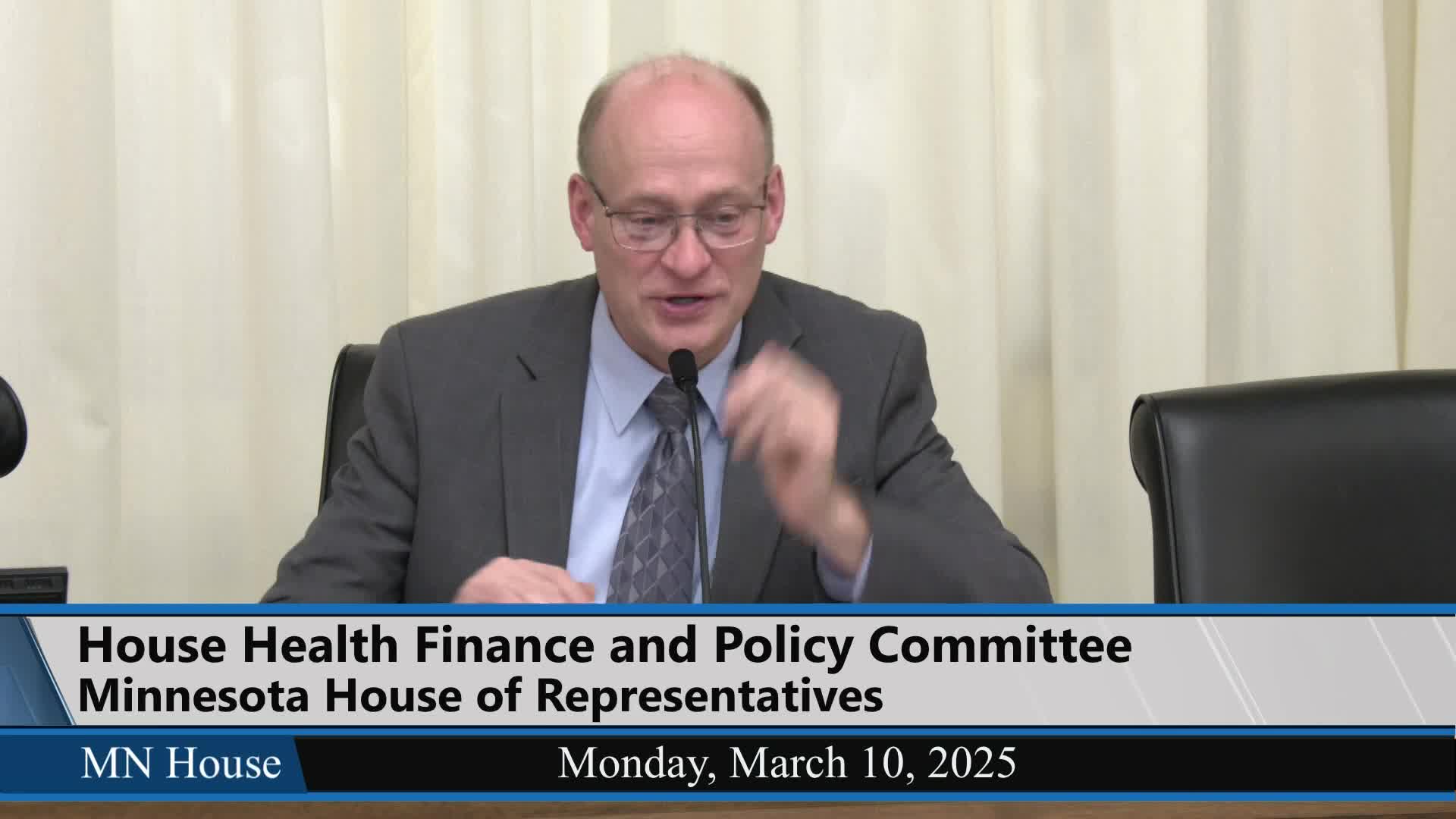
House File 696, a bill to distribute $3 million to ambulance services for nontransport (“no‑load”) runs, was introduced March 10 in the Minnesota House Health Finance and Policy Committee and laid over as amended for possible inclusion in an omnibus bill.
The bill’s author, Representative Backer, moved adoption of an A1 amendment and then presented the bill. The amendment was adopted by voice vote. Representative Backer and testimony from John Fox, interim director at Dodge Center Ambulance, framed the measure as a modest step to shore up rural volunteer services that absorb costs for calls that do not end in an ambulance transport.
John Fox told the committee, “About the last 90 days, I’ve had 68 responses in the last 90 days that are not billable. But I still had to staff, we still had to go out the door, we still had to go on out.” Fox said those unpaid responses represent roughly “20% or so” of his service’s runs and described the labor and supply cost burden on volunteer services.
Representative Backer said the bill uses a point formula administered by the Office of Emergency Medical Services to target smaller services. As described by Backer, services with fewer eligible EMS responses receive more points per no‑load run (for example, 1–25 no‑loads would receive 10 points per response, while higher-volume services receive fewer points). Backer said the point pool would be converted to dollars from the $3,000,000 allocation and awarded at the end of the fiscal year.
Committee members sought details about program mechanics. Representative Liebling asked why metropolitan services were excluded; Backer replied that most metro services are hospital-based and already have larger volumes. Representative Hewitt and others asked how the payments would be used; Backer and Fox said the money would go to training, readiness pay, and other costs that help keep rigs in service. Representative Breyer and others asked for clarity on the point tiers and eligibility language; Backer explained the 10/5/3/1 points tiers and said the Office of EMS helped craft the formula.
A fiscal note presented to the committee reported approximately $2,500 in administrative costs that the author said could be absorbed by the office. Mr. Harney summarized the fiscal note for members.
The chair laid over House File 696 as amended for possible inclusion in an omnibus bill; no final appropriation or distribution schedule was set by the committee.
Ending: The bill will be considered later as part of omnibus negotiations; the committee’s minutes show the measure carried forward with the adopted A1 amendment and an intent to include it in broader legislation.