Get Full Government Meeting Transcripts, Videos, & Alerts Forever!
Get email alerts on the Temporary Nursing Permit 90 Days topic
No spam. Unsubscribe anytime.
Committee lays over bill to extend temporary nursing permit from 60 to 90 days amid divided testimony
Summary
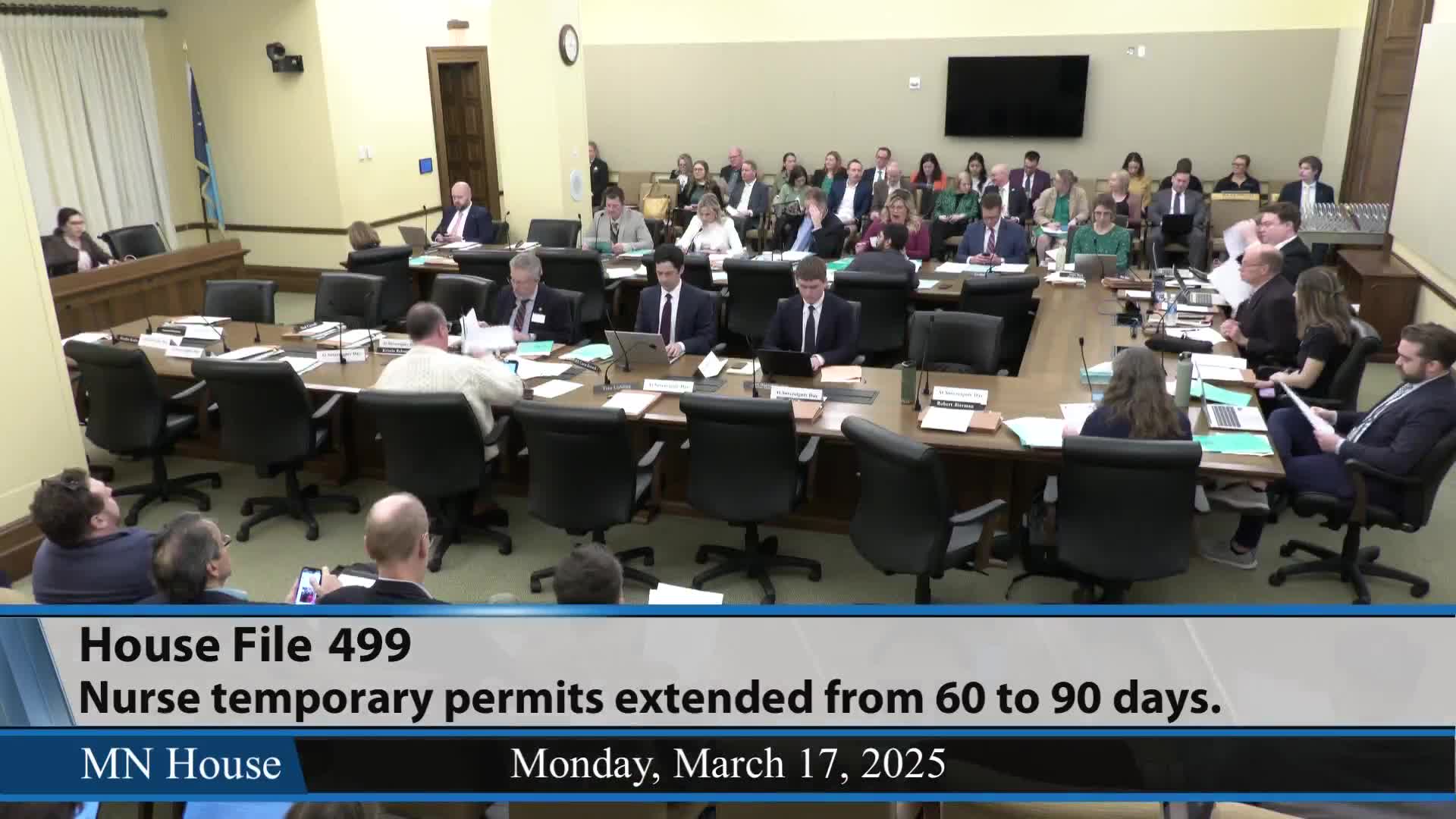
House File 499, which would extend temporary nursing permits from 60 to 90 days, was laid over after divided testimony on staffing needs and licensing standards.
The Health Finance and Policy Committee laid over House File 499 on March 17 after hearing competing testimony about extending Minnesota's temporary nursing permit from 60 to 90 days.
Representative Zalesnikar introduced the measure, saying the change is a small, practical fix to allow newly graduated nurses and out-of-state transfer nurses to work while licensure processes complete. "When we cannot fill positions, it leads to longer emergency department boarding times, increased left without being seen rates, and a reduced ability to accept patients from our regional hospitals," testified Teresa Hannu, chief nursing officer at Aspirus St. Luke's in Duluth.
Proponents, including hospital and provider witnesses, said workforce delays in licensing have kept qualified nurses "on the sidelines" and that states with nursing licensure compacts or different temporary-permit terms offer longer windows than Minnesota's current 60 days. Representative Zalesnikar cited Minnesota's nursing workforce totals and graduation numbers, arguing the 90-day period would improve bedside staffing and continuity of care.
Opponents included Ursula Poularuth (registered nurse speaking for the Minnesota Nurses Association) who argued the extension could lower Minnesota's training and continuing-education standards and might be used during labor actions. "If this became a law ... the scales would be even more tilted in favor of the employer in the event of a strike," she testified, calling HF 499 "an anti-union bill." She emphasized state licensing and continuing-education requirements contribute to Minnesota's nursing quality.
Committee members debated the trade-offs between immediate staffing relief and preserving Minnesota's licensing standards. Representative Bierman, Representative Hewitt and Representative Gilman asked about unionization timing, credentialing processes and whether expanding temporary permits might affect patient safety. Testimony from the Board of Nursing and other supporters said the board has worked on licensure-processing delays and that 90 days is consistent with several other states.
Representative Zalesnikar closed by framing the bill as a patient-care measure: keeping trained nurses at the bedside rather than waiting for administrative processing. The chair laid HF 499 over for possible inclusion in the omnibus bill; no final passage was recorded in committee.
Votes and motions: Committee adopted the intent to lay HF 499 over; there was no roll-call recorded on final passage at the hearing.