Get Full Government Meeting Transcripts, Videos, & Alerts Forever!
Get email alerts on the Point Of Sale Rebates topic
No spam. Unsubscribe anytime.
Committee debates requiring rebates be applied at point of sale; insurers warn of higher premiums
Summary
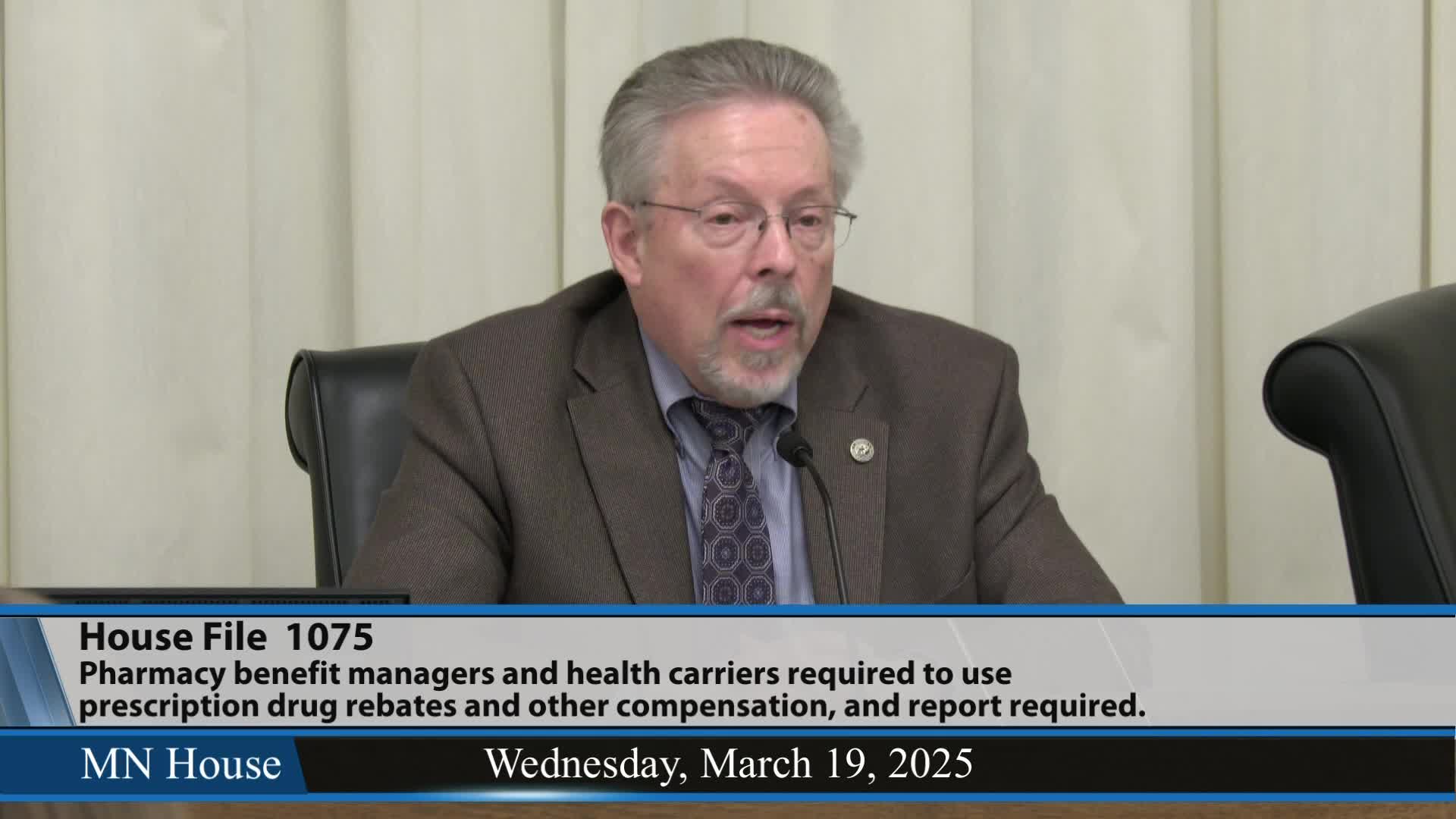
House File 1075, sponsored by Representative Steve Elkins, would require pharmacy rebates to be applied at the pharmacy point of sale to lower enrollees' out‑of‑pocket costs. Insurers and PBMs warned the change could raise premiums; the committee adopted an author’s A1 amendment and laid the bill over.
Representative Steve Elkins said House File 1075 would require plans and PBMs to apply negotiated drug rebates at the pharmacy point of sale to reduce a patient's out‑of‑pocket costs instead of using rebates to lower overall premiums. "What this bill would do is require the PBMs and the plans to take the rebates and use the rebates to buy down the cost of the drugs at the retail pharmacy point of sale for the patient," Elkins told the committee.
Speakers representing plans and PBMs said the change could shift costs to other members and raise premiums. Dan Andreesen of the Minnesota Council of Health Plans said plans use rebates to lower costs for the entire insured pool; applying rebates at point of sale would reduce that pool-level subsidy and could confuse consumers in the individual market because of metal tier rules. Michelle Crimmins of Prime Therapeutics and Michelle Mack of PCMA said applying rebates at point of sale would likely increase overall drug spending and premiums; PCMA estimated the change could increase spending by nearly $135 million in year one and $1.6 billion over 10 years (testifier estimate).
Supporters said point-of-sale rebates could help people with high cost sharing or high-cost drugs. Representative Elkins cited national reporting and examples (insulin pricing) to argue that the current rebate system can result in plans favoring higher‑priced drugs that generate larger rebates.
Members questioned market mechanics and distributional effects. Representatives asked whether rebates are large enough to cover point‑of‑sale discounts, whether manufacturers would change behavior, and which market segments the bill would affect. Staff and stakeholders clarified the A1 amendment limits the change to the fully insured commercial market; self‑insured employer plans and some state programs are excluded under the amendment.
After testimony and discussion the committee adopted the A1 amendment and laid House File 1075 over for possible inclusion in the omnibus bill. Members directed further work on fiscal effects and market scope.