Get Full Government Meeting Transcripts, Videos, & Alerts Forever!
Get email alerts on the Formulary Continuity topic
No spam. Unsubscribe anytime.
Bill would prevent mid-year formulary demotions for enrollees; committee adopts amendment and lays it over
Summary
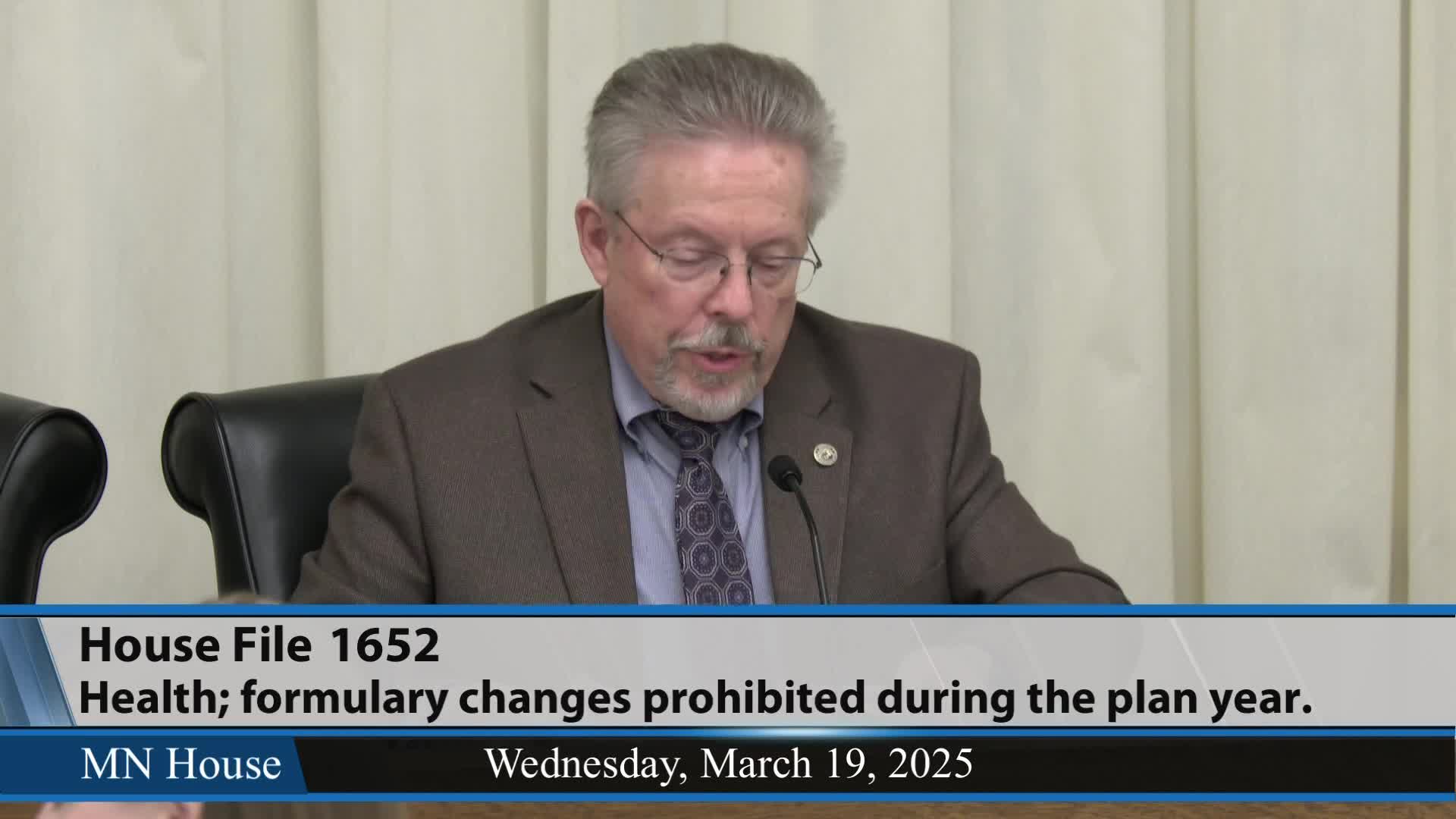
House File 1652 would prohibit health plans from removing or moving a prescribed drug to a more costly tier for an enrollee during the plan year if the enrollee was already prescribed that drug at enrollment.
Representative Steve Elkins presented House File 1652 as a measure to preserve continuity of drug coverage for enrollees who select a health plan based on a drug that is on that plan’s formulary at enrollment. "Sometimes bills like this are called formulary freeze bills. This is not a formulary freeze bill," Elkins told the committee, explaining the sponsor’s intent to allow plans to add new drugs but not to remove or demote drugs for current enrollees during the plan year.
Medical and patient advocates described clinical risks when plans change formularies midyear. Dr. Laurel Reese, a family physician, testified for the Minnesota Medical Association in support, saying patients "often choose their health insurance so that they can continue the treatment that works." Elliot Boutté of NAMI Minnesota said formulary changes can be "disruptive to people's treatment" and in behavioral health may trigger return of serious symptoms.
Insurers, pharmacy benefit managers (PBMs), and trade groups warned of operational and cost implications. Dan Andreesen of the Minnesota Council of Health Plans said plans negotiate prices and rebates during the summer and that the council sees limited in‑year formulary changes in the fully insured market. Michelle Mack of the Pharmaceutical Care Management Association said the bill lacks exceptions for drug shortages and could prevent necessary changes when supply or safety issues arise. Joe Selwood of the Association for Accessible Medicines requested that cheaper biosimilars be explicitly allowed as exceptions.
Members pressed for details: Representative Bonner and others emphasized patient harms when a drug that works is swapped midyear; Rep. Wilkins and others questioned the operational mechanics and whether plans are already protected from midyear price spikes. Chad Hope, pharmacy director at the Department of Human Services, said the DHS preferred drug list can change quarterly and that the proposed language could limit DHS ability to alter its preferred drug list depending on timing and language particulars.
The committee adopted the A1 amendment and laid House File 1652 over for possible inclusion in the omnibus bill. Committee members asked staff and the sponsor to continue working on technical language and exceptions for safety, shortages and biosimilars.