Get Full Government Meeting Transcripts, Videos, & Alerts Forever!
Get email alerts on the Sensitive Exams Consent topic
No spam. Unsubscribe anytime.
Committee advances bill requiring explicit consent for 'sensitive' exams while patients are anesthetized
Summary
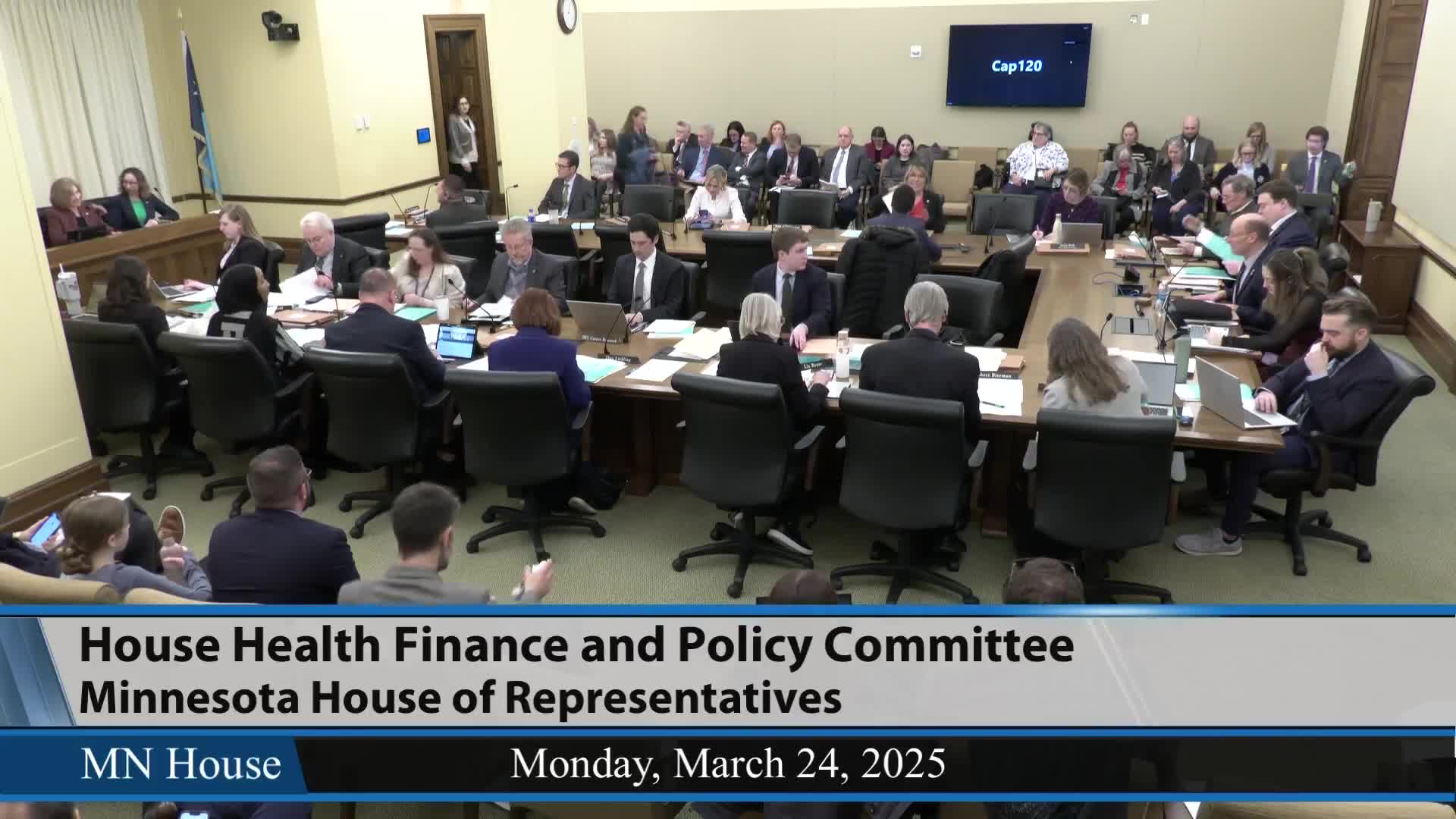
Representative Robbins, the bill sponsor, told the Health Finance and Policy Committee on March 21 that House File 2371 would require patients to give explicit consent before students perform pelvic or prostate exams while the patient is under anesthesia.
Representative Robbins, the bill sponsor, told the Health Finance and Policy Committee on March 21 that House File 2371 would require patients to give explicit consent before students perform pelvic or prostate exams while the patient is under anesthesia. "This is a very simple bill," Representative Robbins said. "It would require that patients give consent before undergoing anesthetized procedures under which they could have a pelvic or a prostate exam performed on them by students who are learning how to be physicians."
The bill’s supporters framed the measure as a patient‑safety and consent reform. Molly Montague, director of state legislative affairs for RAINN (Rape, Abuse & Incest National Network), urged the committee to support HF 2371, saying callers to RAINN’s hotline have reported learning after surgery that unrelated educational exams occurred while they were unconscious. "While likely uncommon, these practice exams unrelated to the procedure that the patient went in for do happen without the explicit permission of the patient," Montague testified. She noted national medical associations have endorsed informed‑consent practices for unconscious practice exams and cited other states that have enacted similar laws.
Committee members praised the intent but pressed sponsors about wording and potential unintended consequences. Representative Liebling said the bill as drafted could criminalize necessary clinical exams and make doctors hesitant to provide care in unexpected circumstances. "When you're doing that and when you're gonna put structures around medical practice, especially when there's a criminal penalty, you have to be extraordinarily careful about how you word this so that you don't end up infringing on appropriate medical care," Liebling said, asking sponsors to tighten exceptions for clinically necessary interventions.
Representative Robbins and co‑sponsor Representative Berg said they plan to refine language to address those concerns. Robbins noted subpart language that allows exams when they are necessary for diagnostic or treatment purposes and described the proposed penalty as a gross misdemeanor, saying the authors would consider language changes and work with the chairs before the bill reaches Judiciary. "If someone is...brought in unconscious and they can't consent prior to a procedure or if during a procedure something happens where it's medically necessary, of course we want to provide doctors that flexibility," Representative Robbins said in closing.
After roughly an hour of testimony and member questions, the chair moved that House File 2371 be re‑referred to the Public Safety Finance and Policy Committee. The motion prevailed by voice vote and the file was referred. The chair and sponsors said they will work with interested members on technical edits before the next stop.
What the committee did not decide: final statutory language, any amendment text, or an alternative penalty structure. Sponsors said they will return with revised language addressing Chair Liebling’s concerns about medical necessity and the bill’s criminal provisions.