Get Full Government Meeting Transcripts, Videos, & Alerts Forever!
Get email alerts on the Traffic Safety topic
No spam. Unsubscribe anytime.
Irvine introduces ordinance to lower posted speed limits across dozens of streets
Summary
Council introduced and unanimously approved for first reading an ordinance updating the city's engineering and traffic survey to establish or reduce posted speed limits on 126 roadway segments, citing AB 43 and state guidance as authority to lower limits in safety corridors and areas with high pedestrian and bicycle use.
The Irvine City Council on Feb. 25 introduced an ordinance (first reading) directing amendments to the city’s engineering and traffic survey that will establish or reduce posted speed limits on 126 roadway segments across the city. The measure passed 5–0 on first reading.
The change follows state guidance in Assembly Bill 43 (AB 43) and the California Vehicle Code, which staff said gives cities greater ability to set lower, enforceable speed limits where conditions warrant. Wyatt Singh, administrator for the city’s traffic engineering team, told the council the 2024 survey reviewed 126 segments: 38 will maintain current limits, six will have a posted speed where none existed before, and 82 segments will see decreased limits.
“California state law establishes that the maximum speed limit for a 2 lane undivided roadway is 55 miles per hour,” Singh said during the presentation, summarizing statutory baselines for posted limits and the engineering process the city used. Staff described the technical method: measuring prevailing speeds (the 85th percentile) and rounding to the nearest 5 mph increment, with AB 43 permitting an additional optional five‑mile‑per‑hour downward adjustment in appropriate corridors.
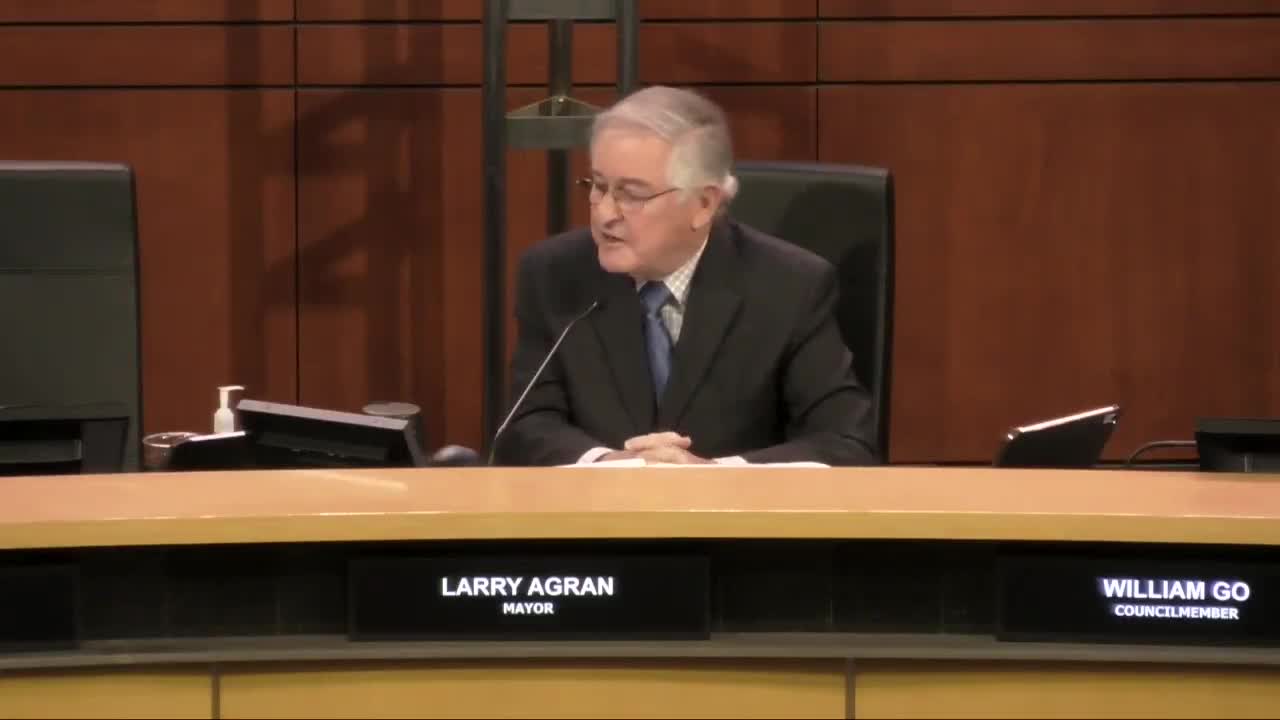
Council members pressed staff on the rationale and evidence for reductions. Vice Mayor James Mai and others asked for a report back showing safety impacts. Mayor Larry Agran said he wanted a follow‑up analysis on whether lower posted limits change driver behavior and reduce injuries, and asked staff to return with a monitoring plan; staff said implementation and sign installation would take about six to nine months after the ordinance is finalized.
Public comment was split. Several residents urged lower limits to protect pedestrians and cyclists and called for physical design changes (protected bike lanes, traffic calming) to complement posted limits. Others objected to the methodology or argued the city had not shown that lower posted limits would reduce crashes; some warned of enforcement and traffic congestion consequences.
Formal action: Council member Agran moved the staff recommendation and Council member Lou seconded. The ordinance was introduced on first reading by a 5–0 roll call vote (Goh, Liu, Tresita, Mai, Agran all voting yes). The ordinance will return for a second reading and adoption at a future meeting; staff said signs and signal adjustments will be scheduled over the next six to nine months.
Ending: Council asked staff to return with follow‑up data on safety outcomes and to consider design changes and enforcement strategies as part of an implementation package.