
Marlboro school board holds budget hearing as Danskammer assessment moves toward tax rolls
Get AI-powered insights, summaries, and transcripts
Subscribe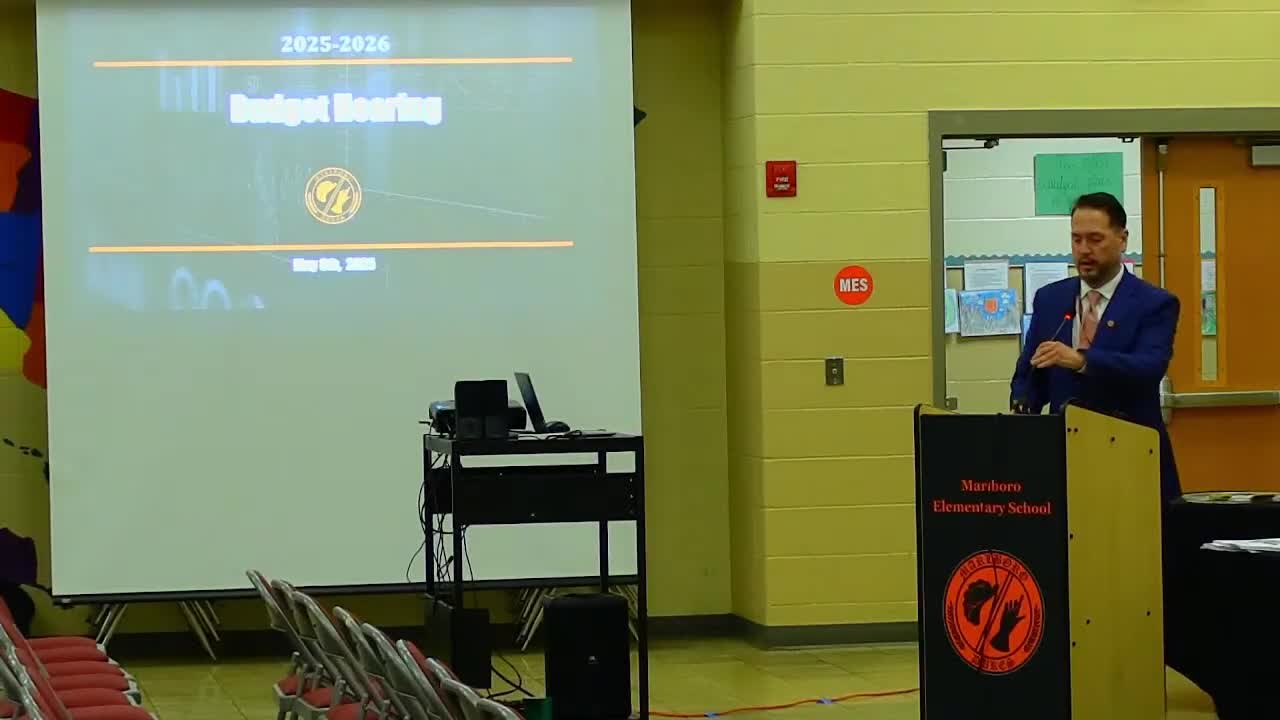
Summary
At a legally required budget hearing, district officials explained a $67.1 million spending plan, said a shift of the Danskammer power plant from a PILOT to the property tax rolls accounts for roughly half of a 9% tax-levy figure, and outlined options if voters reject the budget.
The Marlboro Central School District Board of Education held a legally required budget hearing focused on a proposed $67,127,303 spending plan and the impact of the Danskammer power plant assessment moving from a PILOT payment to the property tax rolls. District officials said the state issued final aid figures and that an estimated $1.5 million of the district’s reported 9% tax-levy increase reflects revenue previously paid under a pilot agreement rather than new real tax on households.
District finance director Emerson Segarra said the budget preserves staff and programs while reflecting a 2.3% year‑over‑year spending increase and an additional $340,000 in foundation aid from the state. “When we drafted this budget… the priority was keep every asset that we have, keep every teacher, every staff member and maintain all the programs,” Segarra said.
The hearing centered on how the Danskammer property’s assessment and its move onto the tax rolls affect the district’s revenue picture. Segarra reported the town’s assessment process produced a market assessment that translated to a taxable value the district estimates will yield about $3 million to the school if the property is assessed at the levels discussed. He said the district is using conservative assumptions and expects a town meeting the following week to clarify final numbers.
Superintendent Mr. Bridal and board members repeatedly emphasized that the headline 9% tax-levy figure does not translate directly to a 9% rise in individual property tax bills because the shift of the Danskammer payment changes how the revenue is sourced. “A 9% in 2025… does not represent a 9% increase in your taxes,” the superintendent said, adding the district’s projections show “a decrease, assuming that all the numbers that we have factored in are correct.”
Board members and staff explained the district’s contingency options if voters defeat the budget: adopt the proposed budget as-is for voter consideration, make further reductions before a revote, or move to a contingency budget that would force specific state-required cuts and prohibit raising the tax levy above the prior year. Segarra said state-mandated automatic cuts under a contingency budget total about $137,000 and that deeper, locally decided cuts would be required to close the larger gap—“realistically… having to cut $3,000,000 in program” if the revenue shortfall is not resolved.
Board members urged turnout for the May 20 budget vote, pointing to potential long-term effects on programs and property values. The board provided logistical details for voting: May 20, 6 a.m.–9 p.m., Milton courthouse (district notice). The board will meet May 22 to accept the results.
The board said its revenue and tax-rate projections were validated by outside consultants who review school finance and that the district will continue to update the community as assessments and final aid figures are confirmed.
What’s next: the budget vote is scheduled for May 20; the board will accept results on May 22. If the budget fails, the board must decide whether to present a revised budget, accept a contingency budget or take other local actions to close the gap.