Get Full Government Meeting Transcripts, Videos, & Alerts Forever!
Get email alerts on the Affordable Housing Tampico Motel Conversion topic
No spam. Unsubscribe anytime.
Anaheim approves bonds to fund Tampico Motel conversion to 31 supportive units for transitional-age youth
Summary
Anaheim City Council and the Anaheim Housing Authority on separate votes approved steps to finance the conversion of the Tampico Motel into permanent supportive rental housing for transitional‑age youth.
Anaheim City Council and the Anaheim Housing Authority on separate votes approved steps to finance the conversion of the Tampico Motel into permanent supportive rental housing for transitional‑age youth.
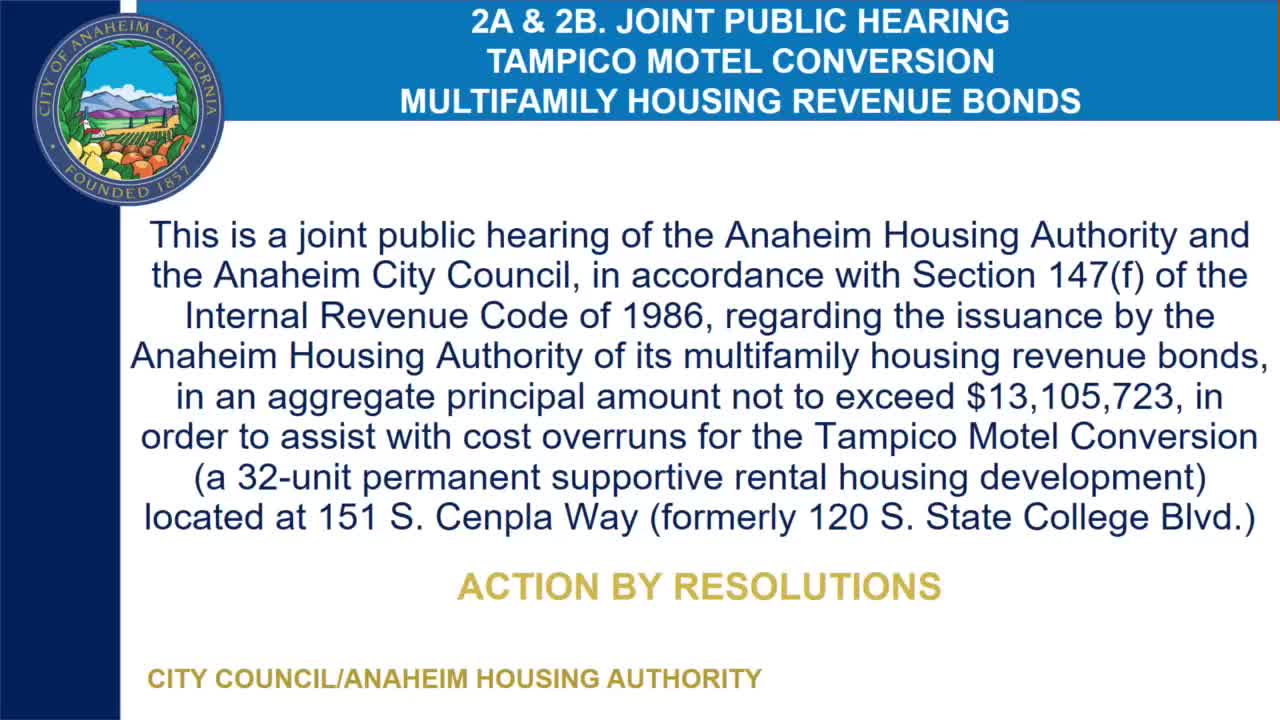
The council adopted a resolution authorizing the issuance of multifamily housing revenue bonds under Section 147(f) of the Internal Revenue Code and held the required TEFRA hearing; the city recorded the vote as 6 ayes, no nays, with the absence of Mayor Aiken. The Anaheim Housing Authority separately approved a resolution authorizing execution of a multifamily housing revenue note “in one or more series” with an aggregate principal amount reported in the meeting record as not to exceed $30,105,723; that resolution also passed by a recorded vote of 6 ayes, no nays, with Mayor Aiken absent.
Why it matters: the action clears a major financing step for a 31‑unit conversion at 151 South Simpela Way (formerly 120 South State College Boulevard). Staff said the project combines tax‑exempt bond financing with a 4% low‑income housing tax credit allocation and local gap financing so the developer can begin construction in mid‑June, with an estimated construction period of about 18 months and an anticipated completion in September 2026. Project proponents described the converted motel units as small studio‑type units (around 200–250 square feet) with on‑site supportive services.
What staff told the council: Director Stefter (staff presenter) described the two‑part request: (1) council authorization to issue bonds under federal tax rules and (2) concurrent Anaheim Housing Authority authorization to proceed with bond issuance as part of the project’s financing package. Staff said the housing authority acquired the site in April 2023, selected Jamboree Housing Corporation through a competitive RFP, and won a 4% tax credit award in December 2024.
Financing details and limits: staff said the project’s financing includes the 4% tax credit equity, roughly $6.6 million in housing authority gap financing, and a $5.5 million state earmark from the office of U.S. Rep. Tom Umberg (reported by staff as state funding that helped purchase the site). At the TEFRA hearing staff described a ‘‘not to exceed’’ bond amount read for the public as $13,105,723; later in the housing authority resolution text presented to the board the aggregate principal limit recorded in the meeting minutes was $30,105,723. Staff responded during Q&A that the financing package is structured so construction‑period bonds provide upfront funds and tax credit equity and project‑based vouchers support ongoing repayment and long‑term stability.
Project population and services: staff and councilmembers said all 31 units will be restricted for transitional‑age youth (generally ages 18–24) and that Orange Wood Foundation was identified as a supportive‑services partner to provide wrap‑around services such as workforce development, education and case management. Staff also said a project‑based voucher contract has been allocated to the site to help cover rents for residents.
Council questions and staff responses: councilmembers asked whether issuing bonds exposes the city’s general fund or creates a default risk. Staff answered that, per the financing plan presented, the issuance is structured so the bonds are paid from the project’s revenues, tax equity and committed housing authority gap funds and that the city’s general fund is not at risk under the current plan. Councilmembers also asked for and received a construction timetable (mid‑June start, ~18 months construction) and confirmation that the development team will execute an affordable housing agreement and related documents before construction begins.
Public comment and next steps: the TEFRA hearing drew two in‑person speakers who urged speed and expressed suggestions about hiring from the unhoused population; one speaker said the city should consider hiring homeless residents with trade skills to work on conversions. With council and housing authority votes recorded, staff can proceed with required bond closing steps and document execution.
Provenance: The staff presentation, project timeline, financing figures and public hearing are documented in the council and Housing Authority proceedings for the joint public hearing on the Tampico Motel conversion, as recorded in the meeting transcript and minutes.
Ending: The council and housing authority approvals clear the major municipal votes needed to move the Tampico Motel conversion into the construction phase; staff told councilmembers they will return with final financing documents and will implement the affordable housing agreement and monitoring commitments required under the financing plan.