Get Full Government Meeting Transcripts, Videos, & Alerts Forever!
Get email alerts on the Civil Rights Demographics topic
No spam. Unsubscribe anytime.
Anaheim council unanimously backs AB 91 to add MENA category to state demographic data
Summary
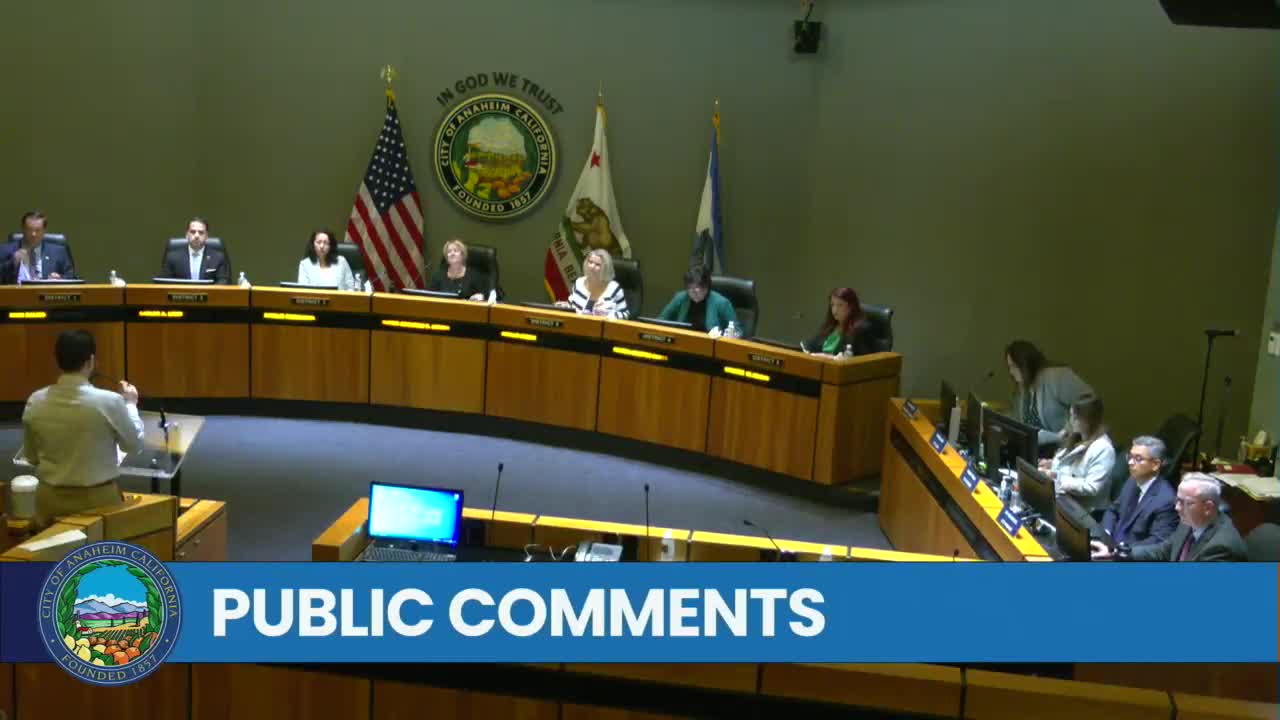
Council voted 7–0 to approve a resolution supporting Assembly Bill 91, which would require California agencies that collect demographic data to include a Middle Eastern and North African (MENA) category beginning in 2026; local MENA advocates urged the measure at the meeting.
The Anaheim City Council voted unanimously on March 25 to approve a resolution supporting Assembly Bill 91, known as the MENA Inclusion Act, a state bill that would require California departments and agencies to include a distinct Middle Eastern and North African demographic category in data collection starting January 1, 2026.
The council’s resolution recognizes the presence and contributions of Anaheim’s MENA community—pointing to Little Arabia and local organizations that provide services to Arab, Middle Eastern and North African residents—and transmits the city’s support to state lawmakers.
Why the change is being sought
Speakers from local community organizations told the council that MENA populations are currently captured under broader racial categories at both state and federal levels, limiting the accuracy of public‑health, education, civil‑rights and economic data and complicating efforts to target outreach and services. Representatives from CARE LA, the Arab American Civic Council, the American Pacific Council and other local groups described COVID‑era outreach gaps and demographic blind spots they say AB 91 would help correct.
Public testimony and council remarks
Alia Yousefey of the Council on American‑Islamic Relations urged the council to pass the resolution, saying public‑health agencies had previously asked community groups to conduct their own MENA‑specific outreach because official data collection omitted the group. Amin Nash and other local organizers described barriers small MENA‑owned businesses face in accessing capital and technical assistance because planning and funding decisions rely on demographic data that do not reflect the community.
Councilmember Carlos Leon introduced the resolution and framed the vote as a matter of visibility and fairness. Councilmembers said Anaheim’s formal support is consistent with existing city actions recognizing Little Arabia and local MENA contributions. At Leon’s request the council amended a final clause to read that “the City of Anaheim will continue to recognize the contributions and culture of the MENA community within the city.” The motion passed 7‑0.
What it means locally and next steps
If AB 91 becomes law, California agencies and local jurisdictions that use state categories for demographic collection will have a distinct MENA column for ancestry or origin questions. Supporters say that will improve resource targeting—health outreach, education, civil‑rights enforcement and economic development programs—and help ensure MENA communities are visible in planning and funding decisions.
The council’s resolution will be transmitted to the author of AB 91 and to regional elected officials to express Anaheim’s official support.
Speakers and sources: Councilmember Carlos Leon (sponsor), Alia Yousefey (CAIR‑Greater LA), Amin Nash (American Pacific Council), David Ochoa (read letter from state senator), Aya (Anaheim resident), and others who testified in support.
Ending
The council’s unanimous vote makes Anaheim among the local governments publicly backing AB 91, a change advocates say will give MENA communities better representation in state data and strengthen the case for targeted programs and funding.
Vote at a glance: Resolution supporting AB 91 — passed 7 ayes, 0 nays (amendment to clause 3 adopted to read that the City will “continue to recognize” MENA contributions).