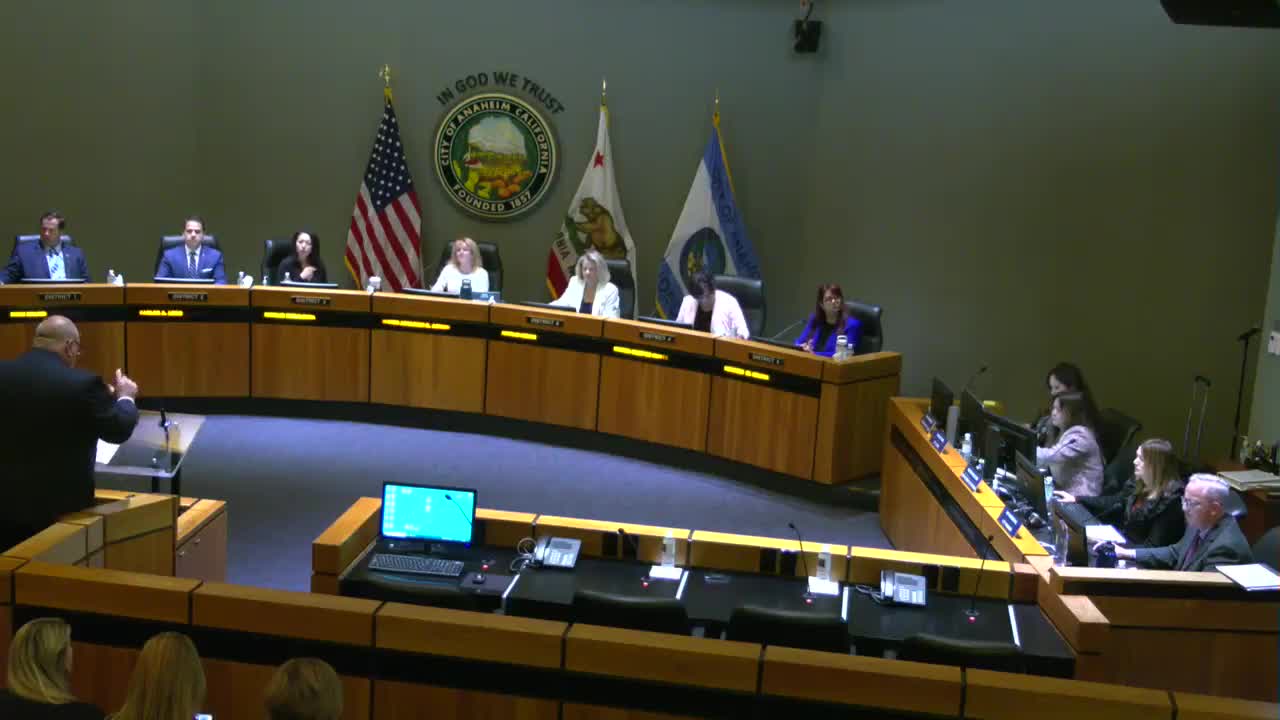
Anaheim council approves amended Visit Anaheim agreement after debate on oversight, reserves and performance measures
Loading...
Summary
The Anaheim City Council voted 7-0 on May 14 to approve an amended and restated agreement with Visit Anaheim that incorporates state audit recommendations and adds new reporting requirements, including economic-impact metrics and Transit Occupancy Tax data.
The Anaheim City Council voted 7-0 on May 14 to approve an amended and restated agreement with Visit Anaheim that incorporates state audit recommendations and adds new reporting requirements, including economic-impact metrics and Transit Occupancy Tax (TOT) data.
Council members and Visit Anaheim representatives said the changes aim to increase transparency after an audit and earlier financial controversy connected to the destination marketing organization. Councilmember Stephen Kurtz moved the amendment requiring an initial one-year term with an automatic two-year extension and annual automatic renewals thereafter; the council adopted the motion and the amended agreement passed unanimously.
The council’s vote followed a long public comment period in which hoteliers, tourism partners and business leaders testified in favor of continuing support for Visit Anaheim, citing recent sales and bookings. Sergio Bocci, general manager of the Hilton Anaheim, said Visit Anaheim’s sales work “directly impacts hotel occupancy, local employment [and] economic health,” and cited millions of room nights and billions in economic impact booked through 2028. Fred Brown, chair of Visit Anaheim’s board, testified that the organization’s leadership and strategy had contributed to the city’s rebound after the pandemic. Zeke Coleman of Tourism Economics said Visit Anaheim is “a national leader” in using data to guide marketing decisions.
Several council members said they wanted stronger accountability. Councilmember Kurtz asked that the agreement explicitly return the “economic impact” indicator to the KPIs after the item had initially been removed; colleagues agreed and staff added an explicit KPI for “economic impact of conventions, conferences and trade shows in Anaheim” and a separate reporting item for “transient occupancy tax collected within the Anaheim Resort.” City staff and Visit Anaheim representatives confirmed those items would be included in the annual report.
Council members also debated contract term length and the organization’s reserve policy. Councilmember Kurtz and others said they were uncomfortable immediately approving a multi‑year renewal without a first-year review of the updated KPIs and state auditor recommendations. Council ultimately approved the compromise: a one‑year initial term, followed by an automatic two‑year extension, then automatic annual renewals thereafter, with the annual report serving as the first-year check‑in. Outside counsel noted the agreement continues to include a 180‑day termination‑without‑cause provision and reporting requirements for subcontracts above $150,000. The council also directed staff to return with recommendations on reserve practices and other governance issues raised in discussion.
Visit Anaheim’s Chief Operating Officer Christina Dawson and city staff confirmed on the record that Visit Anaheim concurred with the contract changes as finalized on the council floor. The amended agreement also memorializes several procedural reforms that staff said implement the state auditor’s recommendations, including enhanced reporting, subcontract oversight and restrictions on transfers of ATID funds without prior written consent.
The council action amends the legal agreement that governs how the Anaheim Tourism Improvement District fees are deployed; any separate policy changes about ATID use or reserve caps would come back to council separately.