Get Full Government Meeting Transcripts, Videos, & Alerts Forever!
Get email alerts on the Childcare Fraud Monitoring topic
No spam. Unsubscribe anytime.
Panel adopts monitoring, electronic attendance and data‑retention changes for high‑volume childcare providers; HF1916 heads to Judiciary
Summary
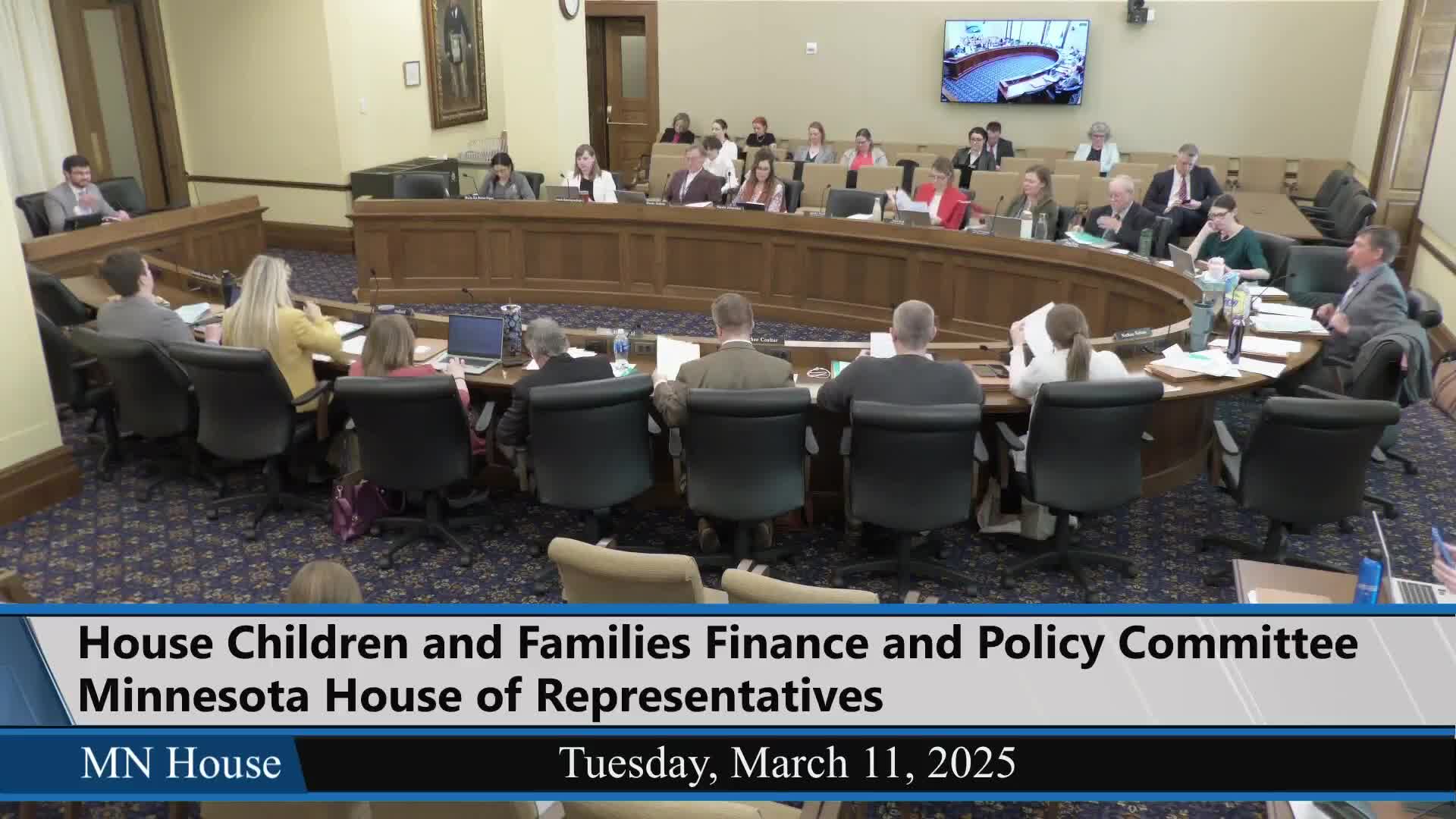
The Children and Families Finance and Policy Committee adopted an amended House File 1916 that requires video monitoring and electronic attendance verification for childcare providers receiving $1,000,000 or more in CCAP or early learning scholarship funds, sets a 30‑day retention period for requested footage, and re‑referred the bill to the Judiciary Committee.
Representative John West moved House File 1916 and the committee adopted an A7 amendment that narrows and clarifies monitoring and electronic‑attendance requirements for larger childcare providers. The amended bill requires video monitoring that covers public entrances and areas where parents or legal guardians sign in and out, sets a 30‑day retention period for requested footage, raises the threshold for required monitoring to providers receiving $1,000,000 or more in Child Care Assistance Program (CCAP) or early learning scholarship funding, and authorizes the Department of Human Services to request footage remotely rather than imposing a live‑stream requirement.
The bill’s sponsor, Representative John West, said the measure responds to fraud vulnerabilities identified by the Office of the Legislative Auditor and recent media reporting. West told the committee that the legislation targets verification of attendance for providers receiving large amounts of public subsidy. "Focusing on entrances, exits and sign‑in areas helps get at the fundamental piece when you're looking at CCAP fraud," West said.
The A7 amendment replaces earlier language and makes several substantive changes: it changes terminology from "childcare center" to "provider," clarifies that the department may request footage rather than require continuous live monitoring, shortens video retention from 90 days to 30 days to reduce storage costs for providers, sets a minimum camera resolution baseline (the amendment references 720p minimum), and raises the program threshold from $500,000 in CCAP funding to $1,000,000 in CCAP or early learning scholarship funds for inspections and footage requests. Committee staff said the appropriation in the bill is intended to fund all activities required under the bill, not only inspections and the statewide attendance system.
Representative Andrew Coulter offered A6, an amendment to apply the bill’s requirements to any provider that receives any CCAP or early learning scholarship funds. Coulter argued the threshold was arbitrary and that providers receiving smaller amounts still receive public subsidies. "If we're serious about addressing these issues, then we really should just treat everybody equally," Coulter said. The committee rejected Coulter’s amendment on a roll call vote, 7 nays to 6 ayes.
Representative Sarah Hansen raised concerns about the risks of expanding video monitoring, citing recent criminal cases and the broader rise in illicitly shared or AI‑generated images. "As we ever expand surveillance of our children in any way, shape or form, this should be something at the top of our minds because it is a global trend that is growing," Hansen said. Representative West responded that the bill permits the department to request footage for review rather than mandate live, internet‑connected streaming; West also said he would work with Judiciary on possible enhanced criminal penalties for malicious access or misuse of footage.
Committee staff explained that narrowing the threshold to the highest CCAP/early learning scholarship recipients was intended to limit administrative burden on the department and avoid imposing new compliance costs on smaller providers; staff estimated the top recipients number in the dozens (committee discussion referenced "about 73" top CCAP recipients from previous distributions). The sponsor said many of the highest dollar providers already use cameras and that the bill therefore targets concentrated funds where fraud risk is highest.
After debate and the failed Coulter roll call, the committee adopted the A7 amendment and re‑referred House File 1916, as amended, to the Committee on Judiciary.